Agency Break-Even Calculator: Retainer Clients, Revenue and Delivery Capacity
Published by MyBreakeven. Report a calculation or content issue to support@mybreakeven.com.
· Updated September 13, 2026
Calculate the retainer clients and revenue an agency or freelancer needs after delivery labor, contractors, software and sales costs.
Agency Finance · Retainers · Utilization · Client Profitability
More clients do not automatically create a healthier agency. Retainer revenue has to cover delivery labor, contractors, software, sales costs and the non-billable time that keeps accounts moving.

Calculator features
- Exact clients and revenue targets without hiding fractional results
- A separate whole-client operating target for real-world planning
- Contribution margin after delivery labor, contractors, client software, processing fees and sales acquisition
- Required customer inquiries based on your conversion rate
- Team-capacity and feasibility comparison using productive hours
- Price sensitivity, cost-drift scenarios and a transparent formula trace
What the Agency or freelancer calculator calculates
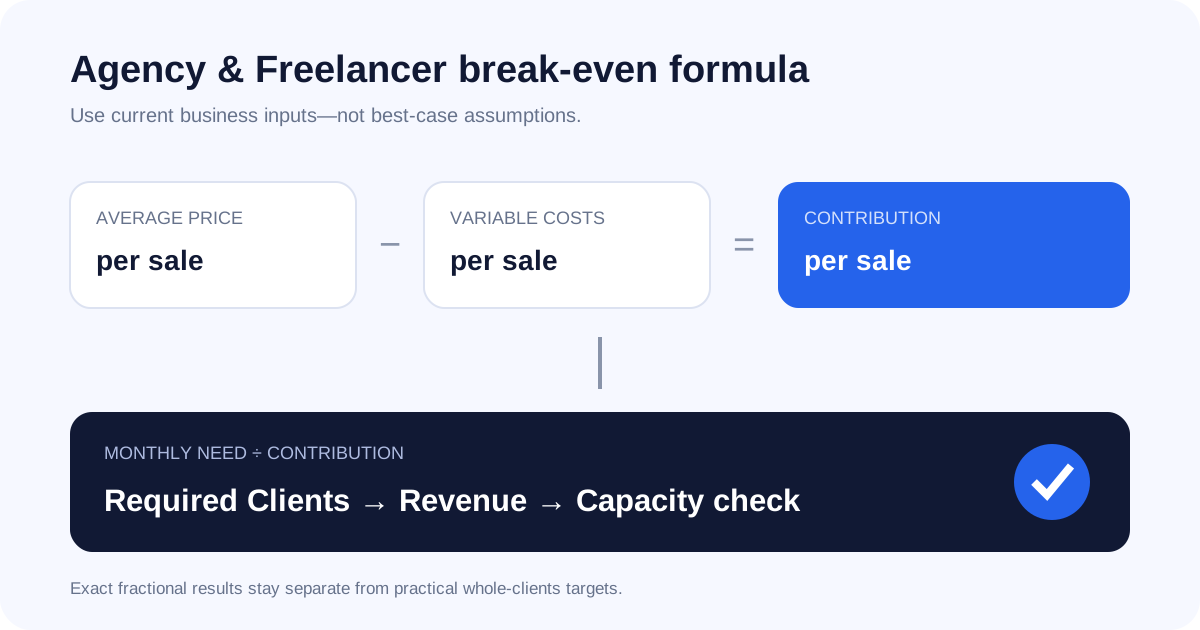
The calculator connects unit economics, monthly financial needs, customer demand and operating capacity. It first finds contribution per client, then calculates the exact clients and revenue required to cover overhead, owner pay and optional target profit. It also shows the rounded-up operating target, required inquiries and whether the team has enough productive capacity.
Inputs to gather before you start
Use recent, representative figures instead of best-case estimates. Enter average monthly client value, delivery payroll, contractors, client-specific tools, sales cost, monthly overhead and team delivery capacity. Keep fixed monthly overhead separate from costs that rise with each client. If a cost applies to every sale, include it in the per-client fields.
- Average monthly retainer or client value
- Direct team labor and contractor cost per client
- Client-specific software and fulfillment expense
- Sales cost per acquired client and payment fees
- Core payroll, rent, software and administrative overhead
- Delivery team hours, hours required per client, utilization and close rate
The break-even formula
Contribution per client = average price − payment fees − direct materials − direct labor − other variable costs − acquisition cost. Required clients = (monthly overhead + owner pay + target profit) ÷ contribution per client. Exact break-even revenue = required clients × average price. MyBreakeven keeps the exact fractional result and displays the next whole client separately.
How to use the calculator step by step
- Select Agency or freelancer from the industry list.
- Choose the currency used by your records; the tool labels values but does not convert exchange rates.
- Enter price and every direct cost per client.
- Add monthly overhead, owner pay and optional target profit.
- Enter team hours, delivery time, productive utilization and inquiry conversion rate.
- Review exact and whole-unit targets, contribution margin, required inquiries and the capacity gap.
- Compare conservative and optimized scenarios before making a pricing or spending decision.
Worked agency or freelancer example
Using the example assumptions—$2,200 per client, $1,283.80 total variable cost and $15,200 monthly financial need—contribution is $916.20 per client. The exact target is 16.59 clients and $36,498.58 revenue. Because a fraction of a client normally cannot be sold, the practical target is 17 clients, or $37,400. Estimated capacity is 17.69 clients; required inquiries are 82.95 at the example conversion rate. This example explains the calculation only and is not an industry benchmark.
How to interpret feasibility
A break-even target can be mathematically correct but operationally impossible. Compare required clients with realistic productive capacity after setup, travel, administration, gaps and rework. A negative capacity gap means the current team cannot deliver the target under the assumptions entered. Test price, service mix, variable costs, utilization or staffing one change at a time.
Common mistakes to avoid
- Treating all staff cost as fixed when delivery effort scales by client
- Ignoring scope creep and non-billable communication time
- Using contract value instead of monthly recognized revenue
- Assuming every sales conversation is a qualified opportunity
Ways to improve the result
Focus on the assumptions with the largest verified effect rather than changing every input at once. Improve scope control, retainer packaging, delivery templates, team utilization, client profitability reviews and qualified close rate. Recalculate after each change and preserve a conservative scenario so the plan does not depend on perfect conditions.
Frequently asked questions
What does the Agency or freelancer break-even calculator include?
It includes price, direct costs, payment fees, acquisition cost, monthly overhead, owner pay, target profit, required clients, inquiries and productive capacity.
Why are exact and whole clients different?
The exact result preserves the mathematical fraction. The whole-unit target rounds up because selling only part of a client is usually not operationally possible.
Does the calculator predict guaranteed profit?
No. It produces an assumption-based planning estimate. Actual sales, costs, cancellations, taxes and timing can differ.
How often should the calculation be updated?
Update it whenever price, wages, supplier costs, advertising performance, overhead or team capacity changes materially, and review it at least monthly during active planning.
Use the free Agency break-even calculator