Corporate Headshot Pricing: Setup, People and Delivery
Published by MyBreakeven. Report a calculation or content issue to support@mybreakeven.com.
· Updated October 3, 2026
Calculate corporate headshot pricing from setup, employee count and editing time. Compare booking sizes, minimum fees and photographer delivery capacity.
Photography · Corporate Headshot Pricing
Calculator features
- Checked illustrative examples with explicit assumptions
- Cost inputs reconciled to the chosen planning unit
- Whole-unit targets checked against delivery capacity
Corporate headshot pricing works best when you separate the cost of bringing the studio to a business from the cost of photographing and delivering each person’s portrait. Estimate the whole assignment, including scheduling, setup, selection and retouching, before quoting a per-person number. A twenty-person booking can spread setup costs efficiently; a five-person booking often cannot use the same rate. All USD figures below are fictional planning assumptions, not current US market averages.
Quick answer: Use a setup fee or minimum booking plus a per-person allowance tied to your actual workflow. In this example, twenty employees at $125 generate $2,500. After $1,220 of delivery costs and a 3% payment fee, contribution is $1,205. Define the number of finished portraits and revision scope before comparing per-person quotes.
Cost the assignment before dividing by people
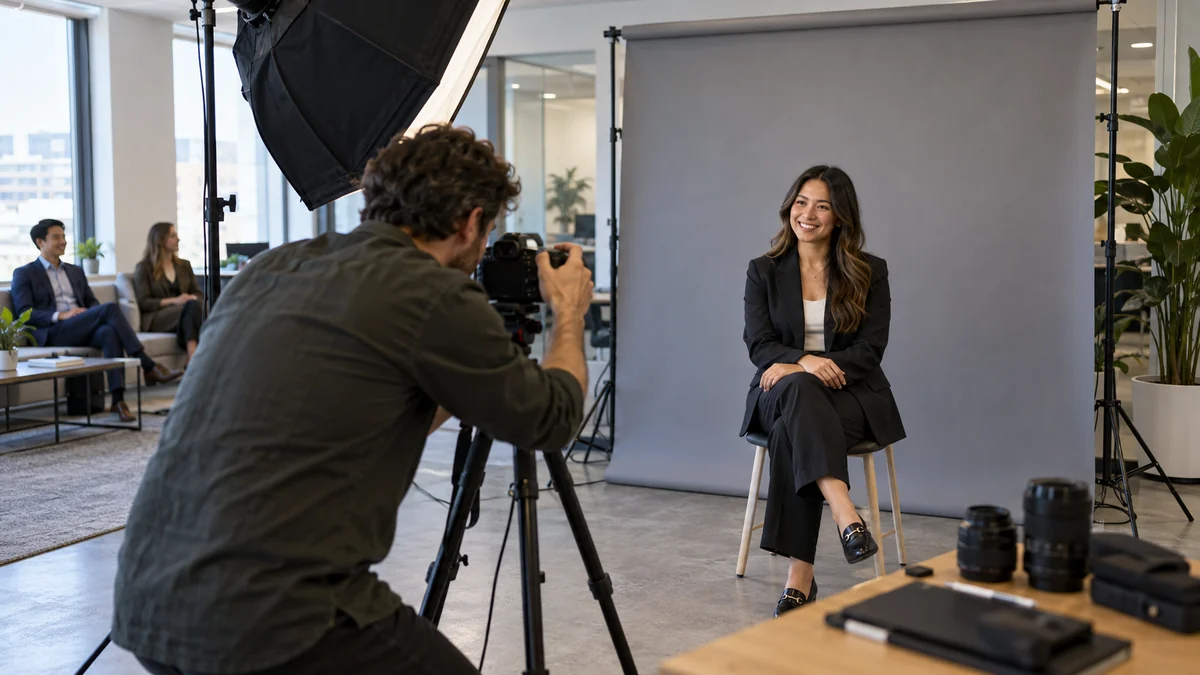
Imagine a business booking twenty employees at one location. The deliverable is one selected, finished portrait per employee with consistent framing and background. The fictional workflow allows eight minutes of camera time per person. Total camera time is 160 minutes, or two hours and forty minutes.
The assignment also needs preparation, travel, setup, selection, retouching, export and delivery. These hours happen even though the client sees only a short portrait appointment. Use the time budget below rather than multiplying camera time by your desired hourly rate.
| Task | Photographer hours |
|---|---|
| Brief, roster and scheduling | 1.0 |
| Travel, setup and teardown | 2.0 |
| Twenty portraits at eight minutes | 2.6667 |
| Selection and basic retouching | 4.0 |
| Export, delivery and communication | 1.0 |
| Planned contingency | 1.3333 |
| Total | 12.0 |
Assign a target cost of $75 per photographer hour, giving $900 of direct delivery labor. Assume an assistant costs $180 for the required period, travel and job equipment running costs are $100, and a client-specific gallery or export expense is $40. Total costs before percentage fees are $1,220.
At $125 for twenty people, revenue is $2,500. An assumed 3% payment fee is $75, leaving $1,205 contribution. That contribution still has to cover monthly overhead and any owner compensation outside the direct labor allowance. If the photographer is the owner and the $900 already funds those twelve hours, do not pay for them again through a second owner-labor line.
This assignment-level view complements photography pricing packages. The distinction is that a corporate session contains many people sharing one setup; it is not twenty unrelated full studio bookings.
What changes the price
Employee count affects efficiency, but only within the working day you can actually deliver. More people may need a longer booking, additional assistant time or a second day. Model the next capacity step instead of assuming the twentieth and fiftieth person have identical incremental cost.
Deliverables change editing effort. One consistent finished portrait per person is a different assignment from several backgrounds, wardrobe changes and a selection of retouched images. State the number of delivered files, the selection process and what constitutes extra retouching. A per-person quote without those boundaries is difficult to compare.
Scheduling also has a cost. Employees arriving late, last-minute roster changes and a request to return for absentees can create additional work. Put a sensible contingency into the estimate, then agree how an extra visit would be quoted. The aim is to make the scope predictable rather than promise unlimited availability.
Usage belongs in the brief. Ask what the client intends to do with the portraits and document the agreed usage scope. ASMP’s Paperwork Share provides examples of photography estimates and licensing arrangements. This guide models production economics; it does not assign a universal licensing price or interpret legal rights.
Location affects both time and expenses. A convenient meeting room with reliable access may be very different from a multi-floor office where equipment must be moved between groups. Verify the room, power, background space and access before treating an on-site job as a standard package.
Three quote scenarios
Twenty people with one standard deliverable
Use the baseline $2,500 assignment and $1,220 costs before fees. Contribution is $1,205, or 48.2% of revenue. At twelve photographer delivery hours, contribution is about $100.42 per photographer hour after the labor allowance and stated direct expenses.
That hourly comparison does not mean the photographer’s hourly wage is $175.42 or that the entire contribution is take-home. It is a management measure for comparing assignments after a consistent labor boundary. Monthly fixed costs remain to be funded.
If actual retouching takes six hours instead of four, direct labor rises by $150. Contribution becomes $1,055 at the same price. Record that overrun so the next estimate uses realistic editing time rather than repeating the twelve-hour assumption.
Five people with the same location setup
Consider a separate small assignment needing seven photographer hours at $75, a $90 assistant allowance, $80 travel and equipment expenses, and $20 delivery expense. Costs before fees total $715. Five people at the large-group rate of $125 generate $625, less than these costs even before a $18.75 payment fee. The assignment loses $108.75 before overhead.
Suppose your chosen minimum is $1,200. After $36 fees and $715 direct expenses, contribution is $449. One transparent structure is a $575 setup charge plus $125 for each of five people. This is an illustrative pricing structure, not a recommended market rate. It explains why the total is higher than simply multiplying the large-group unit rate.
You could also offer a studio-day option that uses a different cost structure. Recalculate the alternative rather than applying a discount without a reduction in work.
Forty people trigger a longer workflow
A separate forty-person job is planned at eighteen photographer hours, giving $1,350 labor cost. Add $300 assistant cost, $150 travel and equipment, and $80 delivery costs: $1,880 before fees. At $110 per person, revenue is $4,400 and a 3% fee is $132. Contribution is $2,388.
The lower per-person rate can leave more total contribution because setup is shared, but the job must fit the agreed schedule. At eight camera minutes each, forty people need five hours and twenty minutes of camera time alone. Add breaks, setup and selection. Do not promise that workload inside a four-hour on-site window just because the overall profit looks attractive.
How to run your own numbers
Treat one corporate assignment as one session when using the photography model. Use total assignment price and all assignment costs; do not enter a $125 per-person price next to twelve hours of whole-assignment work.
| Photography field | Baseline assignment input |
|---|---|
| Average price per session | $2,500 |
| Materials / product cost per session | $0 |
| Direct labor per session | $1,080 |
| Editing + gallery + travel per session | $140 |
| Marketing cost per booked session | $0 for this isolated example |
| Payment and platform fees | 3% |
| Monthly operating overhead | $2,000 |
| Monthly owner pay | $1,000 additional to funded delivery labor |
| Target monthly profit | $1,000 |
| Active team members | 1 photographer |
| Hours per team member / week | 30 |
| Delivery hours per session | 12 photographer-hours |
| Productive utilization | 65% |
| Inquiry-to-session conversion | 25% |
Use the photography break-even calculator. The $1,080 labor line includes $900 photographer labor and $180 assistant cost. The $140 other-cost line includes travel, equipment and delivery expenses, without charging retouching labor a second time. Replace every preset, including acquisition.
This is a photographer-bottleneck model: the assistant’s fee is included, but their hours are not added to the photographer’s capacity. Capacity is 1 × 30 × (52 ÷ 12) × 65% ÷ 12 = 7.04 assignments, or seven whole assignments. The $4,000 financial goal needs 3.32 assignments, rounded up to four. Four assignments provide $4,820 contribution and require forty-eight photographer-hours.
At a 25% inquiry-to-booking assumption, planning for four bookings requires sixteen qualified inquiries. The calculator’s exact inquiry figure uses the unrounded financial target, so use the rounded assignment target for a practical booking plan. Neither figure guarantees leads or bookings. The tool supports other currencies without currency conversion.
Check the photography session cost guide for editing-hour measurement and photography break-even for the wider business model.
Common mistakes
- Applying a large-team rate to a small assignment without a minimum or setup allowance.
- Charging for camera time while leaving scheduling, selection and retouching unpaid.
- Using per-person revenue with whole-assignment costs in the calculator.
- Treating an assistant as an interchangeable photographer in a bottleneck model.
- Promising unlimited revisions without allowing time for them.
- Including the owner’s delivery labor and the same compensation again in monthly owner pay.
FAQs
Should I charge per person or per assignment?
Either can work if the total covers the agreed scope. A minimum booking plus a per-person rate makes shared setup costs visible. Always check the total assignment economics.
How many images should the package include?
Use the deliverables your workflow and estimate support. This example includes one finished portrait per employee. Additional files or retouching need a revised time budget.
Are these typical US headshot prices?
No. The figures are fictional examples showing the arithmetic. Build a quote from your own cost records, scope and buyer requirements.
How should I handle employees who miss the appointment?
Discuss the roster and extra-visit process before the shoot. A return visit has setup and travel costs even if only one person attends. Estimate it separately when it is outside the original scope.
Does a profitable job mean I can accept it?
Not necessarily. Check the on-site window, editing deadline and photographer capacity. A job can contribute well and still conflict with existing commitments.
Should the calculator count each employee as one session?
Not when your inputs describe the whole corporate assignment. Use one consistent unit throughout. A per-person model would need compatible per-person costs and capacity assumptions.
Takeaways
- Cost the complete assignment before publishing a per-person rate.
- Define deliverables, editing and scheduling scope clearly.
- Test small bookings and the next large-group capacity step.
- Use consistent session units and check the photographer bottleneck.
See other pricing methods in the MyBreakeven guide library.