How to Do Break-Even Analysis for a Landscaping Business
Published by MyBreakeven. Report a calculation or content issue to support@mybreakeven.com.
· Updated October 2, 2026
Learn how to calculate landscaping break-even jobs with a worked example, separate owner-pay targets and a crew-capacity check.
Landscaping · Lawn Care · Crew Capacity · Job Costing
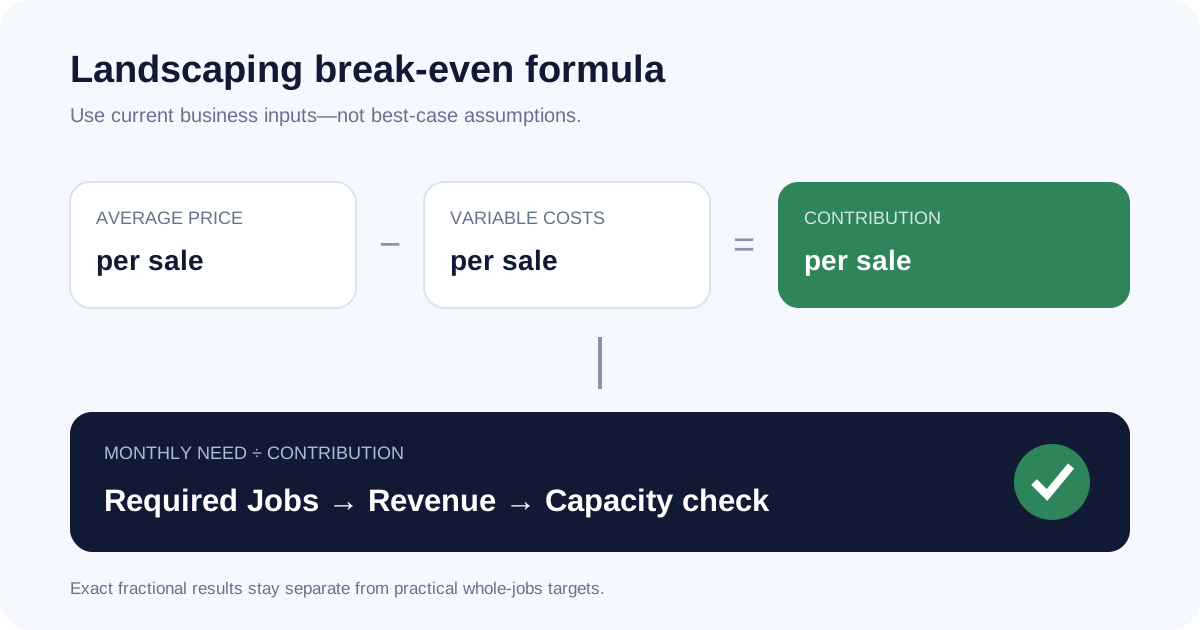
To do break-even analysis for a landscaping business, subtract job-level costs from your average job price, then divide monthly fixed overhead by the contribution left per job. Round up to a whole job and check whether your crew can deliver that volume. Add owner pay and target profit separately when planning the income you want the business to support.

Calculator features
- Separate fixed overhead from job-level costs
- Calculate contribution with a transparent worked example
- Distinguish operating break-even from owner pay and profit goals
- Check seasonal demand against crew labor-hour capacity
How to do landscaping break-even analysis step by step
Use completed-job records and a representative month. The figures below are illustrative USD assumptions, not market prices or industry benchmarks.
- Choose one service or calculate a weighted average using the mix of jobs you actually sell.
- List monthly fixed overhead, such as insurance, storage, software and fixed vehicle commitments.
- Calculate costs that change per job: materials, direct labor, fuel, equipment use, acquisition and payment fees.
- Subtract those variable costs from the average job price to find contribution per job.
- Divide monthly overhead by contribution, then round up the required jobs.
- Add owner pay and optional profit as separate planning goals, then compare the target with crew capacity and seasonal demand.
Inputs to gather before you start
Use recent, representative figures instead of best-case estimates. Enter average job price, materials, field labor, fuel and equipment use, sales cost, fixed overhead and productive crew hours. Keep fixed monthly overhead separate from costs that rise with each job. If a cost applies to every sale, include it in the per-job fields.
- Average landscaping or lawn-care job price
- Plants, materials and direct field labor
- Fuel, disposal and equipment use per job
- Sales or lead cost per booked job
- Vehicles, rent, insurance, software and monthly equipment costs
- Crew size, weekly hours, job duration, utilization and close rate
The formula: operating break-even versus your income target
Contribution per job = average price − total variable cost per job. Operating break-even jobs = monthly fixed overhead ÷ contribution per job. An owner-pay and profit target uses (fixed overhead + owner pay + target profit) ÷ contribution instead. Round up only after calculating the full result.
Count each expense once. If owner field labor is already included in direct labor per job, do not add that same labor again as owner pay. Include only additional compensation you want the business to support. Keep fixed advertising spend in overhead or allocate it per booked job, without counting the same spend twice.
Worked example: a $320 landscaping job
Assume a $320 average job price. Materials are $62, direct labor $96, fuel and equipment use $24, and acquisition $18 per completed job. A 2.9% payment fee adds $9.28. Total variable cost is $209.28, leaving $110.72 contribution per job.
With $4,800 monthly overhead, operating break-even is $4,800 ÷ $110.72 = 43.35 jobs. Round up to 44 jobs, producing $14,080 in sales and $4,871.68 in contribution. That covers overhead under these assumptions; it does not also cover the separate owner-pay goal.
Adding $5,000 in owner pay raises the monthly need to $9,800: $9,800 ÷ $110.72 = 88.51, rounded up to 89 jobs. Adding a further $1,500 profit goal raises the need to $11,300: 102.06 jobs, rounded up to 103 jobs and $32,960 in sales. The unrounded revenue target is $32,658.96.
Four workers at 38 hours weekly, 52 ÷ 12 weeks per model month and 72% productive utilization supply 474.24 productive labor-hours. At five total worker-hours per job, capacity is 94.85 jobs, or 94 whole jobs. A two-person crew working 2.5 hours uses five worker-hours. The 103-job target exceeds this capacity; the 89-job owner-pay target fits the estimate but still needs demand and weather checks.
Turn the capacity gap into a whole-job decision
The worked example above requires 103 whole jobs but estimates capacity at 94.85 jobs. Under that job-duration assumption, only 94 complete jobs fit. The gap is nine whole jobs, not the rounded difference between two fractional figures. Do not round available capacity up simply because the decimal is close to the next job.
At 94 jobs and $110.72 contribution per job, monthly contribution is 94 × $110.72 = $10,407.68. Against the $11,300 financial need, the shortfall is $892.32. This remains an illustrative USD model, not a revenue forecast or an industry benchmark.
In practical terms, your current crew can complete the available jobs and still finish short of the monthly goal. Financial need means the overhead, owner pay and target profit included in this scenario. More inquiries alone do not close a gap caused by a full crew schedule.
One response is to increase contribution enough for 94 jobs to cover the target. The required contribution is $11,300 ÷ 94 = $120.2128, so a two-decimal planning target of $120.22 provides a small rounding buffer. If the entire $209.28 variable cost stayed unchanged, a $329.50 price would leave $120.22 contribution. But that condition does not hold when a payment fee rises with the price.
For a separate fee-sensitive scenario consistent with the same starting totals, suppose the $209.28 contains a 2.9% fee on the original $320 price. That fee is $9.28, leaving $200 of other variable costs. Keeping those other costs unchanged, solve (price × 0.971) − $200 = $120.22. The result is $329.7837, rounded up to $329.79. Contribution is approximately $120.23 after the fee, which is enough for the 94-job target. The 2.9% is a stated assumption, not a claim about your processor.
Compare operational changes before adding a crew
A higher-contribution scenario can close the financial gap without making more hours available. A route or scheduling change can instead raise deliverable jobs, but only if measured travel, setup or downtime actually falls. Keep these as separate scenarios so the model shows which change is responsible for the result.
At the original $110.72 contribution, delivering 103 jobs produces $11,404.16, leaving $104.16 above the $11,300 target. That would require capacity to rise from 94.85 to at least 103 jobs under the original duration assumptions: about an 8.59% increase in modeled output. Check actual paid crew hours and route records before treating that improvement as available.
If a schedule change only supports 100 whole jobs, contribution is $11,072 and the remaining gap is $228. It helps, but does not fully meet the target. A partial improvement should not be described as solving break-even merely because capacity increased.
Now consider a separate staffing scenario that brings an additional $900 monthly fixed cost. The financial need becomes $12,200. If contribution remains $110.72, required output becomes $12,200 ÷ $110.72 = 110.19 jobs, rounded up to 111. The added staffing must support that revised target, with demand to match. Keeping the old 103-job target after adding the cost would understate the requirement.
Weather also changes the schedule. Use the number of workable days for the month you are testing and avoid promising jobs that need unavailable conditions. If fixed payroll continues during downtime, put it in the monthly boundary consistently rather than assuming it disappears with a cancelled visit.
Before adopting a scenario, compare price acceptance, sold workload, material costs, job duration and inquiries. The calculator can trace the arithmetic, but your completed-job records establish whether the inputs are credible. Preserve a conservative case alongside the improved case so the plan does not require perfect routing or every quote to close.
Worked landscaping business example
Using the example assumptions—$320 per job, $209.28 total variable cost and $11,300 monthly financial need—contribution is $110.72 per job. The exact target is 102.06 jobs and $32,658.96 revenue. Because a fraction of a job normally cannot be sold, the practical target is 103 jobs, or $32,960. Estimated capacity is 94.85 jobs; required inquiries are 364.50 at the example conversion rate. This example explains the calculation only and is not an industry benchmark.
How to interpret feasibility
A break-even target can be mathematically correct but operationally impossible. Compare required jobs with realistic productive capacity after setup, travel, administration, gaps and rework. A negative capacity gap means the current team cannot deliver the target under the assumptions entered. Test price, service mix, variable costs, utilization or staffing one change at a time.
Common mistakes to avoid
- Ignoring seasonal downtime and weather disruption
- Leaving fuel, disposal or equipment wear out of job cost
- Using crew clock hours as fully productive hours
- Mixing one-time installation jobs with recurring maintenance without a weighted average
Ways to improve the result
Focus on the assumptions with the largest verified effect rather than changing every input at once. Improve route density, minimum visit pricing, crew scheduling, maintenance-plan mix and material markups supported by actual costs. Recalculate after each change and preserve a conservative scenario so the plan does not depend on perfect conditions.
Use the analysis for seasonal lawn care and mixed services
Calculate active-season and slow-season months separately. A yearly average can hide a winter cash shortage. Keep a cash forecast for equipment purchases, loan principal, taxes and collection delays alongside this contribution model.
Do not blend recurring mowing and material-heavy installation jobs with a simple unweighted average. Calculate each service contribution, then weight it by expected completed-job volume. Recheck the mix when weather or demand changes.
Frequently asked questions
How do I calculate break-even for a landscaping business?
Subtract variable cost from average job price to find contribution per job, divide monthly fixed overhead by that contribution, and round up to a whole job. Add owner pay and target profit separately for an income target, then check crew capacity.
Why are exact and whole jobs different?
The exact result preserves the mathematical fraction. The whole-unit target rounds up because selling only part of a job is usually not operationally possible.
Does the calculator predict guaranteed profit?
No. It produces an assumption-based planning estimate. Actual sales, costs, cancellations, taxes and timing can differ.
How often should the calculation be updated?
Update it whenever price, wages, supplier costs, advertising performance, overhead or team capacity changes materially, and review it at least monthly during active planning.
Can I round landscaping capacity up?
Do not round estimated capacity up when planning complete jobs. At 94.85 jobs of modeled capacity, only 94 whole jobs fit under that duration assumption. Compare that count with the rounded-up financial target.
Does adding staff leave break-even jobs unchanged?
No, when the change adds costs the financial target must be recalculated. In the separate staffing example, an extra $900 of fixed monthly cost raises the requirement to 111 whole jobs at $110.72 contribution. Verify that the new capacity and demand support that target.
Use the free Landscaping break-even calculator