
Mobile Detailing Water Refill Cost: Time and Job Capacity
Published by MyBreakeven. Report a calculation or content issue to support@mybreakeven.com.
Calculate mobile detailing refill costs from paid time, detours and water charges. Check measured water use, route contribution and whole-job capacity.
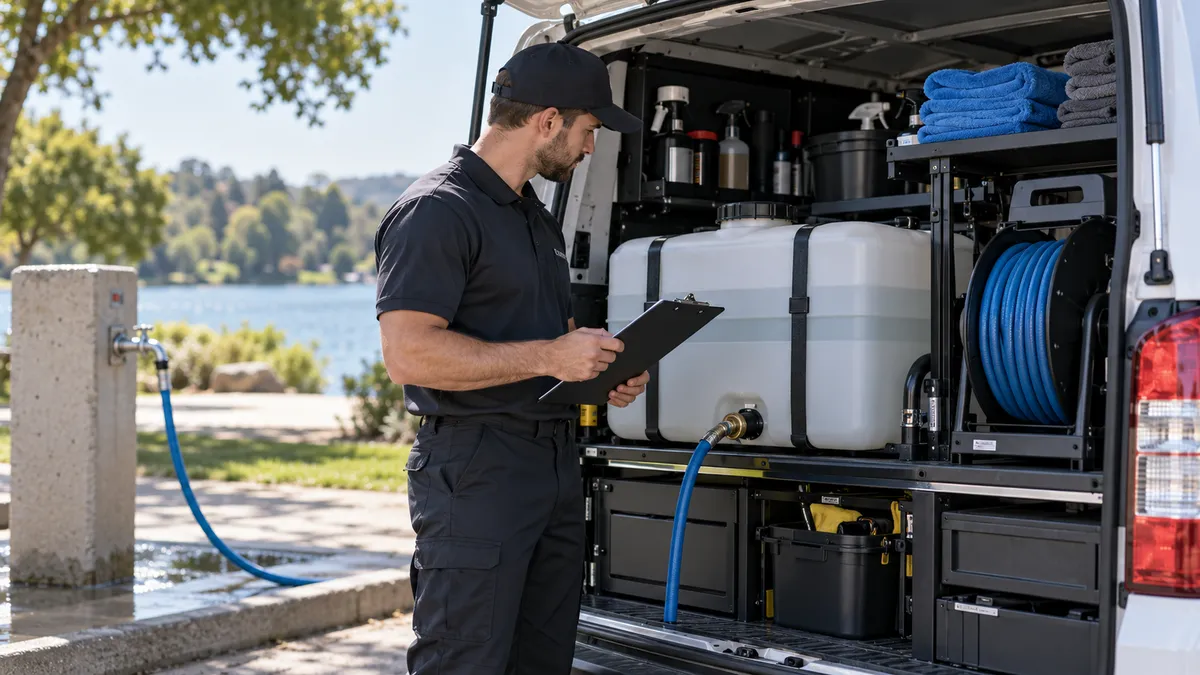
A mobile detailing refill stop costs more than the water you buy. Include the detour, filling and paid handling time, vehicle expense and the effect on appointments that still fit the day. Check water availability and time together: a route can have enough customers and positive job contribution yet run out of usable water before its last stop. This guide translates measured water demand into route cost and deliverable jobs, without recommending a tank size or installation.
Quick answer
Build the route in stop order using your usable starting water and measured consumption for each service. Insert a feasible refill before a stop that cannot be completed with the remaining supply. Add refill travel, handling, filling time and costs to the day. Then check whole-job capacity and contribution after those additions.
Measure the resource your route actually uses
Record starting water, each service's measured use and water needed outside the vehicle task. Use consistent units: US gallons throughout, or litres throughout. Do not mix a label in gallons with job measurements in litres or assume nominal tank size equals usable starting water.
Kärcher's manufacturer FAQs describe pressure-washer flow as model-dependent. Equipment flow is a useful input, but it does not establish consumption for every complete detailing package. Spray time is different from total appointment time, and other water use needs its own entry.
A rough component estimate is equipment flow per minute multiplied by the minutes it actually flows. Confirm that against recorded job consumption before using it across the route. Do not multiply an hour of interior work by a pressure washer's flow rate as though the spray ran for that whole hour.
Plan only water that is usable under your verified equipment setup and operating limits. Any held-back amount is an explicit assumption, not a universal recommended reserve. Customer water access also needs confirmation; an unconfirmed connection is not reliable route supply.
The core comparison has two parts:
- Water check: can each next job be served before the next feasible replenishment?
- Time check: do service blocks, ordinary route travel and refill events fit the available window?
Do both checks in route order. A total volume that looks sufficient at the end of the day does not prove water is available before the third appointment. Keep refill location and availability in the schedule rather than adding gallons without a timed stop.
Worked example: six cars need one refill
Assume a fictional one-person route has a 480-minute operating window. It starts with 50 US gallons, of which five are held back in this scenario, leaving 45 usable gallons. Six identical packages each use eight gallons and occupy 60 minutes including service, normal setup and pack-down. Ordinary route driving takes 60 minutes. These are illustrative measured-use assumptions, not typical detailing consumption or a tank recommendation.
Water demand is 6 × 8 = 48 gallons. After the first five jobs, 40 gallons have been used, leaving ten in the tank, five of them held back. The sixth needs eight usable gallons, so it cannot be completed from the remaining five usable gallons.
Insert a feasible refill after job five. In this example it adds 40 gallons and occupies 30 minutes including detour and handling. That event costs $15 paid labour at an illustrative $30 per hour, $4 vehicle expense and a $6 sourcing charge: $25 total. All prices are hypothetical USD inputs, not local charges or wage recommendations.
| Route check | Without the missing refill | With the planned refill |
|---|---|---|
| Planned vehicles | 6 | 6 |
| Water required | 48 gallons | 48 gallons |
| Starting usable water | 45 gallons | 45 gallons |
| Refill water added | None | 40 gallons after job five |
| Service/setup/pack-down | 360 minutes | 360 minutes |
| Ordinary driving | 60 minutes | 60 minutes |
| Refill event time | Omitted | 30 minutes |
| Total occupied time | 420 minutes, incomplete water plan | 450 minutes, or 7.5 hours |
The replenished route fits the 480-minute window with 30 minutes left. That spare half-hour does not fit another 60-minute package. It can support a schedule buffer without being a whole extra sale.
Calculate the contribution effect
Suppose each package sells for $150 and carries $45 variable delivery cost: one worker-hour at $30, $10 products and $5 equipment use. The illustrative percentage payment fee is 3%. Ordinary driving costs $30 paid labour plus $20 vehicle expense, $50 for the route. Shared business overhead is excluded from this comparison.
Six jobs produce $900 service revenue, $27 fees and $270 car delivery cost. Before recognizing the refill, the apparent route contribution is $900 − $27 − $270 − $50 = $553. Including the actual $25 refill reduces contribution to $528.
With the complete 7.5 occupied worker-hours, contribution per occupied worker-hour is $528 ÷ 7.5 = $70.40. This is contribution after the stated delivery-labour cost and before shared overhead, not owner take-home pay. The incomplete calculation's $553 ÷ 7 hours = $79 would overstate both contribution and hourly performance.
Keep paid refill labour and vehicle expense separate. The worker's time in the van and the vehicle's running cost are different resources. If either is already inside your route cost allowance, remove that overlap rather than charging it twice.
What changes the answer
Measured package use. An interior-focused service and a water-intensive exterior service may have different demands. Retain service-specific measurements and enough context to explain variation. A low-use example does not instruct you to change a cleaning method beyond what is appropriate for the work.
Usable starting supply. Record the actual starting level and any explicit held-back amount. A nominal capacity does not prove the tank began full. Do not treat this arithmetic as approval to carry more water; equipment capacity, vehicle payload and installation suitability need their own verified limits.
Refill location and timing. The event includes the detour, queue, access, filling and return to the planned route. A refill between two appointments may be unavailable at the time needed. Test a slower event as well as the convenient assumption.
Crew size. Two people on a 30-minute refill consume one paid worker-hour, even if they cannot both accelerate filling. Separate elapsed route time from worker-hour cost. More people can increase the cost of a bottleneck without automatically shortening it.
Collection and overhead boundaries. These examples use service revenue before taxes and a simplified percentage fee. A refill sourcing charge may be paid before customer receipts arrive. Keep actual cash dates separate, and place recurring equipment commitments in one consistent part of the monthly model.
Two route variations
A seventh appointment does not fit
Seven identical packages need 56 gallons. The same starting supply still requires a replenishment. Time becomes 7 × 60 + 60 ordinary driving + 30 refill = 510 minutes, or 8.5 hours. That exceeds the eight-hour window by 30 minutes.
For six packages the complete route uses 450 minutes, so six is deliverable under these assumptions. Quoting seven merely because 7 × 60 + 60 = 480 minutes would hide the refill. The hypothetical seven-job contribution would be $1,050 − $31.50 fees − $315 car costs − $50 driving − $25 refill = $628.50, but that financial result depends on a longer day than the stated plan allows.
Do not insert the seventh job's revenue into an eight-hour business plan until its delivery constraint is resolved. Nor should you automatically call it a lost sale; it may be an unbooked opportunity rather than a confirmed customer you cannot serve.
Service mix can move both constraints
Assume two heavier packages each use 14 gallons, occupy 100 minutes, sell for $240 and cost $70 directly. Three standard packages use six gallons each, occupy 60 minutes, sell for $150 and cost $45. These are new scenario inputs, not a claim about normal product consumption.
Water demand is 2 × 14 + 3 × 6 = 46 gallons. With the heavy jobs first, followed by the standard jobs, the first four use 40 gallons. The last standard job cannot use the remaining five usable gallons, so the scenario includes one replenishment before it.
Time is 200 + 180 service minutes + 60 ordinary travel + 30 refill = 470 minutes. Revenue is $480 + $450 = $930. Direct car costs are $140 + $135 = $275. With the same $50 route cost, $25 refill and 3% fee of $27.90, contribution is $552.10.
That five-car route has more contribution than the six-car example's $528, but uses 20 more minutes. The important comparison is complete service mix, supply and time, not car count alone. Neither scenario predicts demand for those packages.
How to run your own numbers
Use the mobile detailing break-even calculator to connect representative complete route economics with monthly commitments and productive hours. Allocate shared refill cost once across the modeled jobs and include the corresponding worker-hours consistently. The calculator supports other currencies; it does not simulate water levels or plan refill locations automatically.
For ordinary route geography, use mobile detailing travel-fee planning. For a service menu built from scope, use detailing price-list costs. For opening purchases and cash, use mobile detailing startup costs. Keep those tasks separate from this daily resource bottleneck.
Common mistakes
- Multiplying equipment flow by the whole appointment rather than actual flow time.
- Counting nominal tank volume as confirmed usable starting supply.
- Adding replenishment water without a feasible timed route stop.
- Pricing the water while omitting paid refill labour and detour expense.
- Treating a spare 30-minute block as a full 60-minute sale.
- Counting refill time in both job duration and a separate route-time allowance.
Frequently asked questions
Are eight gallons per car typical?
No. Eight gallons is an explicit input in the fictional route. Replace it with measurements for your own process and service mix rather than using it as an industry benchmark.
Can I plan solely from total daily water demand?
No. Check when water is available before each stop. A replenishment scheduled after a job does not supply water for that job earlier in the route.
Is more tank capacity always the best answer?
No. This article does not recommend equipment size or authorize a payload change. Compare verified options, their full costs and operating constraints separately; the route calculation only identifies the bottleneck.
Does a customer water connection remove refill cost?
Only model confirmed supply that is available and suitable for the planned work. Include connection and handling time where relevant. Do not silently assume every property provides it.
What if the refill takes an hour instead of 30 minutes?
The six-car example would occupy 480 minutes rather than 450. At the same $30 hourly labour basis, refill labour rises from $15 to $30, reducing contribution by another $15 if other costs stay unchanged. There would be no spare time left in that window.
Is water demand the same as chemical cost?
No. Water availability constrains route delivery, while concentrate price, dilution and product usage determine chemical spending. Account for each separately and avoid treating an extra gallon of water as though it were an extra gallon of purchased concentrate.
Closing takeaways
- Use measured demand and actual usable starting supply.
- Insert refills in route order before a shortfall occurs.
- Price paid time, vehicle expense and sourcing cost together.
- Check deliverable whole jobs before accepting the revenue target.
Explore the Mobile Detailing planning hub or all business planning guides.
Planning estimates only—not accounting, tax, legal or lending advice.