
Ordinary Annuity vs Annuity Due: Payment Timing Explained
Published by MyBreakeven. Editorial standards and corrections. Report a calculation or content issue to support@mybreakeven.com.
Compare end-period and beginning-period payments with timelines and worked examples. Match contribution frequency, compounding and valuation date.
Quick answer: ordinary payments occur at period end; due payments occur at the beginning. Two $1,000 annual deposits at 5% finish at $2,050 versus $2,152.50 respectively. Compare timing in the calculator.
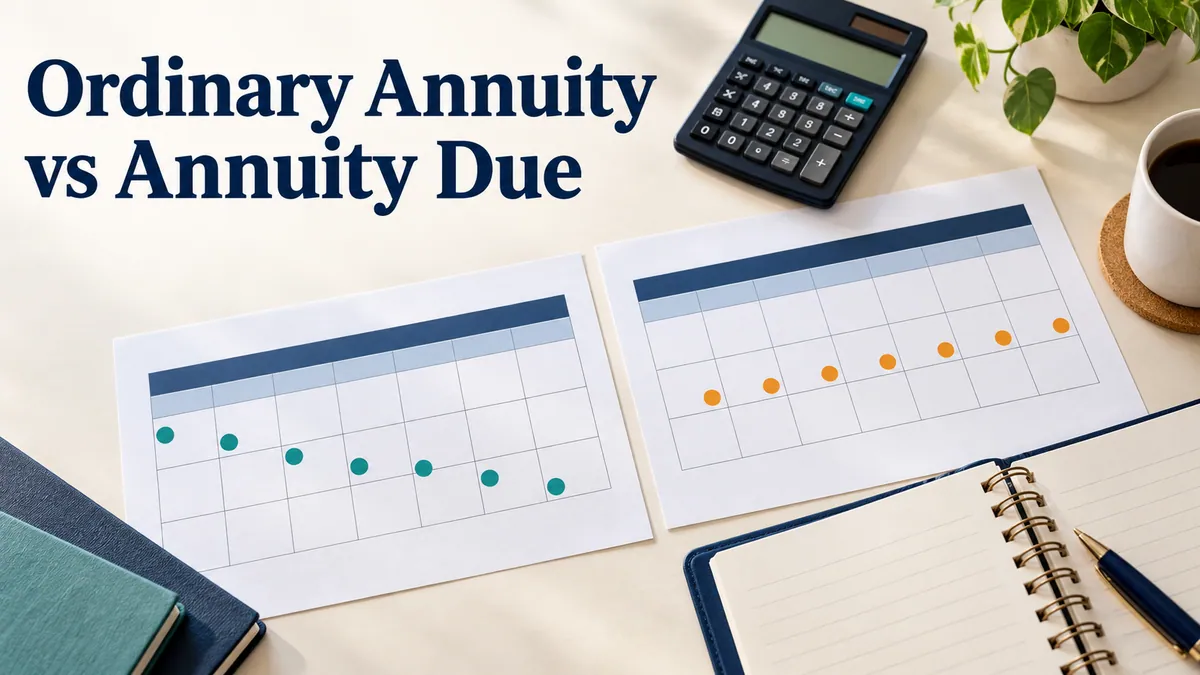
The difference is when each payment happens
An ordinary annuity has payments at the end of each period; an annuity due has payments at the beginning. For otherwise identical deposits and a positive period rate, beginning payments have one extra period of growth at the common ending date. “Annuity” here means a regular cash-flow pattern, not a recommendation to buy an insurance product.
The Future Value calculator supports both timing conventions. Enter the same principal, contribution, rate and horizon before changing only the timing option.
Draw the payment dates first
| Time | Ordinary / end | Due / beginning |
|---|---|---|
| Start of year 1, t=0 | No contribution | First contribution |
| End of year 1 / start of year 2, t=1 | First contribution | Second contribution |
| End of year 2, t=2 | Second contribution; value total | Value total; no third contribution |
Both paths contain exactly two contributions. Do not accidentally put a third payment at the final date in the beginning case. A deposit count error can matter more than the interest calculation. Initial principal is a separate cash flow and is not another recurring contribution.
Apply the matched-period annuity formulas
For n equal end-period payments P and effective period rate i: FV ordinary = P × [(1+i)n − 1] ÷ i. Beginning-period future value is FV due = FV ordinary × (1+i). Add PV × (1+i)n separately for initial principal.
At i=0, both contribution totals are P×n. The due multiplier applies to the contribution stream, not the existing principal. For a negative valid effective rate, beginning contributions can finish lower because they experience the negative rate for longer.
Compare two $1,000 annual deposits
| Payment | Ordinary value at t=2 | Due value at t=2 |
|---|---|---|
| First 1,000 | 1,000 × 1.05 = 1,050 | 1,000 × 1.05² = 1,102.50 |
| Second 1,000 | 1,000 | 1,000 × 1.05 = 1,050 |
| Total | 2,050 | 2,152.50 |
The $102.50 difference is payment timing under the stated assumptions. It is not an extra deposit or a guaranteed bonus. If there is also $10,000 initial principal, both paths add the same $11,025 principal future value; do not multiply that amount by another 1.05.
Check a short monthly example
With no initial principal, $100 per month, two months and 1% effective monthly growth, end-month deposits finish at $100×1.01 + $100 = $201. Beginning deposits finish at $100×1.01² + $100×1.01 = $203.01.
To reproduce a monthly rate through an annual input, use a matched convention: 12% nominal compounded monthly gives 1% per month. An effective annual rate of 12% gives a smaller monthly effective rate. Keep these labels visible rather than dividing every annual rate by twelve.
Zero-rate check: with no starting principal, twelve $100 monthly deposits and a 0% rate, both timing choices finish at $1,200. With a negative effective monthly rate of −1%, two $100 deposits instead finish at $199 at period end and $197.01 at period beginning. Earlier deposits experience the negative rate for longer, so “annuity due is higher” applies only to a positive rate.
Contribution frequency is not compounding frequency
A bank or projection may quote monthly compounding while the user deposits quarterly. The effective quarterly rate must represent the growth across that three-month payment interval. Under the calculator’s disclosed equivalent-rate convention, nominal j compounded m times a year converts to payment-period rate (1+j/m)m/p−1 for p payments per year.
The tool requires whole contribution periods. Annual contributions need a horizon made of whole years, quarterly contributions whole quarters and monthly contributions whole months. It does not invent a fractional final deposit.
Use timing without assuming it is free money
Beginning contributions may reduce cash available for payroll or suppliers earlier in the period. A savings projection does not check those operating commitments. For a replacement reserve, choose deposit dates the business can actually fund and compare them with the payment calendar.
Use the dated cash forecast for short-term liquidity and present versus future value to compare money on a common date. Payment timing and product risk remain separate decisions.
Check the common timing mistakes
Do not mix rent paid at the beginning with a formula assuming end payments. Do not give the final ordinary deposit a full extra period of growth. Do not add n+1 deposits to a horizon defined as n contribution periods. Do not multiply the whole balance, including existing principal, by the due adjustment.
Schedules may display cents while the engine retains precision. Sum unrounded values when reconciling; a one-cent display difference across independently rounded rows is not an extra return. Download the tool’s CSV with its assumptions when saving a scenario.
Sources and next step
OpenStax discusses ordinary annuities and annuities due. The payment timelines, business application and numerical examples here are original teaching cases.
Return to the Future Value calculator to change contribution timing while keeping all other inputs constant. The fixed-rate model does not forecast market returns or decide whether an annuity product suits your circumstances.
Frequently asked questions
Which has higher future value, ordinary annuity or annuity due?
For the same positive period rate, dates and contribution count, annuity due is higher because each payment grows for one extra period. At zero rate they agree.
Does the due multiplier apply to my starting balance?
No. It applies to the recurring payment stream. Initial principal follows its own full-horizon growth formula.
Can contributions and compounding have different frequencies?
Yes, with a disclosed effective-rate conversion and consistent payment intervals. The calculator supports annual, quarterly and monthly contributions.
Does this calculator price an insurance annuity?
No. It models equal periodic cash flows at a constant assumed rate, without product-specific fees, guarantees or contract terms.
Browse the MyBreakeven blog hub for related planning guides.
Planning estimates only—not accounting, tax, legal or lending advice.