How to Estimate a Post-Construction Cleaning Job
Published by MyBreakeven. Report a calculation or content issue to support@mybreakeven.com.
· Updated September 29, 2026
Estimate a post-construction clean from a site walk, crew hours, supplies, access and scope. Follow a worked bid with a practical client checklist.
Cleaning · Post-Construction · Estimating
Calculator features
- A checked worked example
- Clearly stated assumptions
- Practical capacity and risk checks
The contractor says the renovation is finished. You arrive to find dust on the window tracks, tape on the glass and a second trade still cutting trim. A simple square-foot quote cannot tell you how many times you will clean the same room. Before you give a price, decide exactly what is ready, what needs doing and when the client will accept the work.
Quick answer: Walk the space after the trades have defined their finish date. List the cleaning stages and surfaces, estimate paid cleaner-hours by task, add direct supplies and travel, reserve time for a defined final walkthrough, then add allocated overhead and price for your target margin. Put exclusions and a change-order rule in writing. A fictional 2,000-square-foot office example below costs $1,154 to deliver and support; at a 20% margin its quote is $1,442.50, before applicable tax. Your own bid may differ substantially.
This guide is for an ordinary one-time post-construction or post-renovation clean. It is distinct from pricing a recurring office contract. The square footage in the example describes the site; it is not a universal rate card.
Walk the job before pricing it
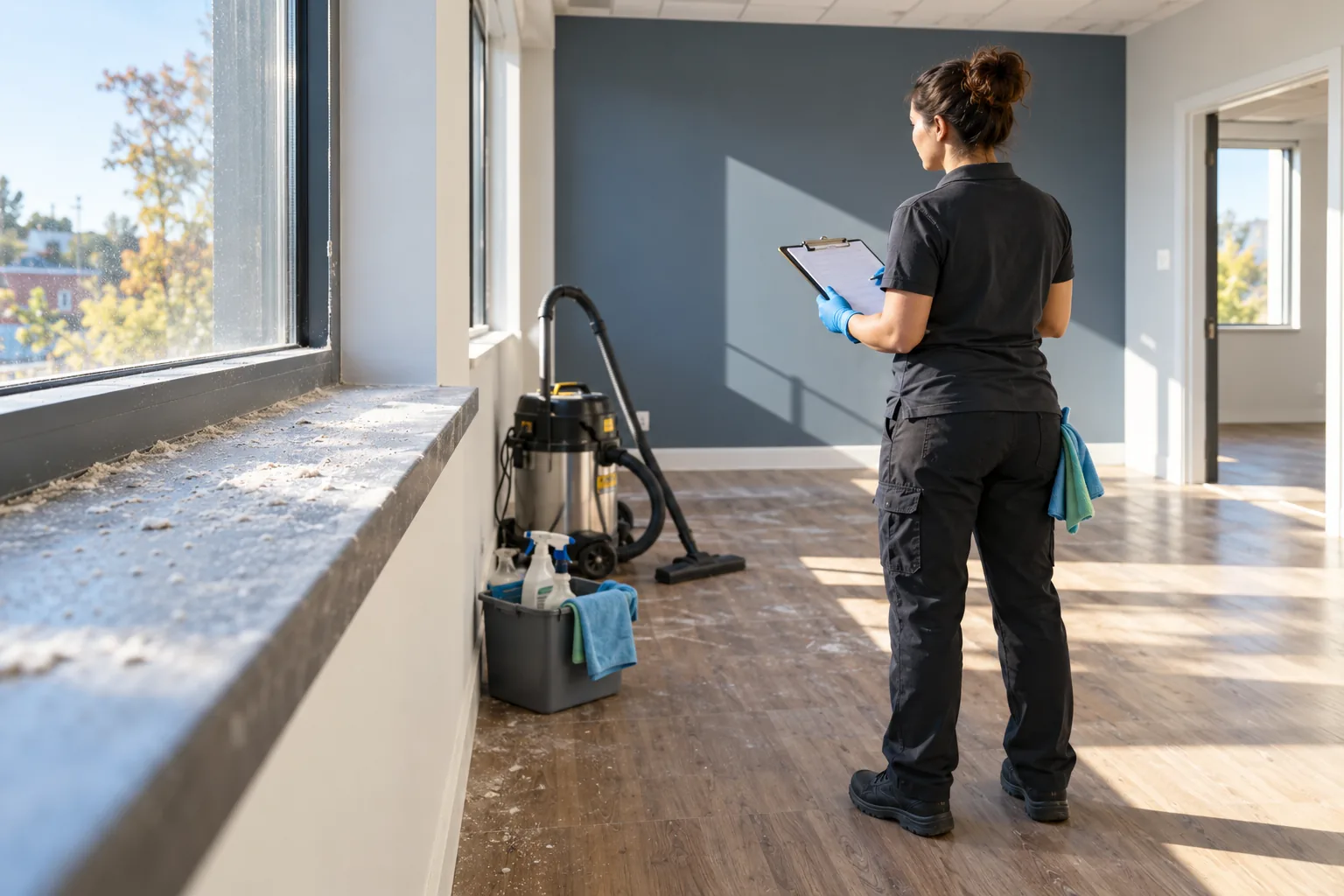
Ask when construction dust-generating work will stop and when the area will be released to the cleaning crew. Photograph the condition with permission. Note floor types, number of rooms, bathrooms, kitchens, interior glazing, high shelves, vents or fixtures within safe reach, adhesive residue, paint specks, access hours, parking, elevator or stair travel, water and power. Count items, not just floor area: ten new cabinets and their drawers may take more detail time than an open room of the same size.
Clarify what the contractor has already removed. Normal service might include collecting light leftover debris, dust capture on reachable surfaces, cleaning interior glass, wiping fixtures and wet cleaning suitable floors. Heavy rubble, demolition waste, paint removal, grout restoration, duct cleaning and high-access work can require different crews, equipment or separate quotes. Identify who is responsible for disposal fees and dumpsters. An occupied building may require noise restrictions, security check-in or working around other trades. Every one of those conditions affects paid time.
Most importantly, ask whether this is a rough clean, a final clean, or a separate touch-up after punch-list work. Rough work can address debris and accessible surfaces before final finishes. Final work targets fine dust and presentation after the trades finish. A touch-up is a return visit for fingerprints and dust created after that final clean. Do not promise all three for one price unless you have allocated hours for all three and established the handoff dates.
Convert the task list into cleaner-hours
Use your own job records or a room-by-room time trial for the base estimate. A pair of cleaners on site for four hours is eight cleaner-hours. Add paid loading, setup, travel between locations and a handover where relevant. Say whether the work can happen in one visit or requires separate trips. In the example below, assume the contractor has removed major debris and finished dust-generating work. The final clean and one short sign-off visit are included; new dust from later trades is an approved extra.
| Illustrative work package | Paid cleaner-hours |
|---|---|
| Prep, setup and protection check | 2 |
| Detail dust capture on reachable ledges, cabinets and fixtures | 10 |
| Interior glass, frames and tracks | 6 |
| Bathrooms and kitchenette | 5 |
| Floors and finish-safe spot work | 6 |
| Walkthrough, touch-ups and closeout | 3 |
| Total | 32 |
At an illustrative fully loaded labor cost of $28 per paid cleaner-hour, labor is 32 × $28 = $896. “Fully loaded” here means the business's budgeted cost of employing that hour, not the employee's take-home pay. Do not treat $28 as a national labor rate. Replace it with your own payroll, employer costs, paid travel rules and staffing setup.
Now add $78 of supplies and consumables, $55 for travel and parking, $45 for equipment use and maintenance, and $80 of allocated supervision and operating overhead. The total estimated job cost is $896 + $78 + $55 + $45 + $80 = $1,154. These are invented example inputs, not a market quote.
To target a 20% margin on the quoted price, divide $1,154 by (1 − 0.20): $1,442.50. The modeled difference of $288.50 is 20% of the quote. Adding 20% to cost would be $1,384.80 and yield a lower margin, so make clear which method you use. Check whether local sales tax applies to your service separately; the calculation above excludes tax.
For internal comparison only, $1,442.50 divided by 2,000 square feet is about $0.72 per square foot. That number is the output of this inspected scope and these assumptions. Copying it onto a different site with a different amount of glass, residue or rework would be a bad bid.
Price the uncertainty you can actually describe
Suppose the final clean takes six additional paid cleaner-hours because adhesive remains on accessible glass. At the same $28 cost, direct labor rises by $168. If all other costs stay constant, cost becomes $1,322. At the original $1,442.50 price, modeled profit falls to $120.50, an 8.35% margin. To preserve 20%, the revised price would be $1,652.50 ($1,322 ÷ 0.80), subject to a scope change the client approves. The $210 price difference is a change-order example, not permission to bill an unexpected charge without agreement.
Instead of hiding unlimited “contingency” in the quote, name the triggers: new debris after handoff, another trade working during the clean, adhesive beyond the inspected area, no running water, delayed access or a second return trip. State the included number of visits and the price method for approved extra cleaner-hours or a revised fixed price. If you know a condition is likely, put realistic time for it in the base scope.
| Bid check | Base case | Six extra cleaner-hours at unchanged price | Approved revised scope at 20% margin |
|---|---|---|---|
| Modeled job cost | $1,154 | $1,322 | $1,322 |
| Client price before tax | $1,442.50 | $1,442.50 | $1,652.50 |
| Modeled margin | 20% | 8.35% | 20% |
The numbers make the operational issue visible: a little extra labor can consume much of a one-time job's planned profit. Recording why the hours changed will improve your next estimate far more than copying a competitor's square-foot price.
Treat fine dust and possible hazards as scope decisions
Construction dust can be different from ordinary office dust. If tasks could expose workers to respirable crystalline silica, OSHA's construction silica standard limits dry sweeping or dry brushing when it contributes to exposure, except where alternatives such as wet methods or HEPA-filtered vacuuming are not feasible. Choose equipment and work practices based on the actual material and applicable requirements; a household vacuum or a quick dry broom is not a universal solution.
If a renovation disturbed painted surfaces in a pre-1978 home or child-occupied facility, stop and clarify responsibility before quoting an ordinary final clean. EPA's Renovation, Repair and Painting work-practices page describes containment, cleanup and verification requirements for covered work. Your general cleaning bid should not claim to perform lead-safe verification or hazardous-material remediation unless the appropriately qualified team and required procedure are actually in scope. The same principle applies to suspected asbestos or unknown contamination: have the responsible contractor assess it, then define the service you can safely deliver.
Also protect new finishes. Verify the manufacturer's instructions for flooring, stone, glass coatings and cabinetry before selecting chemicals or abrasive pads. A fast clean that damages a new surface is expensive for everyone. Put unusual residue removal or surface repair on a separate approved scope.
Give the client a quote they can compare and accept
A usable proposal names the property, date of walkthrough, areas and surfaces, included tasks, number of passes or visits, target access dates, conditions required for the site to be ready, supplies and equipment, disposal responsibility, exclusions, price before tax, payment terms and who approves extra work. Define acceptance: a joint walkthrough or written punch list within an agreed period after completion. A client can then see what the price covers and when your team is done.
For example, describe “interior glazing and tracks accessible from the floor” rather than “all windows.” Describe “dust capture on reachable finished surfaces after trades vacate” rather than “remove all construction dust forever.” Be specific without burying the customer in a legal document. If the builder needs a rough clean now and final clean after inspection, list two visits and price the second trip's travel and setup.
Keep a short job record afterward: estimated versus actual cleaner-hours by task, materials used, number of returns and what caused rework. Use it to refine the next bid. Our commercial cleaning contract bidding guide addresses monthly recurring work; its visit-frequency model should not be copied onto this one-time project. If you need a baseline for the business's monthly survival target, use the cleaning business break-even calculator with your average job contribution, fixed expenses and owner pay. The calculator tests monthly business volume; this site-walk worksheet sets the individual job quote. See also cleaning business monthly expenses when assigning overhead.
Common estimating misses
Using square footage as the whole scope. A 2,000-square-foot shell and a finished 2,000-square-foot office have different numbers of ledges, cabinets, bathrooms and glass panels. Count them.
Forgetting the second visit. A rough clean before final trim work may need a full final clean later. Count both loading and travel as well as on-site hours.
Confusing crew time with payroll hours. Two people spending six hours each is 12 paid cleaner-hours. Price labor at the full 12, plus paid setup or travel.
Leaving overhead and owner work out. Scheduling, walk-throughs, insurance, equipment upkeep and administration have costs even on a one-time job. Allocate them consistently, then check your desired margin.
Promising hazard removal in a normal clean. Unknown dust or old painted surfaces warrant a scope and safety check before work begins. Put any specialist work with the appropriately qualified provider.
Assuming construction is finished because the date says so. Confirm the actual release of the area and specify how later trade activity is handled.
FAQs
How much should I charge per square foot for post-construction cleaning?
There is no single price that fits every site. Inspect tasks and surfaces, estimate cleaner-hours and direct expenses, then add allocated overhead and your target margin. Divide the resulting quote by area only as a cross-check against your own completed jobs with similar scope.
How do I estimate labor hours before I have job history?
Break the site into rooms and tasks, time a small representative area if access is allowed, and record assumptions. Include setup, movement between areas, final checks and likely touch-ups. Compare the first job's actual hours with the estimate and improve the template.
Is rough cleaning the same as final cleaning?
No. A rough clean generally happens earlier, while the final clean prepares finished surfaces for handover. The exact definitions vary by project, so list tasks and timing for each pass in your proposal.
Do I include debris removal and a dumpster?
Only if you have inspected the debris, can handle it safely and have priced labor, transport and disposal. State whether the builder removes construction waste and who pays any fees.
What happens if workers make new dust after I finish?
Set a handoff time and acceptance process. If later trade activity requires a return, define it as an approved extra visit or separately priced touch-up, with access and payment terms agreed beforehand.
How does a 20% margin differ from a 20% markup?
Margin uses client price as its denominator; markup uses cost. On $1,154 of modeled cost, a 20% margin requires $1,442.50. A 20% markup gives $1,384.80, which is about a 16.67% margin.
Takeaways for the next walkthrough
- Write down the actual surfaces, stages and site-readiness conditions before pricing.
- Count paid cleaner-hours for the full crew, direct costs and allocated overhead.
- Check dust and material risks before assigning ordinary cleaning methods.
- Show the included visits, exclusions and change-order triggers in the quote.
- Compare estimated and actual hours afterward so your next bid uses evidence from your own work.
Browse the MyBreakeven blog hub for related planning guides.