
Takeout vs Dine-In Profit: Compare the Whole Order
Published by MyBreakeven. Report a calculation or content issue to support@mybreakeven.com.
Compare takeout and dine-in contribution after ingredients, packaging, labor and fees. Test quiet-night orders, peak capacity and platform pricing.
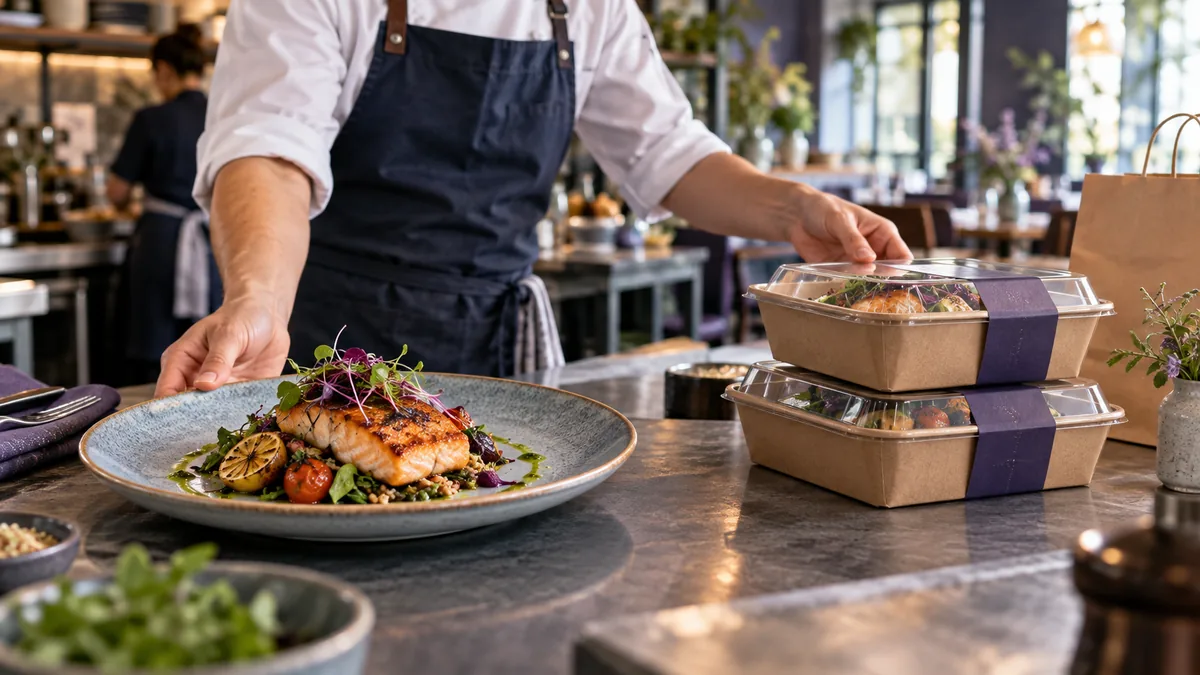
Takeout and dine-in should be compared by the contribution left after each channel's sale-dependent costs, then by the volume and capacity they consume. A takeout order can save table-service work but add packaging, platform fees and packing time. A dine-in order can include profitable extras but occupy a table longer. The fictional USD examples below separate those effects instead of assuming one channel is always more profitable.
Quick answer
Use actual paid order revenue, ingredients, packaging, incremental labor and channel fees. Subtract those costs to find contribution per order. Compare order volume, kitchen minutes and any displaced sales. Keep scheduled staff and rent in the monthly budget once. A channel's higher sales total or lower food-cost percentage does not by itself establish higher profit.
The direct answer: one meal through three channels
Suppose a dine-in order produces $25 revenue. Ingredients cost $8, genuinely incremental service labor $2 and a 3% payment fee $0.75. Contribution is $25 − $8 − $2 − $0.75 = $14.25, or 57% of revenue.
An equivalent direct takeout order sells for $23. Ingredients cost $8, packaging $1, incremental packing labor $0.75 and a 3% fee $0.69. Contribution is $12.56, or 54.61%. Takeout leaves $1.69 less contribution per order under these assumptions, but that is not the complete capacity decision.
Now sell the $23 order through a platform taking 20% of revenue, with no separate processing charge in this illustration. Ingredient, packaging and packing costs remain $9.75. The platform charge is $4.60. Contribution is $23 − $9.75 − $4.60 = $8.65, or 37.61%.
The same meal therefore leaves three different contribution amounts. Actual contracts can define different fee bases, fixed charges or promotions. Replace these simplified assumptions with your statements. Never assume the platform deduction includes payment processing unless the agreement says it does.
Scheduled labor belongs outside these figures when it is committed for the period. If the restaurant pays the same shift wages with or without the next order, those wages stay in the fixed-cost plan. The illustrative labor above is explicitly sale-dependent; count it once.
The delivery commission guide explores platform deductions. This comparison includes direct pickup and dine-in as alternatives, making the operational choice wider than a fee calculation.
What changes the answer
Basket size matters. Dine-in customers may buy drinks, sides or desserts, while pickup customers may order several meals together. Compare observed order revenue and order cost, not an individual dish from one channel against a complete basket from another.
Packaging changes with food and journey. A hot meal, liquid dish and dessert can require different containers. Count bags, seals, cutlery and remake costs where they apply. Packaging bought in bulk still has a cost per usable order.
Capacity can make incremental takeout valuable during quiet service. If the kitchen and staff have room, a positive-contribution order can help cover existing commitments. During a full service, the same order might delay or displace a more valuable dine-in sale.
Table occupancy has a separate limit. A dine-in order uses a seat and service time; takeout normally does not. Compare contribution per occupied table period only after keeping kitchen constraints in view. A freed table is worth money only if another customer is likely to use it.
Refunds and remakes reduce realized contribution. Record who pays a refund, whether the platform returns its commission and whether replacement food creates another cost. A refunded order can leave more costs than the original worksheet predicts.
Promotions alter the actual paid price and sometimes the fee base. A discount funded by the restaurant is different from one paid by the platform. Reconcile the settlement rather than assuming the listed discount describes your revenue loss.
Use restaurant food-cost percentage for ingredient measurement, and keep the channel comparison tied to paid sales.
Three worked scenarios
Quiet-night direct pickup
An extra 30 direct takeout orders at $12.56 contribution leave $376.80. Suppose they create a $100 extra fixed packing shift that was not included in the per-order labor. Incremental contribution after that shift is $276.80.
If those orders use spare kitchen capacity and displace no other sales, that money helps cover monthly commitments. It is not final business profit. If the $100 shift was already included in direct labor, subtracting it again would be a mistake.
A peak-hour platform trade-off
Twenty platform orders at $8.65 contribution leave $173. Suppose accepting them means turning away 15 dine-in orders at $14.25 contribution, a loss of $213.75. The net change is $173 − $213.75 = −$40.75 before any other effects.
Platform volume has increased gross sales but reduced the expected contribution from this constrained period. The displacement assumption is the key uncertainty. Measure actual kitchen delays and lost orders rather than treating the fictional trade-off as universal.
A different platform price
Raise the platform price to $26 while keeping $9.75 non-percentage variable cost and a 20% platform charge. Contribution becomes $26 × 0.80 − $9.75 = $11.05.
To equal the direct takeout contribution of $12.56 under these same costs, required platform price is ($12.56 + $9.75) ÷ 0.80 = $27.8875, or $27.89 rounded upward. That solves the contribution equation; it does not establish demand, permitted pricing terms or customer acceptance.
How to run your own numbers
Model each channel separately in the restaurant break-even calculator. Enter a consistent order unit, channel-specific paid price, ingredients, packaging, incremental labor and fees. Keep monthly rent, scheduled payroll and owner pay in their appropriate fields.
The calculator supports other currencies. Compare channels in one currency and one observation period. When modeling an average basket, use average basket costs and delivery hours as well; do not combine an order price with one dish's ingredients.
Build a settlement worksheet with gross paid orders, discounts, refunds, platform deductions and payouts. Contribution is a planning measure based on sales and costs, while the payout also reflects settlement timing and adjustments. Reconcile them without assuming they must be identical on every day.
Record peak and off-peak performance separately. An average can hide a channel that helps at lunch but causes delays at dinner. The restaurant sales-forecast guide connects expected orders to staffing and capacity.
Common mistakes
Comparing listed prices instead of paid revenue overlooks restaurant-funded discounts. Use the amount that belongs to the sale after the relevant adjustments.
Counting an inclusive platform fee and a separate assumed processor fee duplicates costs. Verify the actual fee structure first.
Ignoring packaging treats pickup as the same cost as plated service. Cost the usable packaging set for each order type.
Calling every positive-contribution order beneficial ignores displaced orders at a bottleneck. Check what else could have used the same kitchen time.
Charging the whole scheduled rota as both fixed payroll and variable labor double-counts wages. Identify incremental work separately.
Using one average order for all channels hides different basket sizes. Keep the calculation's unit consistent before comparing results.
FAQs
Is direct pickup always more profitable than delivery?
Not always. Direct pickup may have lower fees, but price, basket size, packaging and volume can differ. Compare contribution under your actual channel terms and include the operational effects of accepting each order.
Should takeout include rent?
Rent remains in the monthly operating plan unless the channel creates an additional space cost. You may allocate it for a full-cost view, but do not deduct it twice. Contribution explains what orders leave to cover such commitments.
What if dine-in customers buy more drinks?
Use the observed full basket rather than a meal-only comparison. Include the drink revenue and its sale-dependent costs. A channel comparison should represent what customers actually buy.
Can I increase a platform menu price?
The worksheet can calculate a required price, but permitted pricing and commercial terms come from your actual agreement. Customer demand also needs testing. A mathematically sufficient price is not a guarantee of accepted orders.
How should I treat delivery tips?
Keep money that belongs to another party outside the restaurant revenue used in this model. Treatment depends on the arrangement and applicable rules. Do not count all collected money as restaurant contribution.
When should I pause a channel?
Examine contribution, delays, refunds and displaced sales in the relevant period. A temporary capacity decision differs from abandoning the channel. Test the operational problem and track the resulting service performance.
Closing takeaways
- Compare full paid baskets and actual channel costs.
- Separate quiet-period additions from peak-period displacement.
- Reconcile platform fees and discounts to statements.
- Keep monthly commitments outside contribution, counted once.
Find more methods in the business guide library.
Planning estimates only—not accounting, tax, legal or lending advice.