Salon Booth Rent vs Commission: The Owner's Break-Even Math
Published by MyBreakeven. Report a calculation or content issue to support@mybreakeven.com.
· Updated September 28, 2026
Compare booth rent and commission from the salon owner's side using occupied chairs, service sales, labor costs and shared overhead.
Salon · Booth Rent · Commission

Calculator features
- Visible assumptions and checked arithmetic
- A practical capacity or risk check
- A clear method to use your own records
For a salon owner, booth rent and commission earn money in different ways. Rent gives a contracted payment for an occupied chair; commission gives the salon a share of service sales while the salon usually carries more operating costs. Compare the net contribution of each occupied chair and then test the whole room against its fixed bills.
Quick answer: Calculate monthly net contribution per occupied chair for both models. If rent is $1,200 and chair-specific costs are $100, the rental chair contributes $1,100. If the salon retains 45% of $4,000 in service sales and pays $500 of salon-funded service costs, the commission chair contributes $1,300. The commission option is ahead by $200 in this illustration, before shared overhead.
Compare the money that stays with the salon owner
Under a rental model, the salon invoices a renter for the agreed use of a station and any separately agreed services. Under a commission model, the salon receives client payments and pays a stylist under the actual arrangement. From the owner's side, the useful comparison is monthly contribution after costs specifically caused by that chair. Do not compare rent with the stylist's total client sales: the rental client's payment may belong to the renter.
Here is a fictional one-chair example using one consistent month. The rental chair collects $1,200 in rent and consumes $100 of extra utilities and administration, leaving $1,100 to cover shared salon overhead. The commission chair performs $4,000 of services. Assume the salon retains 45%, or $1,800, after the stylist's agreed 55% share. Salon-funded color, laundry, processing, employer costs where applicable and incremental front-desk support cost another $500. Contribution is $1,300. On those inputs commission contributes $200 more, but that difference can disappear when services slow.
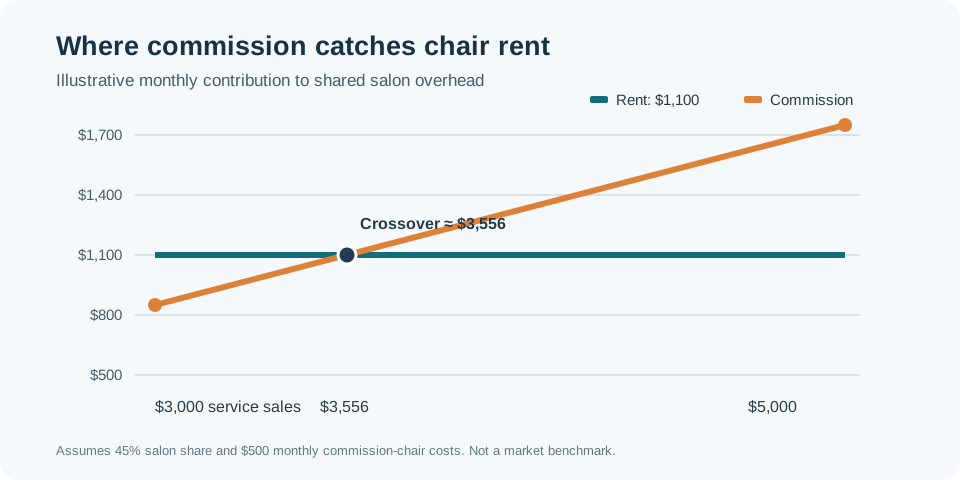
The commission chair reaches the rental contribution when its share of service sales minus the $500 chair-specific costs equals $1,100: 0.45 × sales − $500 = $1,100. Divide $1,600 by 0.45 for a crossover of $3,555.56 monthly service sales. At $3,000 of services, commission contribution is $850 and rent is ahead by $250. At $5,000, commission contribution is $1,750 and commission is ahead by $650. If the $500 includes costs that change with sales, replace the simple equation with a variable-cost rate before trusting the crossover.
Worker status, payroll obligations, control of schedules and state licensing do not follow from the label “booth rent.” The IRS explanation of independent contractors emphasizes the actual relationship. Ask qualified local advisers to review the arrangement before acting on this financial comparison; the figures here do not classify any worker or recommend a legal structure.
What changes the result?
Occupancy: four stations with three renters produce only three rent checks while the lease covers all four. Service demand: commission income rises with completed client services but often falls with quiet weeks and cancellations. What the salon supplies: products, booking, reception, towels, utilities and marketing may differ under the two written arrangements. Collection risk: an invoiced rental fee is not cash until received. Owner workload: recruiting, coaching and scheduling require time; include that work in the relevant model.
Put fixed salon rent, base utilities, insurance, software and owner management pay in a shared monthly budget. Keep the incremental station expenses in the per-chair comparison. If a receptionist is required only under the commission model, either charge the extra shift to commission chairs or run a separate whole-salon scenario. Apply the same cost boundary to both models.
Three operating scenarios for four chairs
Assume the salon has four usable chairs and $4,000 monthly shared overhead including a defined owner management-pay target. Figures below are fictional operating cases, not common salon benchmarks.
| Illustrative use of four chairs | Monthly chair contribution | Less shared overhead | Operating result |
|---|---|---|---|
| Four occupied rental chairs at $1,100 each | $4,400 | $4,000 | +$400 |
| Three occupied rental chairs at $1,100 each | $3,300 | $4,000 | −$700 |
| Four commission chairs at $1,300 each | $5,200 | $4,000 | +$1,200 |
At the assumed $1,100 contribution, $4,000 ÷ $1,100 = 3.64; you need four occupied rental chairs to cover the full monthly shared cost. At the assumed $1,300 contribution, $4,000 ÷ $1,300 = 3.08; you also need four equally productive commission chairs. Three commission chairs generate $3,900 and leave a $100 gap. The model's attractive per-chair contribution means little if you cannot fill the stations or sell enough services.
A mixed salon can be modeled chair by chair: two rental chairs contribute $2,200 and two commission chairs at $1,300 each contribute $2,600. Total contribution is $4,800; after $4,000 shared overhead, the example leaves $800. Do not double-count the same chair as rental and commission income unless your actual contract supports both charges.
How to run your own numbers
For the commission case, enter collected service sales, the salon's actual stylist pay and other per-service costs, monthly overhead, owner pay and realistic booked capacity into the salon break-even calculator. For rental, first calculate monthly net rental contribution separately, then compare that total with the salon's fixed bills: the service-sales model should not be mistaken for a booth-rent calculator. The tool supports other currencies if USD is not yours.
For the service-side cost inputs, see how salon services are priced. For the shared bills, use the salon break-even guide; the clients-per-day guide deals with service demand rather than chair-rental income.
Common mistakes when comparing the models
- Counting renters' service sales as salon revenue: rent received and commission-service receipts have different owners and cost bases.
- Using a full-chair assumption: empty stations still cost rent and utilities.
- Assuming a flat cost for growing services: color and card fees may rise with commission sales; use a rate when appropriate.
- Leaving receptionist or manager time out: extra scheduling work changes the effective contribution.
- Conflating labels with worker classification: the written contract and actual work relationship require professional local review.
- Quoting the crossover as a universal number: it depends entirely on your rent, split, service mix and costs.
Takeaways
- Compare the owner's net contribution per occupied chair on both models.
- Check the crossover at slow, base and busy service-sales levels.
- Cover the full salon's fixed bills with realistically occupied stations.
- Have the actual employment and rental arrangement reviewed locally.
FAQs
Is booth rent or commission more profitable for a salon owner?
Neither wins for every salon. On the example's assumptions, commission contributes more when that chair sells more than about $3,555.56 per month; below that, the rental chair contributes more. Check occupancy and the full salon's fixed expenses too.
How do I find the salon owner's crossover point?
Set net rent per occupied chair equal to the salon's retained service sales less incremental chair costs. If incremental costs rise with sales, subtract their percentage before dividing by the remaining share.
Do booth renters' client payments count as salon revenue?
Do not assume so. For an independent rental arrangement, start with the amounts the salon actually receives under the agreement and ask your accountant how to record them. The salon's own retail sales, if any, are separate.
What happens if a salon chair is empty?
That chair brings in no rent or commission contribution while part of the salon's lease and insurance remains. Use an occupied-chair forecast and calculate the minimum occupied stations needed to pay fixed bills.
Can a salon offer a mix of rentals and commission chairs?
Financially you can model each occupied chair separately and sum its net contribution. Whether a proposed mixed operation complies with local licensing, employment and contract rules requires qualified local review.
Does the salon calculator directly model booth rent?
Its main model is service sales and operating break-even. Work out rent contribution separately and compare it with shared fixed costs; use the calculator to stress-test commission service volume and capacity.
Explore the MyBreakeven guide library for related business planning guides.