
Start a Home-Based Business: Workspace, Costs and Capacity
Published by MyBreakeven. Editorial standards and corrections. Report a calculation or content issue to support@mybreakeven.com.
Plan a home-based business with separate workspace, incremental costs, operating limits, capacity and a location-specific verification record.
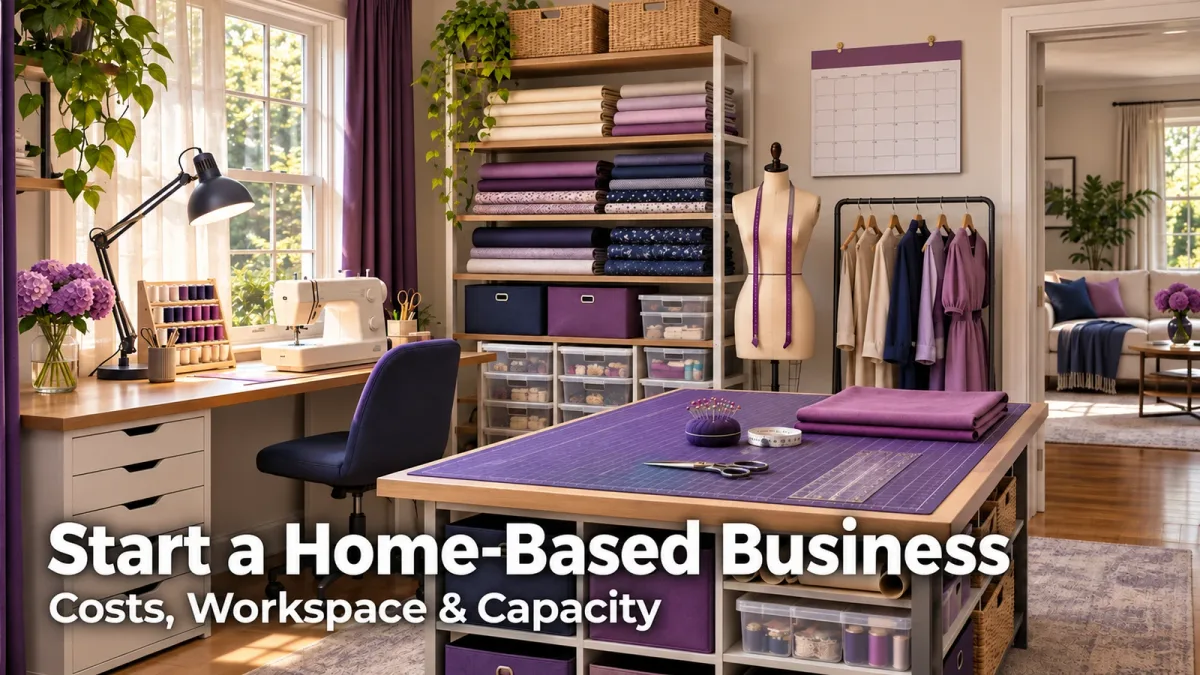
A home-based business needs a workable location, a clear boundary between household and business activity, and enough delivery capacity to cover its commitments. Check the actual property and local requirements before assuming that working from home removes premises costs or restrictions.
All amounts and operating results below are original fictional teaching examples in USD. They are not customer results, industry averages or forecasts. Use your own dated records and applicable accounting policies.
Verify the proposed activity at the actual address
List customer visits, employees, storage, deliveries, noise, equipment and signage before asking the relevant authority what is permitted. Arizona Commerce’s location checklist illustrates why residential zoning and property restrictions matter even for an online business. It is an Arizona reference, not permission for another city or state. Obtain current information for your actual location.
Keep a dated verification record: office contacted, activity described, response, reference number and unresolved conditions. Review lease or property restrictions and relevant insurance coverage. A quiet desk-based activity and a home food-production operation need different checks. Do not substitute a generic startup checklist for activity-specific requirements.
Design the work boundary and safe capacity
Specify a dedicated work area, storage maximum, customer handoff method and working hours. Separate business records and customer data from shared household access. Identify equipment, internet or power dependencies and the practical fallback if a failure prevents a promised delivery. Avoid counting every hour at home as productive capacity.
In this case, the owner has 56 hours available monthly, reserves 16 for administration and selling, and can deliver in the remaining 40. At two hours per completed job, that permits 20 jobs. Family commitments, interruptions and rework could lower that ceiling. Test actual completion times before accepting the maximum schedule.
Separate incremental cash from household allocations
| Item | Amount / quantity | Scope |
|---|---|---|
| One-time equipment | $900 | Cash before launch |
| Workspace adaptation | $300 | Cash before launch |
| Monthly incremental commitments | $350 | Software, utilities and cover in this case |
| Net price per job | $120 | Accepted service output |
| Relevant cash cost per job | $25 | Included job inputs |
| Contribution per job | $95 | Before owner income and fixed costs |
| Practical job capacity | 20 | 40 available delivery hours / 2 hours |
| Selected owner-income goal | $1,500 / month | Separate planning requirement |
Startup cash here is $900 + $300 = $1,200. It is separate from the monthly $350 commitments. A fair-use share of existing household rent may help an internal full-cost view, but it is not necessarily an additional cash payment caused by starting. Document whether each amount is new cash, an allocation or an owner-time allowance. The treatment for a tax return is a separate question for the applicable rules and adviser.
At $95 contribution, covering $350 monthly commitments takes four whole jobs because $350 / $95 is about 3.68. Adding the separate $1,500 owner-income planning goal needs twenty jobs because $1,850 / $95 is about 19.47. That uses the entire delivery capacity. It leaves little room for rework and does not fund additional owner benefits or tax.
Test a slower job before relying on the plan
At 2.5 hours per job, forty delivery hours permit sixteen jobs. Sixteen × $95 − $350 = $1,170 toward the stated owner goal, leaving a $330 gap against $1,500. The business can cover its narrow overhead while failing the owner-income target. Do not label “above operating break-even” as “enough to support the owner.”
If all twenty jobs sell at the planned scope, $2,400 sales less $500 job cash costs and $350 commitments leaves $1,550 before the separate exclusions. Recovery of the $1,200 startup spending requires additional analysis over time; do not deduct it twice as both a one-time launch payment and monthly fixed cash.
Set a review routine before accepting more work
Reconcile accepted jobs, hours, refunds, stock if any and cleared cash weekly. Limit bookings by productive hours and property constraints, not website demand alone. Record when you will revisit price, scope, equipment or location. Expansion can create a new permit, insurance or capacity question rather than being a simple multiplication of sales.
Use the general startup roadmap for wider launch decisions and the online delivery test for digital channels. The startup cost calculator records launch cash; the risk assessment records operational dependencies.
Download the editable worksheet
Download the printable HTML worksheet. It contains the completed case and a separate blank working record. It does not calculate automatically. Edit in your browser, then print or save a completed copy before closing; your edits are not sent to MyBreakeven.
Sources and scope
Primary references below support the stated definitions or framework. The worked case, numbers and decision records are original MyBreakeven material. Reviewed November 6, 2026; no external professional sign-off is claimed.
Frequently asked questions
Does a home business avoid zoning checks?
No. Check the actual activity and location, along with applicable property restrictions.
Is household rent an incremental business cash cost?
Only the actual additional payment belongs in that view. An internal allocation and tax treatment answer separate questions.
Does covering monthly overhead mean the owner earns enough?
No. Test the separate owner-income requirement and realistic capacity.
Can I use all time at home as delivery hours?
No. Allow for selling, administration, breaks, household constraints and rework.
Browse the MyBreakeven blog hub for related planning guides.
Planning estimates only—not accounting, tax, legal or lending advice.