
What this calculator includes
- Instant results as you change inputs, with plain-language explanations.
- A checked example, transparent formula and step-by-step input guide.
- Searchable global currency labels, including USD, GBP, EUR, CAD and AUD; no exchange-rate conversion.
- No signup required; calculation inputs remain in this browser tab.
- Break-even and target ROAS from your actual order cost mix.
- Maximum ad cost per order and contribution after advertising.
How to calculate break-even ROAS after fees
Use one campaign or a comparable group of orders over a consistent period. If you mix a low-margin product with a high-margin product, the average must represent the orders your advertising actually sells.
- Enter net average order value after discounts and refunds.
- Enter direct cost before advertising: products, fulfillment, shipping subsidies and flat fees.
- Enter the percentage selling fee separately. Do not count it again in direct cost.
- Add ad spend and ad-attributed net revenue for the same reporting window.
- Choose a target margin after ads and compare the actual return with both thresholds.
Break-even ROAS and maximum CPA formulas
Contribution per order = order value × (1 − fee rate) − direct cost. Contribution margin = contribution ÷ order value. Break-even ROAS = 1 ÷ contribution margin.
Actual ROAS = attributed revenue ÷ ad spend. Contribution after ads = attributed revenue × contribution margin − ad spend. Maximum CPA before fixed overhead equals contribution per order.
Target ROAS = 1 ÷ (contribution margin − target margin). Use decimals in this formula. If the target margin is at least the pre-ad contribution margin, there is no finite ROAS that reaches that target with positive ad spend.
Does a 4× ROAS mean your ads are profitable?
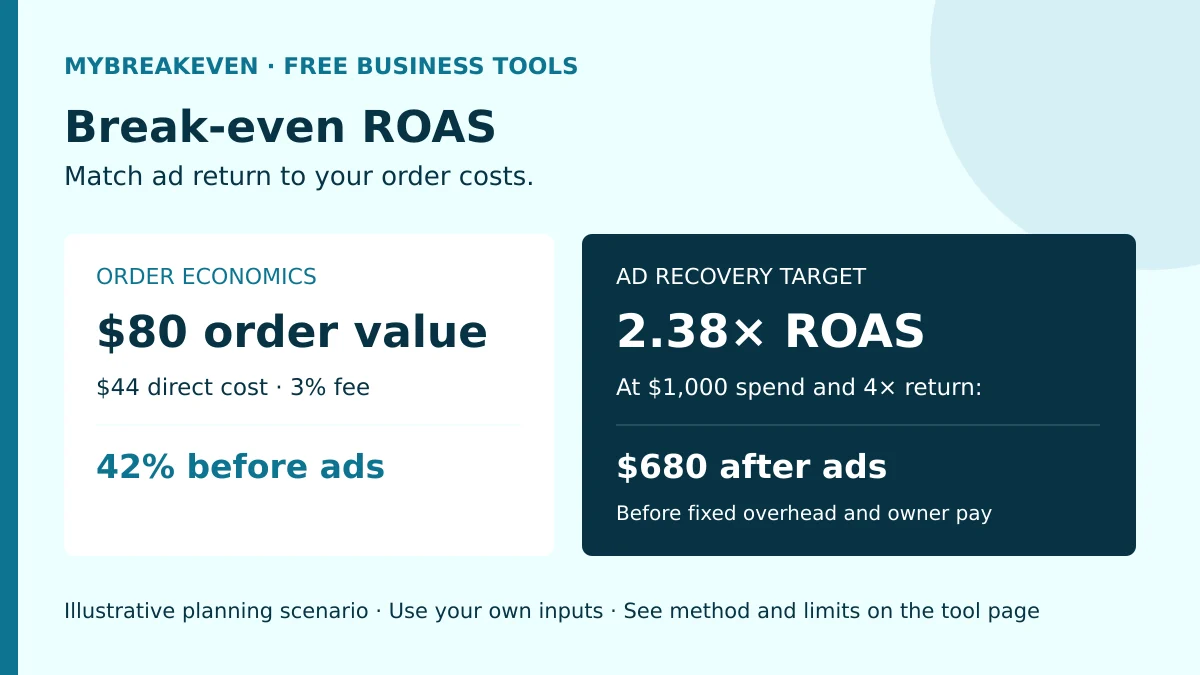
These examples are fictional planning assumptions, not advertising benchmarks. At $80 order value, $44 direct cost and 3% fees, contribution is $80 − $2.40 − $44 = $33.60. Margin before ads is 42%; break-even ROAS is 1 ÷ 0.42 = 2.380952…×.
With $1,000 spend and $4,000 attributed net revenue, actual ROAS is 4×. Estimated contribution after ads is $4,000 × 0.42 − $1,000 = $680. A target of 10% revenue left after ads requires 1 ÷ (0.42 − 0.10) = 3.125×.
If direct cost rises to $60, contribution falls to $17.60, or 22%. Break-even ROAS rises to 4.54545…×. The same 4× return now leaves $4,000 × 0.22 − $1,000 = −$120. A fixed ROAS benchmark misses this cost change.
Read campaign contribution before increasing spend
A positive result covers the modeled direct costs, fees and ads. It still has to fund rent, salaries, software and owner pay. Use the ecommerce break-even calculator to add those monthly commitments.
Maximum CPA is a per-order ceiling before overhead, not a recommended bid. Actual platform attribution can include sales that would have happened without the ads. Compare the model with refund-adjusted records and your own testing.
Common ROAS calculation mistakes
- Using gross revenue before returns alongside net costs.
- Counting ads in direct order cost and again as ad spend.
- Comparing different attribution windows or currencies.
- Calling the contribution after ads net profit.
- Using one average margin when ads change the product mix.
Assumptions and limits
The model uses a stable average order value and direct cost mix. Percentage fees are unchanged. Revenue and spend must use the same attribution window. It excludes fixed overhead, owner pay, taxes and unentered retention costs. Refunds must already be reflected in net revenue and your cost allowance. Attribution does not prove incremental sales.
Frequently asked questions
What is a good break-even ROAS?
There is no universal number. Your direct costs and fees determine the contribution margin. A 42% margin before ads needs about 2.38×; a 22% margin needs about 4.55×, both before overhead.
Is ROAS the same as ROI?
No. ROAS compares attributed revenue with ad spend. This tool also shows contribution after direct costs and ads, but does not calculate whole-business ROI.
Can I use this for Meta or Google Ads?
Yes, if you supply consistent net revenue and spend from the same reporting window. The tool does not connect to either platform or verify attribution.
Why is target ROAS not attainable?
Your requested post-ad margin leaves no positive allowance for ads. Lower the target or improve the order contribution before comparing returns.
Does maximum CPA include overhead?
No. It is the contribution available per order before advertising and fixed overhead. Set a lower operational ceiling if you need those orders to fund monthly commitments.
Method references
Check the full monthly business target
Check whether your contribution can fund overhead, owner pay and your profit target, then compare the required sales with your available working capacity.
Build my full break-even plan →Explore Pro plan comparisonsPublished by MyBreakeven. Method and examples checked . Business calculation methodology · Report a calculation issue.