
Cost Performance Index: Earned Value, Actual Cost and Forecast Limits
Published by MyBreakeven. Editorial standards and corrections. Report a calculation or content issue to support@mybreakeven.com.
Calculate CPI from earned value and actual cost. Check weighted totals, separate project cost performance from margin and compare remaining-work forecasts.
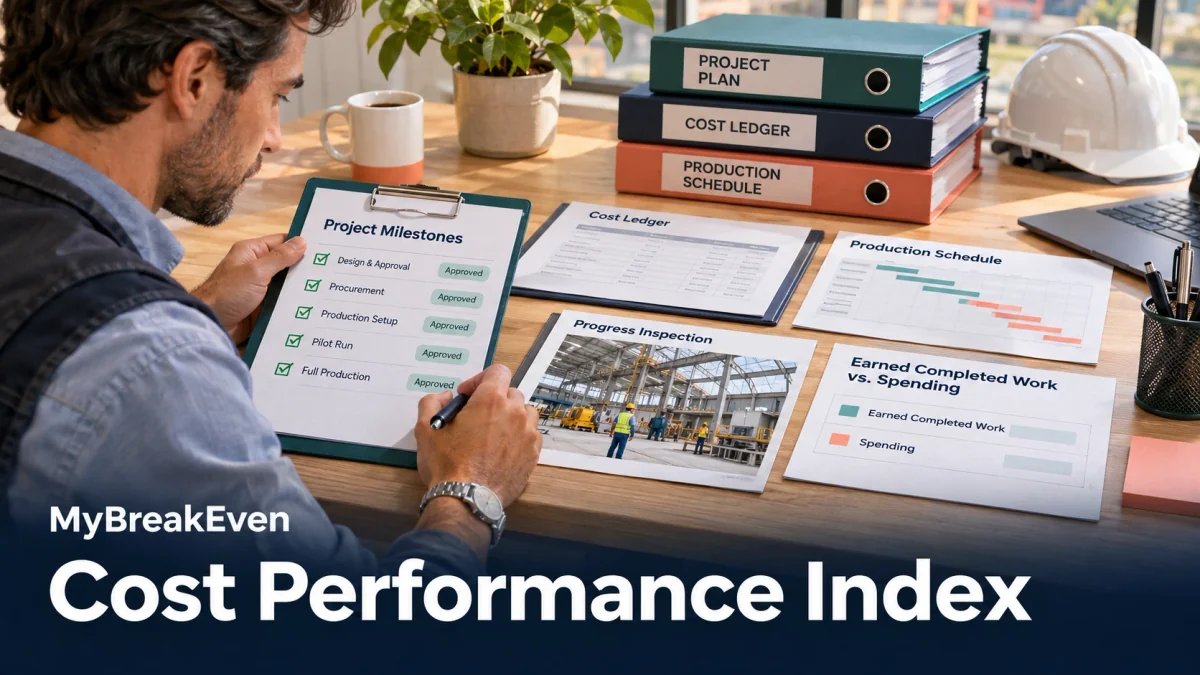
Cost Performance Index, or CPI, equals earned value divided by actual cost for the same project scope and status date. It measures the budgeted value of completed work per dollar of actual cost; it does not measure sales revenue or profit margin.
Every amount in the worked case is an original fictional USD planning assumption. It is not an industry benchmark, a customer result or a prediction.
Define planned value, earned value and actual cost
Planned value is the approved budget for work scheduled by the status date. Earned value is the approved budget for work actually completed by that date, using a defensible completion method. Actual cost records what that completed work has cost on a consistent accounting basis. Match scope, cut-off and currency before dividing.
CPI = EV ÷ AC. Below 1 means the measured work has consumed more actual cost than its budgeted value; above 1 means the opposite. A zero actual-cost denominator needs investigation, not a fabricated finite index. Missing supplier accruals can make CPI look artificially favorable.
Calculate cost and schedule performance separately
| Measure | Amount / result | Meaning |
|---|---|---|
| Budget at completion (BAC) | $100,000 | Approved project budget |
| Planned value (PV) | $60,000 | Budgeted work scheduled so far |
| Earned value (EV) | $50,000 | Budgeted completed work |
| Actual cost (AC) | $62,500 | Cost recognized to the status date |
| CPI | 0.80 | $50,000 ÷ $62,500 |
| Cost variance | −$12,500 | EV − AC |
| Schedule performance index | 0.8333 | EV ÷ PV |
The project has earned $0.80 of budgeted work for each actual dollar. CPI does not mean a 20% profit loss, and the schedule index does not directly convert into days late. In this example, cost performance and scheduled completion both require investigation, but they describe different dimensions.
Choose an estimate-at-completion assumption explicitly
If all remaining work can be delivered at its original remaining budget, EAC is AC + (BAC − EV): $62,500 + $50,000 = $112,500. If the same cost efficiency is assumed to continue across the total project, EAC is BAC ÷ CPI: $100,000 ÷ 0.80 = $125,000. The $12,500 gap is an assumption difference, not an arithmetic error.
A bottom-up remaining estimate of $58,000 would instead produce EAC of $120,500. Document supplier commitments, remaining quantities, rework and resource rates behind that estimate. Do not select the most reassuring formula without checking what is causing the variance. EAC is a forecast, not a confirmed final invoice.
Aggregate dollars before calculating portfolio CPI
Suppose work package A has EV $30,000 and AC $25,000, so CPI is 1.2. Package B has EV $20,000 and AC $37,500, so CPI is approximately 0.5333. The simple average of the two indices is 0.8667, but project CPI is ($30,000 + $20,000) ÷ ($25,000 + $37,500) = 0.80. Weighting follows the underlying totals.
Verify completion evidence rather than treating dollars spent as percentage complete. An expensive early purchase can increase actual cost while little eligible work is earned; a milestone-based rule can delay earned value. State those rules and apply them consistently.
Turn the ratio into a corrective project decision
- Confirm baseline, completion evidence and status-date cut-off.
- Investigate quantity, rate, productivity, scope and rework causes.
- Re-estimate the remaining work from supported inputs.
- Choose and fund the response; log approved scope changes.
- Review the next status date without erasing the original baseline history.
Use job-order costing for recorded job cost and budget variance analysis for driver-specific performance. CPI is a project earned-value measure, separate from a business operating margin.
Use the worksheet with your own records
Download the printable, editable HTML worksheet. It contains the completed example and a blank table. Open it in a browser, edit the blank fields, calculate the outputs using the stated method and print to PDF or paper. It does not automatically calculate results or replace your accounting records.
Method references and source notes
The method references below support the definitions. The examples, assumptions and decision checks on this page are independently constructed.
Frequently asked questions
Can CPI be used as a profit margin?
No. Earned value is budgeted completed work, not customer revenue. A CPI of 0.8 is not an 80% margin.
Does EAC equal BAC divided by CPI in every situation?
No. That formula assumes the measured cost efficiency continues. A remaining-at-budget or bottom-up estimate uses different assumptions.
Can I average work-package CPI values?
Calculate total earned value divided by total actual cost. A simple average of ratios can misstate the project because packages have different cost weights.
What happens when actual cost is zero?
The division is undefined. Investigate missing costs, timing or completion rules rather than presenting a finite CPI value.
Browse the MyBreakeven blog hub for related planning guides.
Planning estimates only—not accounting, tax, legal or lending advice.