Landscaping Seasonal Break-Even: Pay for the Slow Months
Published by MyBreakeven. Report a calculation or content issue to support@mybreakeven.com.
· Updated September 28, 2026
Calculate the active-season jobs needed to cover a full year of landscaping overhead, then size the cash reserve for slow winter months.
Landscaping · Seasonality · Break-Even

Calculator features
- Visible assumptions and checked arithmetic
- A practical capacity or risk check
- A clear method to use your own records
A landscaping company can cover its bills during the mowing season and still lose money across the year. If fixed costs continue through winter, the active months must earn enough contribution to pay for both active operations and the slow months. Calculate the annual target first, then check when the cash actually arrives and leaves the account.
Quick answer: Add fixed costs for all 12 months, subtract contribution you can reliably earn in the slow season, and divide the remainder by contribution per active-season job. If fixed bills are $5,000 monthly, there is no winter work and a $100 job costs $40 to deliver, eight active months need 1,000 paid jobs total: 125 jobs per active month. Cash timing needs a separate reserve.
Make the active months carry the full year
For a fictional owner in a climate with eight strong service months and four slow months, assume fixed monthly costs of $5,000 year-round. That includes base vehicle and equipment payments, insurance, storage, software and a specified owner management-pay target. It excludes costs that occur only when crews perform a job. Twelve months of fixed cost are $60,000. Your own season may have a very different length, and not every landscaping business slows in winter.
Now assume an average completed job sells for $100 and costs $40 in direct labor, fuel, disposal and job-specific supplies. Contribution is $60 per job. With zero contribution from winter services, annual break-even jobs are $60,000 ÷ $60 = 1,000 jobs. Spread across eight active months, that is 125 completed and collected jobs a month. A target of 100 jobs a month would create only 8 × 100 × $60 = $48,000 annual contribution and leave a $12,000 annual shortfall, even though each active month covers its own $5,000 fixed bill and shows $1,000 left over.
“Break even in June” is therefore different from “break even for the year.” Use your actual cost schedule. If a seasonal crew is laid off during the slow period, some payroll changes with activity; if you retain supervisors, their guaranteed pay remains due. Finance principal and tax remittances affect cash but should not be silently mixed into operating contribution. The SBA break-even method separates fixed costs from variable costs when calculating required sales volume.
What changes the seasonal target?
Regional climate: the number of workable weeks determines how many jobs must fit into a shorter period. Contract terms: monthly payments across 12 months may smooth cash even when work is concentrated in eight; check the actual service obligation. Winter services: snow, cleanup or other work may contribute, but do not rely on contracts you have not secured. Route density: travel between dispersed jobs eats crew hours and contribution. Fixed obligations: changing rent, insurance, retained payroll or vehicle finance changes the amount due when work stops.
Use contribution from each service type rather than counting every landscape job as the same. A mowing visit, leaf cleanup and installation can have different prices, labor, materials and weather exposure. If the mix shifts during the year, calculate contribution for each activity and add the totals. Capacity matters: 125 active-month jobs over 20 service days require an average of 6.25 jobs a day. If each job and its share of travel require 90 minutes, that is 9.375 crew-hours daily; one person cannot deliver that in an eight-hour workday.
Three annual operating scenarios
Keep eight active months, four slow months, $5,000 monthly fixed costs and $60 active-job contribution. Winter contribution, if any, is after winter service variable costs. Every figure is illustrative rather than a regional benchmark.
| Scenario | Active jobs each month | Active contribution in year | Slow-month contribution | Less annual fixed costs | Annual result |
|---|---|---|---|---|---|
| Busy-month comfort trap | 100 | $48,000 | $0 | $60,000 | −$12,000 |
| Year-round break-even | 125 | $60,000 | $0 | $60,000 | $0 |
| Same jobs plus contracted slow-season work | 125 | $60,000 | $8,000 | $60,000 | +$8,000 |
In the third row, $8,000 of winter contribution means $2,000 each of four slow months after the direct cost of that work. That improves the annual result but does not eliminate the monthly gap: $5,000 fixed costs less $2,000 winter contribution still require $3,000 of cash support per slow month. If the winter work is unreliable, model it as a separate upside case, not money already in the bank.
Budget the winter cash separately
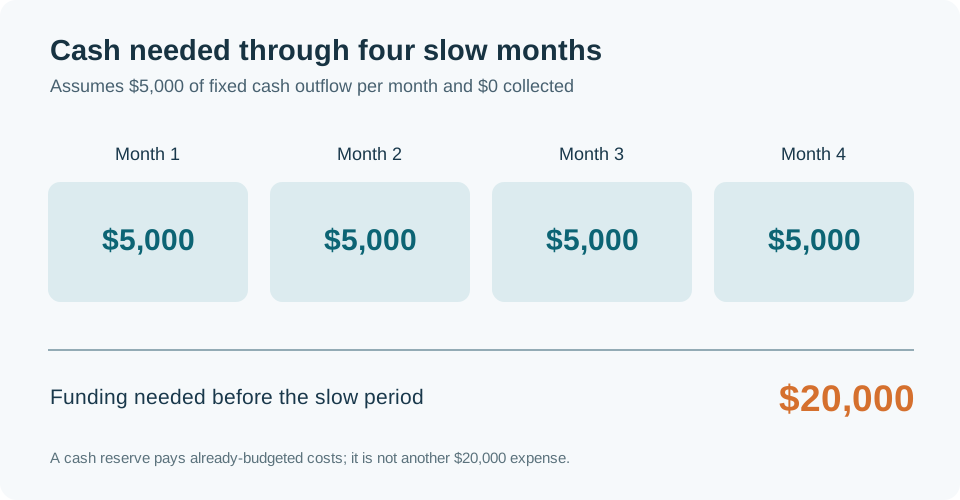
At $5,000 a month of actual fixed cash payments and no cash collected in four slow months, the simple winter funding need is $20,000. That is a timing requirement, not an additional operating expense on top of the $60,000 annual fixed-cost total. Save it from collected peak-season cash or arrange another reliable funding source; do not subtract it twice from annual profit. If some monthly $5,000 items are noncash accounting allocations, remove them from the cash schedule, and add principal, tax and equipment payments that actually become due.
A plan that just breaks even over the year can still run out of money if the busy-season surplus has been spent before winter. A simple monthly cash table should show opening bank balance, collected sales, supplier payments, payroll, fixed bills, debt principal, taxes and closing balance. The National Association of Landscape Professionals' slow-season cash-flow guidance likewise emphasizes planning the cash needed through the off-season. Confirm seasonality for your region rather than copying someone else's winter calendar.
How to run your own numbers
Run an active month with realistic average job price, variable job cost, fixed monthly obligations, owner pay and crew availability in the landscaping break-even calculator. Then extend its monthly contribution to your actual number of workable months and subtract the full year's fixed costs and separately estimated slow-season contribution. Maintain a month-by-month cash schedule beside it. Other currencies are supported if USD is not yours.
For fuller annual cost context, read the landscaping break-even guide. To validate whether a daily target physically fits the route, see the landscaping route-density guide. The lawns needed for a $100,000 goal answers an income-target question; here the task is to fund the months with fewer jobs.
Common seasonal planning mistakes
- Using one profitable summer month as annual proof: the other months still have costs.
- Counting unsigned winter work: forecast secured and speculative revenue separately.
- Double counting a winter reserve: it funds costs already included in the annual budget.
- Using booked instead of completed jobs: weather delays and cancellations can reduce realized contribution.
- Ignoring crew hours: daily jobs required by the model may exceed safe available capacity.
- Assuming profit equals bank cash: invoices, tax payments and loan principal have different timing.
Takeaways
- Use 12 months of fixed costs even if sales occur in fewer months.
- Divide the remaining annual target by contribution from completed jobs.
- Test the resulting daily volume against crew hours and weather.
- Keep an independent monthly cash forecast for the slow period.
FAQs
How do I calculate landscaping break-even with a winter slowdown?
Add annual fixed costs, subtract dependable slow-season contribution and divide by contribution per completed active-season job. Then divide the job count by the number of months you can actually serve customers.
Can a landscaping business profit in summer and lose money for the year?
Yes. In the worked example, 100 monthly jobs create $1,000 above fixed bills in each active month, but eight such months still leave a $12,000 shortfall against the full year's fixed costs.
How much cash should I keep for winter?
Forecast each slow month's actual cash receipts and payments, then fund the largest cumulative shortfall with an allowance for timing uncertainty. Four months at $5,000 fixed cash cost with no income need $20,000 in the simple illustration, before other cash obligations.
Is a winter reserve an extra expense in break-even math?
No. A reserve is cash set aside to pay costs already budgeted for the winter. Treating both the winter costs and the reserve as expenses would count the same obligation twice.
Do annual service contracts remove seasonality?
They may smooth invoicing and collections, but the work and costs can still cluster in particular months. Follow the agreement's payment and service schedule in a cash forecast.
What if I offer snow or cleanup services in winter?
Estimate their contribution after direct labor, fuel and materials, and subtract only dependable contribution from the annual target. Check contract terms and weather uncertainty with separate scenarios.
Explore the MyBreakeven guide library for related business planning guides.