
What this calculator includes
- Instant results as you change inputs, with plain-language explanations.
- A checked example, transparent formula and step-by-step input guide.
- Searchable global currency labels, including USD, GBP, EUR, CAD and AUD; no exchange-rate conversion.
- No signup required; calculation inputs remain in this browser tab.
- Protected reserve, net burn and full-month runway in one view.
- A month-by-month constant-flow cash table and horizon funding gap.
How to calculate small-business cash runway with a reserve
Use accessible cash today and expected receipts and payments, rather than accounting profit. An invoice sent today may not turn into spendable cash for several weeks.
- Enter cash you can access now. Do not add uncollected invoices.
- Choose how much of that cash should remain as a reserve.
- Enter monthly cash you expect to receive and pay. Include taxes, debt payments and owner withdrawals if applicable; do not double-count them.
- Choose a planning horizon from 1 to 36 whole months.
- Read time to reserve alongside the projected monthly balances. Reconcile seasonal or one-off payments in a dated forecast.
Cash runway formula using net burn
Usable cash = current cash − protected reserve. Monthly net cash burn = monthly payments − monthly receipts. Runway to reserve = usable cash ÷ positive monthly burn.
Ending cash at month N = current cash − net burn × N. Extra cash needed to protect reserve = the greater of zero and (net burn × N − usable cash).
When receipts equal or exceed payments and cash is above reserve, the constant-flow model has no depletion horizon. If current cash already equals reserve, the tool reports zero room above reserve today even if future receipts would build cash.
Cash runway example for a six-month planning horizon
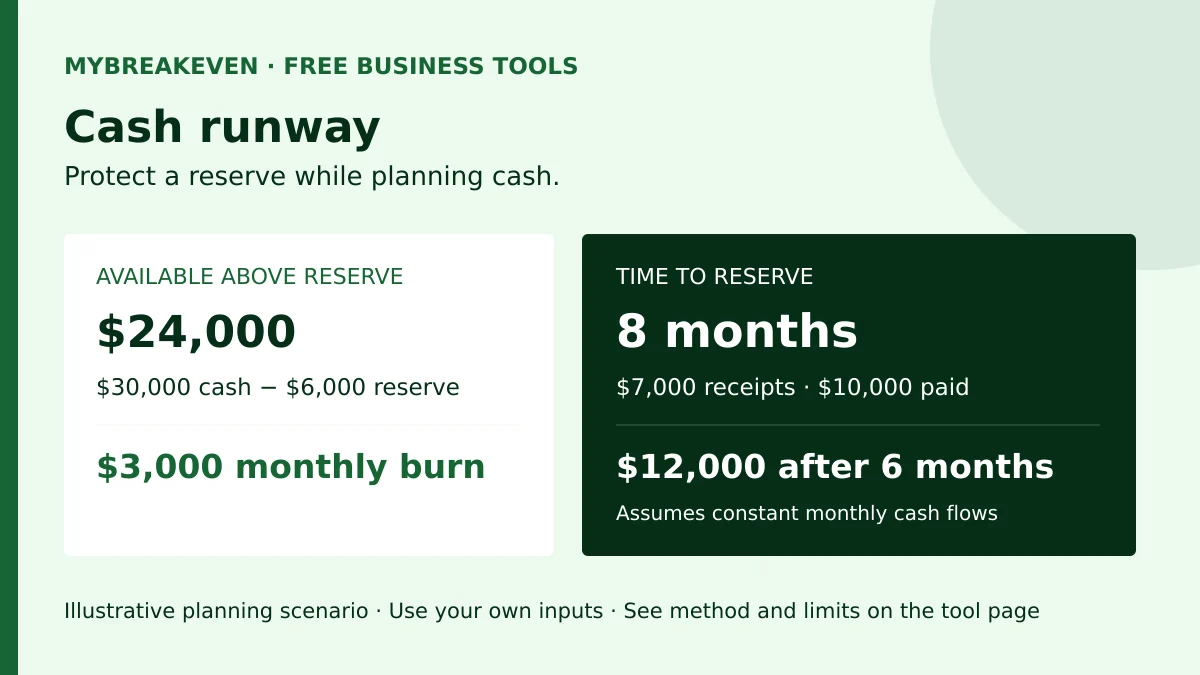
These are illustrative cash assumptions. Start with $30,000 accessible cash and protect $6,000. Usable cash is $24,000. With $10,000 monthly payments and $7,000 receipts, monthly net burn is $3,000.
Runway to the reserve is $24,000 ÷ $3,000 = 8 months. Six-month ending cash is $30,000 − 6 × $3,000 = $12,000, so no additional cash is needed to keep the $6,000 reserve over that horizon.
If receipts fall to $5,000 while payments remain $10,000, burn rises to $5,000. Runway becomes 4.8 months, or four full months above reserve. After six months, projected cash is zero; the reserve funding gap is $6,000. Negative later balances show a cash need, not money the business can actually spend.
Read cash runway without confusing it with profit
A profitable business can still have a cash gap when customers pay late, inventory is purchased early or loans are repaid. Count money when you expect it to move. The result is a simple planning screen, not a forecast based on your transaction dates.
A no-depletion result means only that the entered recurring receipts cover payments. Recheck when contracts end, tax payments arrive or large purchases are planned. The reserve is your assumption; the tool does not prescribe a universal safe buffer.
Common cash runway mistakes
- Counting unpaid invoices as cash available today.
- Using revenue earned instead of cash received.
- Leaving owner withdrawals or debt payments outside monthly payments.
- Assuming a positive monthly ending balance means every earlier bill can be paid.
- Ignoring one-off purchases, seasonality or funding that has not been secured.
Assumptions and limits
Receipts and payments stay constant and are evenly spread for the fractional-month runway estimate. The model excludes unentered one-off purchases, new financing and seasonal changes. It reports time to your reserve, not a legal insolvency date. A monthly ending balance can miss an earlier payment shortfall within that month. Use a dated cash-flow forecast for actual payment scheduling.
Frequently asked questions
What is the difference between cash runway and profit?
Runway measures available cash against cash moving in and out. Profit uses accounting revenue and costs. Timing differences mean a profitable business can still run out of spendable cash.
Why protect a reserve?
The reserve defines cash you do not want the plan to consume. Choose it for your own needs; there is no universal reserve amount built into this calculator.
What if monthly cash burn is zero or negative?
When cash is above reserve, the model shows no depletion at the entered pace. Receipts cover payments. This does not account for unentered seasonal or one-off expenses.
Does 4.8 months mean I can pay every bill for that long?
No. Fractional runway assumes the net flow is evenly spread. Actual payment dates may create a shortfall earlier. Use a dated cash-flow forecast for payment decisions.
Can the projection show negative cash?
Yes. A negative ending balance represents an unfunded cash requirement. The tool does not assume overdraft or borrowing is available.
Method references
Check the full monthly business target
Check whether your contribution can fund overhead, owner pay and your profit target, then compare the required sales with your available working capacity.
Build my full break-even plan →Explore Pro plan comparisonsPublished by MyBreakeven. Method and examples checked . Business calculation methodology · Report a calculation issue.