
What this calculator includes
- Instant results as you change inputs, with plain-language explanations.
- A checked example, transparent formula and step-by-step input guide.
- Searchable global currency labels, including USD, GBP, EUR, CAD and AUD; no exchange-rate conversion.
- No signup required; calculation inputs remain in this browser tab.
- Billable-time and working-week adjustments for realistic annual capacity.
- A rate rounded upward to the next cent, with monthly and annual checks.
How to calculate a freelance hourly rate
Start with the income your business needs to fund before personal income tax. Add costs the business must pay regardless of which client buys your time.
- Enter your monthly owner income goal and overhead.
- Add a separate profit buffer if you want retained business profit.
- Enter total weekly work hours and the weeks you plan to work each year.
- Estimate billable share after admin, prospecting, meetings and revisions you cannot invoice.
- Add payment or platform fees. Check the resulting rate against the hours you can realistically sell.
Hourly rate formula with non-billable time and fees
Annual billable hours = weekly working hours × working weeks × billable percentage. Annual funding need = (monthly owner income + monthly overhead + monthly profit target) × 12.
Required rate = annual funding need ÷ annual billable hours ÷ (1 − percentage fee). Round upward to the next currency cent so the displayed rate does not underfund the target.
Average monthly billable hours are annual billable hours ÷ 12. This average smooths time off across the year; it does not assume every month has the same invoicing pattern.
Freelance hourly rate example with 60% billable time
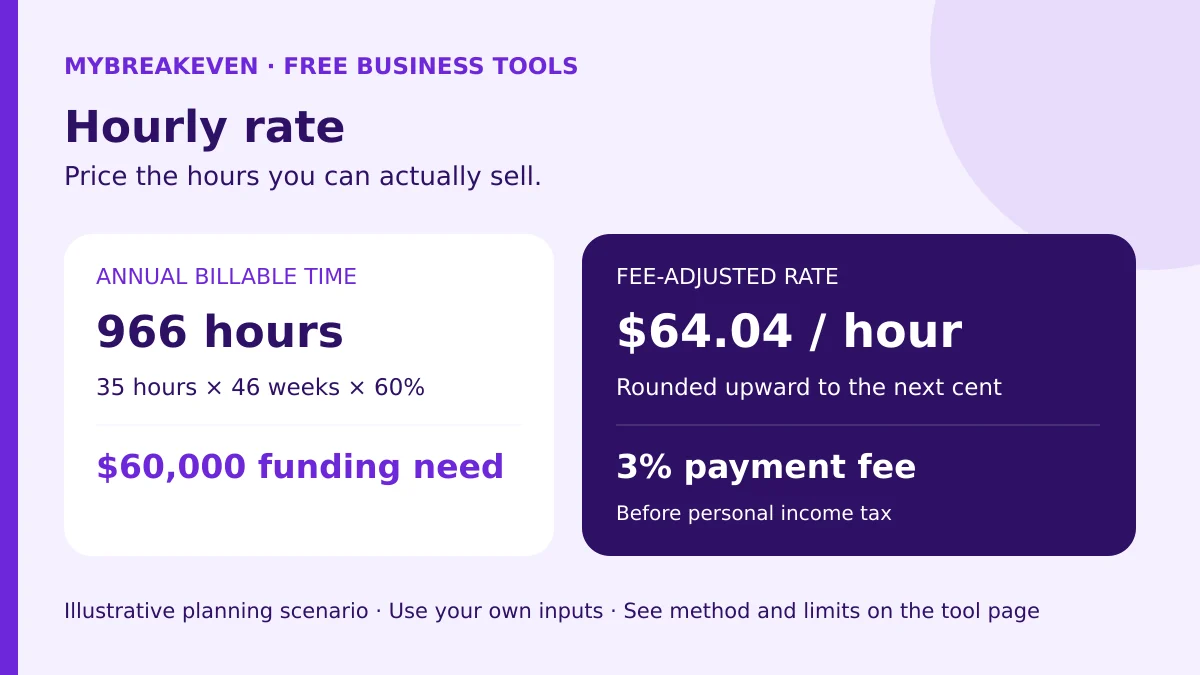
Illustrative example: owner income $4,000, overhead $600 and profit buffer $400 total $5,000 per month, or $60,000 a year. Weekly hours 35 × 46 working weeks × 60% billable time = 966 billable hours.
The fee-adjusted rate is $60,000 ÷ 966 ÷ 0.97 = $64.0333… per hour. Rounded upward, charge at least $64.04 under these assumptions. Annual billed revenue is $64.04 × 966 = $61,862.64. After a 3% fee, $60,006.7608 remains to fund the annual need.
If billable share falls to 40%, annual billable hours fall to 644. The same funding need requires $96.05 per billed hour. This is a capacity issue: more total working hours do not help if the additional hours cannot be invoiced.
Understand minimum rate versus a market price
The result is your funding threshold, not evidence that customers will accept the rate. Test it against the work scope, delivery skill, buyer demand and observed client budgets. A project quote can also price scope and outcomes rather than hours.
The monthly amount after fees and overhead should cover owner income and the entered profit buffer. If a job needs materials, subcontractors or other project costs, charge them separately or use the agency calculator for that delivery model.
Common hourly pricing mistakes
- Dividing income by every working hour instead of billable hours.
- Using 52 working weeks while planning several weeks away.
- Counting personal income tax as already included when it is not.
- Adding profit buffer but forgetting committed overhead.
- Assuming invoiced hours are collected when clients pay late or do not pay.
Assumptions and limits
The model assumes all planned billable hours are sold and collected at one rate. Monthly income, overhead and profit targets are annualized over 12 months. It excludes unentered per-project costs, unpaid invoices, tax calculations and changes in workload. The fee applies to all billed revenue. Currency selection changes labels only.
Frequently asked questions
Should I use 40 hours as billable time?
Only if you actually invoice and collect for all 40 hours. Enter total working hours first, then reduce the billable share for admin, marketing and non-chargeable delivery time.
Does the hourly rate include tax?
It does not calculate personal income tax, sales tax or VAT. The owner income goal is before personal income tax. Adjust your own funding target with qualified advice where needed.
Why are fees divided out instead of added?
A percentage fee takes a share of the final billed amount. Dividing by the retained percentage funds the target exactly; adding the same percentage does not.
Can I price projects with this?
Use the rate as an internal labor funding reference and multiply by estimated billable project hours. Add direct project costs and check scope changes separately.
Is this the best rate for my market?
No. It is a minimum funding rate under your assumptions. Your market price also depends on demand, scope, value and how reliably you can sell the modeled hours.
Check the full monthly business target
Check whether your contribution can fund overhead, owner pay and your profit target, then compare the required sales with your available working capacity.
Build my full break-even plan →Explore Pro plan comparisonsPublished by MyBreakeven. Method and examples checked . Business calculation methodology · Report a calculation issue.