
What this calculator includes
- Instant calculations with clear validation and no signup.
- Searchable global currencies; labels change without exchange-rate conversion.
- Transparent formulas, checked examples and practical input guidance.
- Inputs remain in this browser tab; reset restores the illustrative example.
- Ecommerce return allowance per order with inventory recovery.
How to use the ecommerce return cost calculator
Start with one consistent service, route, product recipe or order cohort. Use invoice costs and measured operating records rather than a generic industry rate. The reset figures are a fictional example for checking the method.
- Match fulfilled orders and returns from the same cohort; recent orders may not yet have completed the return window.
- Value recovered stock at retained cost after write-downs, not expected resale revenue.
- Enter only net unrecovered shipping and fee amounts.
- Use the allowance once in planning; do not add outbound costs again if already embedded in the same allowance.
Ecommerce return allowance per order with inventory recovery: formula
Expected returns = orders × return rate. Inventory loss = product cost × (1 − recoverable cost share). Cost per return = inventory loss + unrecovered outbound shipping + return shipping + processing + retained fees. Monthly burden = expected returns × cost per return. Allowance per fulfilled order = return rate × cost per return.
Calculations retain decimal precision. Displayed money rounds to two decimals. A rounded display is not a supplier price, recommended rate or forecast.
Worked example using the default inputs
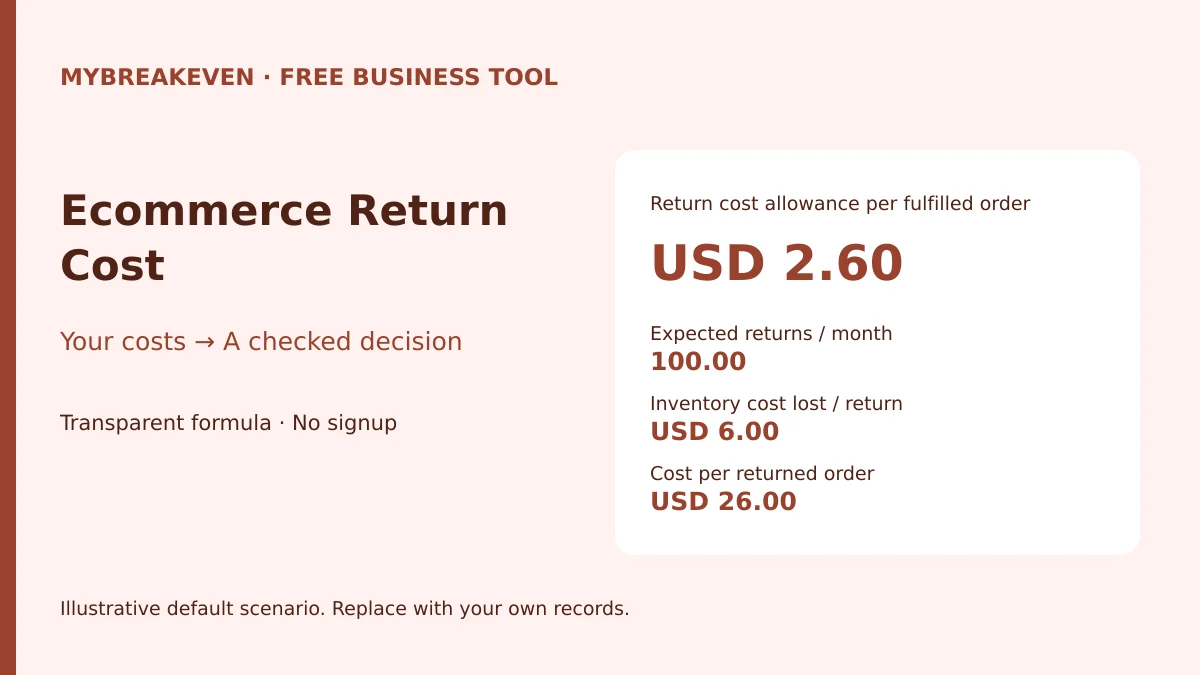
For 1,000 orders at a 10% return rate, expect 100 returns. A $30 product with 80% inventory recovery loses $6 inventory cost. Add $6 outbound shipping, $8 return shipping, $4 handling and $2 retained fees: cost is $26 per return, $2,600 monthly, or a $2.60 allowance per fulfilled order. Refunded revenue and lost sales contribution are separate.
At an 8% return rate with all per-return costs unchanged, monthly burden falls from $2,600 to $2,080, saving $520 in modeled operating costs. At 100% inventory-cost recovery and a 10% return rate, cost per return falls from $26 to $20 and monthly burden becomes $2,000. Refunds still reduce revenue separately.
Use the result in your next business decision
Full-order returns and refunds only. This is an operating-cost allowance, not total profit loss, lost contribution, cash-flow timing or an accounting journal. Refunds reduce revenue separately. Recovered inventory is valued at retained acquisition cost. Resale revenue is excluded. No monthly overhead or advertising is counted.
Change one input at a time and compare the result with the original example. Check the largest cost driver against actual records before changing pricing. Carry the relevant cost or contribution into the linked industry break-even calculator; it adds the broader monthly business target.
Avoid double counting and misleading averages
- Enter only net unrecovered shipping and fee amounts.
- Use the allowance once in planning; do not add outbound costs again if already embedded in the same allowance.
- Keep quantities and reporting periods consistent.
- Include a cost in only one field. Use a separate scenario when the cost mix changes.
Assumptions and limits
Full-order returns and refunds only. This is an operating-cost allowance, not total profit loss, lost contribution, cash-flow timing or an accounting journal. Refunds reduce revenue separately. Recovered inventory is valued at retained acquisition cost. Resale revenue is excluded. No monthly overhead or advertising is counted.
Frequently asked questions
Does this measure the total profit lost from a return?
No. It measures the operating cost burden of fully returned orders. Revenue refunds and the original sale contribution are separate. If revenue is already net of refunds, do not subtract those refunds again.
Are the example values industry averages?
No. They are fictional inputs chosen to demonstrate and check the formula. Replace them with your records.
Does this include all business expenses?
Full-order returns and refunds only. This is an operating-cost allowance, not total profit loss, lost contribution, cash-flow timing or an accounting journal. Refunds reduce revenue separately. Recovered inventory is valued at retained acquisition cost. Resale revenue is excluded. No monthly overhead or advertising is counted.
Can I change the currency?
Yes. Search the currency selector by currency code, name or country. It changes display labels; enter all amounts in the same currency.
How should I use this with break-even planning?
Carry the relevant per-service cost or contribution into the linked industry calculator and add monthly overhead and owner pay there. Avoid counting the same allowance twice.
Method references
Check the full monthly business target
Check whether your contribution can fund overhead, owner pay and your profit target, then compare the required sales with your available working capacity.
Build my full break-even plan →Explore Pro plan comparisonsPublished by MyBreakeven. Method and examples checked . Business calculation methodology · Report a calculation issue.