
MYBREAKEVEN · BUSINESS PLANNING
One-Page Business Plan Template with a Completed Example
Download a concise editable Word plan or print-ready PDF. Write the business story, then check whether the customer target fits delivery capacity and cash timing.
Published · By MyBreakeven
Download the blank template or completed example
Choose the editable Word file to write your plan, or the PDF to print it. Each supplied document is one US Letter page. No account or email address is required. The example describes a fictional service business, not a customer outcome or a tested market opportunity.
Blank one-page business plan
Eight short prompts for the business decision, customer, offer, marketing, delivery, financial target, cash and risks. Replace the bracketed prompts in Word, or use the PDF’s writing lines.
Download blank Word templateDownload blank PDFCompleted service-business example
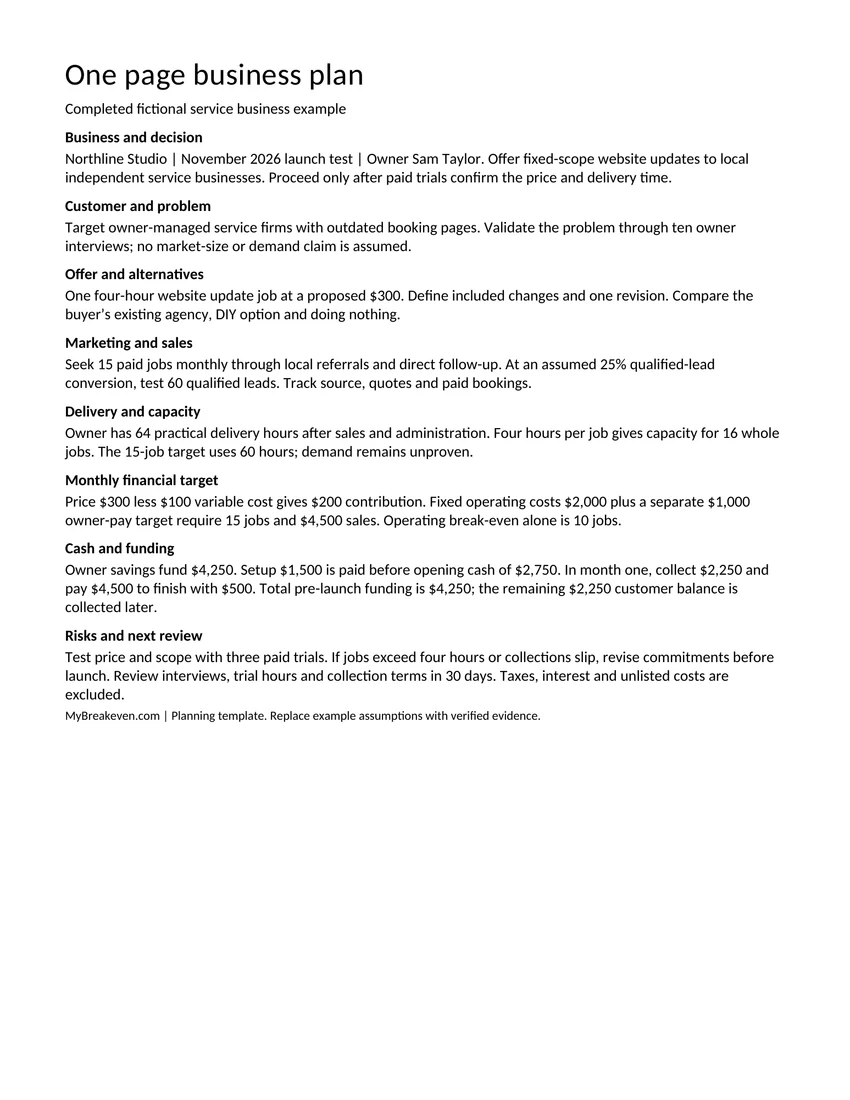
Northline Studio tests a fixed-scope website-update service. Its proposed monthly jobs, delivery hours and opening cash are checked below so you can see what each figure means.
Download example in WordDownload example PDFThe Word files contain editable text, not automatic spreadsheet formulas. The PDFs are static and print-ready, not interactive PDF forms. Update the calculations when you change the assumptions.

Completed example: a small service business with a specific launch decision
Northline Studio is an invented owner-operated business considering four-hour website-update jobs for local service companies. Its plan is a November 2026 launch test. It will proceed only after paid trials test the proposed price, delivery time and collection terms. All figures below are illustrative USD assumptions.
Customer and offer
The intended buyer is an owner-managed service firm with an outdated booking page. The offer is a defined update package with one revision at a proposed $300 per job. Ten owner interviews and three paid trials are planned; no completed interviews, bookings or market demand are claimed.
Sales and delivery
The monthly target is 15 paid jobs. An assumed 25% conversion from qualified leads would require 60 qualified leads. Referrals and direct follow-up are proposed channels. The owner reserves 64 practical delivery hours after sales and administration, and each job is assumed to take four hours. Capacity is therefore 16 whole jobs, not an unlimited number of leads or sales.
Finance and cash
At $300 price and $100 variable cost, each completed job contributes $200. Fixed operating costs are $2,000 and the owner separately targets $1,000 of pay. Fifteen jobs cover that $3,000 planning requirement. Owner savings of $4,250 fund $1,500 setup spending plus $2,750 opening cash. First-month collections are only $2,250 against $4,500 payments, leaving $500.
Decision and next review
Validate price and hours before committing. If jobs take longer than four hours or customers collect later than assumed, revise scope, price, timing or commitments. Review the interview record, paid-trial results and collection terms after 30 days. A feasible arithmetic target is not evidence that customers will buy.
Check the financial target before polishing the wording
A concise plan still needs consistent arithmetic. Start with contribution per job, state which fixed commitments it must cover, round required jobs upward and compare that number with practical capacity. Keep owner pay separate so the label tells the reader which target they are looking at.
| Monthly assumption or result | Initial idea | Revised example |
|---|---|---|
| Price per job | $250 | $300 |
| Variable cost per job | $100 | $100 |
| Contribution per job | $150 | $200 |
| Fixed operating costs plus owner-pay target | $2,000 + $1,000 | $2,000 + $1,000 |
| Required whole jobs including owner-pay target | 20 | 15 |
| Hours needed at four hours per job | 80 | 60 |
| Practical capacity | 64 hours / 16 jobs | 64 hours / 16 jobs |
| Target fits capacity? | No: four jobs beyond capacity | Yes: one job of spare capacity |
At the initial $250 price, maximum modeled contribution is 16 × $150 = $2,400. That leaves $600 of the $3,000 owner-pay-inclusive requirement unfunded. Writing “sell 20 jobs” in a financial box cannot create the missing 16 delivery hours.
The revised $300 offer gives $200 contribution. Operating break-even alone is $2,000 ÷ $200 = 10 jobs. Adding the separately stated $1,000 owner-pay target increases the requirement to 15 jobs. At 16 jobs, contribution would be $3,200, leaving $200 after these specified commitments. These amounts exclude tax, interest and unlisted costs; the owner-pay target is not presented as an accounting expense classification.
For this fictional example, the $100 variable cost consists of $60 outside production support, $20 platform/payment costs and $20 job-specific materials. Fixed costs total $800 workspace, $400 software and $800 marketing/administration. They exclude the owner’s delivery labor, which is represented by the separately included owner-pay target. Replace the boundary if your staffing or fee structure differs.
A 25% qualified-lead conversion is only an assumption: 15 ÷ 25% = 60 qualified leads. If conversion is 15%, the same 15 jobs need 100 qualified leads. Neither a capacity calculation nor a lead target establishes demand. Keep quote and paid-order records to improve the assumption.
Use the break-even calculation guide for the underlying method or the agency calculator for a fuller contribution and capacity check. The downloadable Word document does not recalculate these figures.
Show when sales become usable cash
The revised plan sells 15 jobs at $300, or $4,500 in the month. Suppose only 50% is collected that month and the remaining $2,250 arrives later. All $1,500 job costs, $2,000 fixed costs and $1,000 owner pay are paid during the month. There are no other modeled cash transactions.
| Cash item | Illustrative USD |
|---|---|
| Owner savings provided before launch | $4,250 |
| Setup paid before the month starts | ($1,500) |
| Opening cash after setup | $2,750 |
| First-month customer collections | $2,250 |
| First-month payments including owner pay | ($4,500) |
| Closing cash | $500 |
| Customer balance still to collect | $2,250 |
Do not subtract the $1,500 setup spending again after using the $2,750 opening cash. It was already paid before that opening balance. Similarly, the uncollected $2,250 is not added to bank cash merely because it is included in sales.
The $500 closing balance is a chosen example, not a recommended reserve. It also does not prove every payment date is funded: if all $4,500 payments precede any collection, opening cash of $2,750 is insufficient. Test the actual sequence in the 13-week dated cash forecast and review tight weeks daily. Use net cash flow to summarize a completed period, rather than treating forecasts as actual transactions.
How to write a one-page business plan that remains usable
- Name the decision. State whether you are testing an offer, opening a location, changing a price or reviewing an existing business. Add an owner and review date.
- Describe one specific customer. Explain their problem and the alternatives they currently use. Separate interview evidence from assumptions.
- Define the paid offer. Specify the deliverable, unit, scope limits and proposed price. “Consulting” or “quality service” alone is too broad to cost.
- Explain how a customer reaches a paid order. Name the channel and show the assumed link from qualified leads to sales. Track actual conversion instead of inventing a large market share.
- Allocate practical delivery capacity. Deduct non-delivery commitments before using hours per job. A full calendar is not the same as paid utilization.
- Check the monthly contribution target. Keep variable costs, fixed costs and owner pay on the same period and use whole-job rounding.
- Separate cash from sales. Show setup spending, opening cash, collection timing, payments and the funding source. Keep a dated schedule outside the one-page narrative.
- Set evidence-based next actions. Name the largest uncertainty, its test, the person responsible and the next review date.
Write a short answer under each heading, then remove repetition. Keep quotes, interview notes, financial schedules and contracts in a separate evidence folder. The one-page document should communicate the decision without trying to hold every supporting record.
Choose a one-page summary or a more detailed business plan
A one-page plan suits an initial discussion, a relatively simple offer or a frequent review. The U.S. Small Business Administration describes lean plans as a compact way to summarize key business elements. A recipient may instead require a traditional plan with more detailed research and financial information. Ask for their requirements before assuming one page is sufficient.
This resource owns the concise general plan. For a specific delivery model, continue to the existing freelance business-plan financials or agency planning guides. Those pages provide deeper industry context; duplicating their full models inside this template would weaken the one-page task.
Inventory and receivable balances need their own review. The working-capital guide and editable worksheet explain the balance-sheet snapshot, while the cash forecast schedules when payments become due. Keep these supporting checks separate from the concise narrative.
Edit, print and review the final page
The supplied DOCX and PDF files have been rendered and checked as one-page US Letter documents. Replace bracketed prompts rather than adding long paragraphs beneath them. Keep a readable font and normal margins. After editing, export a new PDF and inspect the page count, line wraps and every financial number.
For Google Docs, upload a copy of the DOCX and review the converted layout before sharing. Word processors can substitute fonts and change line breaks; native Google Docs import has not been independently certified here. The static PDF gives you the supplied print layout, while the Word file is the editable starting point.
Before using the plan, check that the offer’s unit matches its price and costs, the required jobs fit capacity, the cash schedule includes payment timing, the funding source is named and unresolved assumptions have a test. If the figures fail, revise the plan rather than compressing text or presenting a larger sales target as a solution.
Frequently asked questions
What is a one-page business plan?
A concise overview of the customer, offer, sales approach, delivery model, finances, funding and next decisions. It summarizes the plan; supporting research and detailed schedules can remain separate.
Is this one-page business plan template free?
Yes. The blank Word and PDF files and completed fictional example are free, with no signup required. The DOCX is editable; the PDF is designed for viewing and printing.
Can I edit the PDF?
The PDF is a static print-ready copy, not a fillable form. Edit the Word document and export your own PDF, or print the blank PDF and write on it.
Can I open the Word template in Google Docs?
You can import a copy of the DOCX into Google Docs. Review font substitution, spacing and page count after conversion. Native Google Docs rendering has not been certified for this download.
Is one page enough for a loan or investor application?
Requirements vary. Ask the recipient what they need. This is a planning summary, not a promise of lender acceptance or a substitute for requested statements, market evidence or projections.
Does owner pay belong in operating break-even?
Here owner pay is a separate planning target added after fixed operating costs. The example labels operating break-even and the owner-pay-inclusive target separately; it does not assume owner withdrawals are an accounting operating expense.
Why does the example need cash if its sales cover costs?
Only half the first month’s sales are collected in that month, while all modeled payments are made. The uncollected balance remains a receivable; sales and bank receipts are different amounts.
Will the template stay on one page after editing?
The supplied blank and filled documents each render to one US Letter page. Longer answers or different fonts can add pages. Shorten the summary and retain detailed evidence separately, then inspect the exported PDF.
Sources and example status
The structure, templates, fictional company and calculations are original MyBreakeven material. SBA business-planning guidance provides general context on plan formats and research. It does not approve this template or verify the example’s demand, costs or funding.
Read our editorial standards and calculation methodology. Return to business planning resources for the next worksheet.