
Accounts Receivable Process: Invoice, Collect and Reconcile
Published by MyBreakeven. Editorial standards and corrections. Report a calculation or content issue to support@mybreakeven.com.
Build an invoice-to-collection workflow with a reconciled customer ledger, credits, due-date aging, disputes and cash application. Includes an editable record.

The accounts receivable process tracks customer amounts from a valid invoice through credits, collections and reconciliation. Keep each invoice, due date, receipt allocation and open balance connected so the total can be explained from individual customer records.
All amounts and operating results below are original fictional teaching examples in USD. They are not customer results, industry averages or forecasts. Use your own dated records and applicable accounting policies.
Agree the terms and evidence before billing
Record the customer identity, approved scope, delivery or acceptance evidence, invoice contact and agreed payment terms. Establish who can approve a credit change or adjustment. An invoice date is not proof that the full revenue-recognition criteria were met; the accounting basis and delivery facts still matter.
JPMorgan’s receivables guidance describes the broad sequence from credit assessment through cash application and reconciliation. This article supplies a small original invoice ledger, not an assessment of customer creditworthiness or a debt-collection legal procedure. Use appropriate professional support for disputed obligations and regulated collection activity.
Keep a reconciled invoice-level record
| Invoice | Invoice date | Due date | Invoice | Applied cash | Credit | Open | Status on Nov 6 |
|---|---|---|---|---|---|---|---|
| A-101 | Oct 1 | Oct 31 | $5,000 | $2,000 | $0 | $3,000 | 6 days overdue |
| A-102 | Oct 20 | Nov 19 | $4,000 | $0 | $500 | $3,500 | Not yet due |
| A-103 | Sep 15 | Oct 15 | $3,000 | $1,000 | $0 | $2,000 | 22 days overdue |
| Total | As of Nov 6, 2026 | Due-date aging | $12,000 | $3,000 | $500 | $8,500 | Reconcile to control account |
Open gross receivables are $12,000 invoices − $3,000 allocated collections − $500 approved credit = $8,500. A-102’s credit reduces its balance to $3,500; it is not a $500 receipt. Record the credit’s reason and approval. This ledger does not include an expected-credit-loss allowance; a financial-statement carrying amount may need a separate supported adjustment.
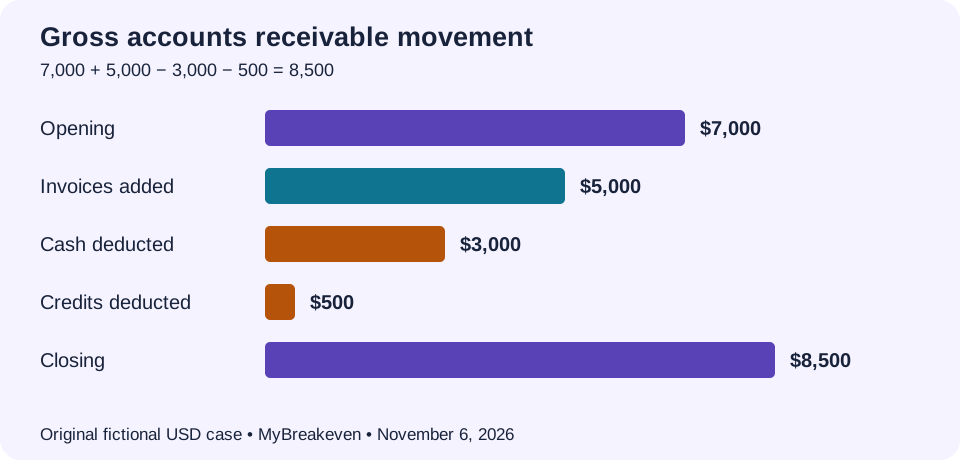
Check every customer row and the overall movement. At an opening gross AR of $7,000, new invoices of $5,000, collections of $3,000 and credits of $500 produce the same $8,500 closing control balance. The movement is a separate summary of this month’s activity, not a second set of invoices to add to the ledger.
Age balances using one explicit date policy
Using due dates and a November 6 cutoff, A-101 is six days overdue, A-103 twenty-two days overdue and A-102 not yet due. Thus $5,000 is 1–30 days overdue and $3,500 is not yet due. The aging total is $8,500. A report aged from invoice date would show different buckets, so label the basis before comparing reports.
Separate disputes, promises to pay and collection estimates from posted cash. A customer email promising $2,000 does not reduce the open balance. Assign a dispute owner, required evidence and next contact date. Preserve the original terms and any approved change; do not rewrite a due date simply to improve the aging report.
Match the receipt without earning revenue twice
For A-101, apply the $2,000 receipt to that invoice and retain its bank reference. A general transfer from a customer may need remittance evidence before allocating across several invoices. Keep unidentified receipts visible for investigation under the accounting policy instead of guessing an allocation.
If a processor settles $970 against a supported $1,000 invoice and withholds a documented $30 fee, the settlement may require $970 cash plus $30 fee to clear the $1,000 receivable. Do not leave a fictional $30 customer debt or reduce sales without examining the actual settlement. Refunds, withholding and currency differences need their own documented treatment.
Reconcile detail, control account and bank evidence
At cutoff, total the customer detail and compare it with the general-ledger AR control account. Explain manual journals, unapplied cash, credits, duplicates and timing differences. Separately reconcile bank activity. An AR ledger cannot equal the bank balance because it represents unpaid amounts rather than cash held.
Re-run the detail after corrections, retain the reconciliation and have an appropriate reviewer investigate unresolved differences. Feed expected clearing dates into the cash forecast. For definitions use current assets; for the customer-versus-supplier distinction use AR versus AP. The AP workflow handles money owed to suppliers, without netting unrelated customers and vendors.
Download the editable worksheet
Download the printable HTML worksheet. It contains the completed case and a separate blank working record. It does not calculate automatically. Edit in your browser, then print or save a completed copy before closing; your edits are not sent to MyBreakeven.
Sources and scope
Primary references below support the stated definitions or framework. The worked case, numbers and decision records are original MyBreakeven material. Reviewed November 6, 2026; no external professional sign-off is claimed.
Frequently asked questions
Does a promise to pay reduce receivables?
No. Keep it as a collection expectation until a supported transaction is posted.
Should receivables equal the bank balance?
No. Reconcile customer detail to the AR control account and bank cash separately.
Does a credit note count as collected cash?
No. It reduces the customer balance for its approved reason without creating a receipt.
Should I age invoices from their date or due date?
Choose and label a consistent policy. This guide’s overdue buckets use contractual due dates.
Browse the MyBreakeven blog hub for related planning guides.
Planning estimates only—not accounting, tax, legal or lending advice.