
Accounts Receivable vs Accounts Payable: One Invoice, Two Ledgers
Published by MyBreakeven. Editorial standards and corrections. Report a calculation or content issue to support@mybreakeven.com.
Compare receivables and payables with matched entries. Reconcile an invoice, credit and partial payment without confusing revenue, expense and cash.
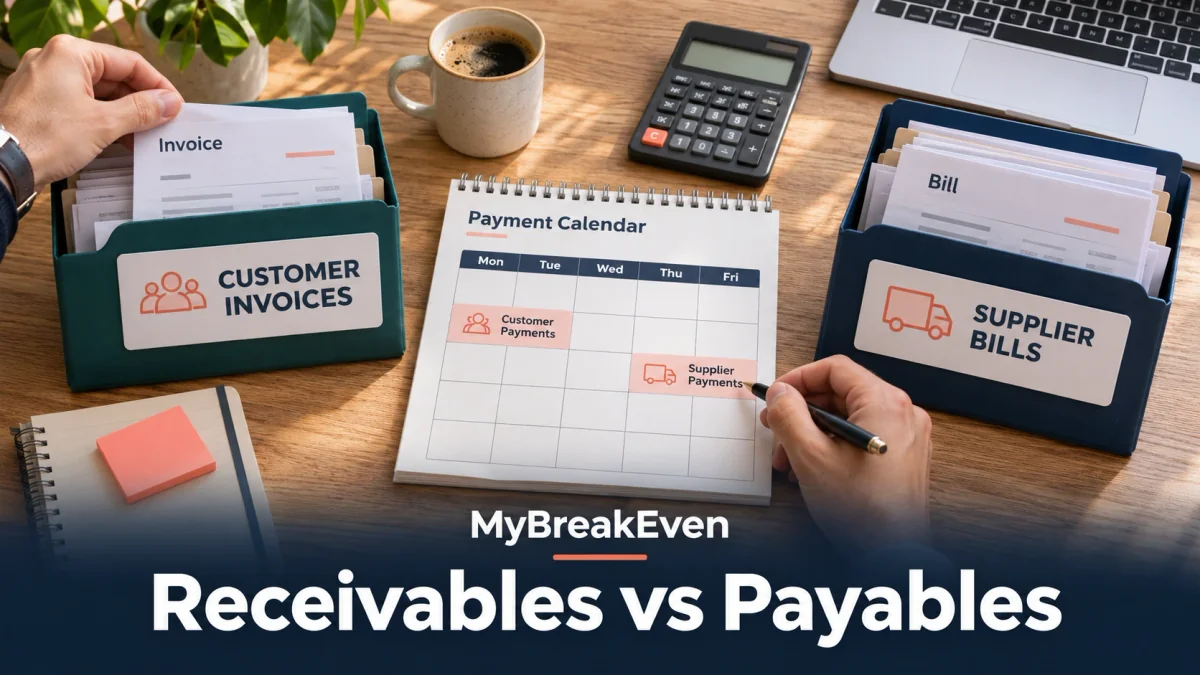
Accounts receivable is an amount customers owe your business; accounts payable is an amount your business owes suppliers. The same credit transaction can create the seller’s receivable and the buyer’s payable, but each business keeps its own ledger and payment dates.
Every amount in the worked case is an original fictional USD planning assumption. It is not an industry benchmark, a customer result or a prediction.
Compare the direction, classification and supporting records
| Question | Accounts receivable | Accounts payable |
|---|---|---|
| Who owes whom? | Customer owes the business | Business owes supplier |
| Usual balance-sheet category | Asset | Liability |
| Main evidence | Sales invoice, credit, receipt | Supplier bill, credit, payment |
| Normal increase entry | Debit AR | Credit AP |
| Cash event when settled | Business receives cash | Business pays cash |
Trade balances are often current, but classification depends on the operating cycle and terms. A debit or credit is an accounting direction, not a synonym for good or bad. Customer deposits and prepayments can require other accounts; do not force every balance into ordinary AR or AP.
Follow an invoice, credit and partial payment
In a fictional accrual-basis example with no tax, Harbor Supplies delivers $3,000 of materials to a customer on November 5, with payment due December 5. The customer receives and records the materials as inventory. On November 12, a valid $300 return is accepted. On November 25, the customer pays $1,000. The remaining open balance is $1,700.
| Event | Seller ledger | Buyer ledger |
|---|---|---|
| Invoice / delivery | Debit AR $3,000; credit revenue $3,000 | Debit inventory $3,000; credit AP $3,000 |
| Accepted return | Debit sales returns $300; credit AR $300 | Debit AP $300; credit inventory $300 |
| Partial payment | Debit cash $1,000; credit AR $1,000 | Debit AP $1,000; credit cash $1,000 |
| Open amount | $3,000 − $300 − $1,000 = $1,700 | $3,000 − $300 − $1,000 = $1,700 |
The seller’s inventory cost and related cost-of-sales reversal are excluded from this narrowly matched ledger example because the acquisition cost was not given. A complete accounting record must include them where applicable. Sales tax, foreign currency, discounts, impairment and framework-specific recognition require additional treatment.
The payment changes cash without creating the same revenue twice
The seller’s invoiced net sales in this case are $2,700 after the return, but the cash collected so far is $1,000. The receipt reduces AR; it is not another $1,000 of accrual revenue. The buyer’s payment reduces AP; it does not automatically create another expense. Buying inventory is also different from recognizing cost of goods sold when that inventory is sold.
The outstanding $1,700 affects collection or payment planning. Put its expected settlement date into the cash forecast. The balance alone does not say whether it is overdue; compare it with the agreed due date and any dispute or amendment.
Reconcile the open balances instead of relying only on totals
For AR, opening balance plus invoices less credits, receipts and applicable write-offs should explain the closing ledger. For AP, opening balance plus accepted bills less credits and payments should explain the closing ledger. Reconcile customer/supplier subledgers with the control account, then match settlement amounts to the bank.
Review unapplied receipts, duplicate bills, unmatched credits and cut-off errors. Keep disputed amounts visible. Amounts due from and to the same counterparty should not be netted casually: applicable offsetting rules and agreements matter. Use aging buckets based on a consistently stated method, such as days past due.
Choose the detailed workflow after understanding the difference
AR management concerns invoicing, collection, disputes and customer credit exposure. AP management concerns approved bills, valid suppliers, due dates and controlled disbursement. This comparison does not replace either full process. For the collection-speed calculation, use DSO; for the broader balance relationship, use working capital. Keep the historical cash-flow statement separate from the forecast of future dates.
Use the worksheet with your own records
Download the printable, editable HTML worksheet. It contains the completed example and a blank table. Open it in a browser, edit the blank fields, calculate the outputs using the stated method and print to PDF or paper. It does not automatically calculate results or replace your accounting records.
Method references and source notes
The method references below support the definitions. The examples, assumptions and decision checks on this page are independently constructed.
Frequently asked questions
Are accounts receivable revenue?
A credit sale can create revenue and AR at recognition, but AR is the outstanding asset balance. Collecting that balance is not another sale.
Is paying accounts payable always a new expense?
No. Payment settles the liability. The related asset or expense was recognized according to the original transaction and applicable accounting method.
Does a partial payment change the original invoice revenue?
Not by itself. In the stated accrual example it reduces the open receivable/payable and moves cash. A valid credit or correction is a separate event.
Should balances with the same counterparty be netted?
Do not net them casually. Check the applicable accounting offsetting rules and agreements, and retain the underlying records.
Browse the MyBreakeven blog hub for related planning guides.
Planning estimates only—not accounting, tax, legal or lending advice.