
Accounts Payable Process: Approve, Pay and Reconcile
Published by MyBreakeven. Editorial standards and corrections. Report a calculation or content issue to support@mybreakeven.com.
Follow supplier invoices through receipt checks, approval, payment and reconciliation. Use a checked payable ledger, exception example and editable worksheet.
The accounts payable process verifies supplier obligations, records approved invoices and credits, schedules authorized payments and reconciles the remaining balance. Match what was ordered, received and billed before paying, and preserve evidence for exceptions.
All amounts and operating results below are original fictional teaching examples in USD. They are not customer results, industry averages or forecasts. Use your own dated records and applicable accounting policies.
Capture the invoice and validate the supplier record
Use a controlled intake location and record supplier, invoice number, currency, date, terms, purchase reference and total. Check duplicates using more than a file name: the same bill can arrive as a PDF, reminder and statement. A supplier statement summarizes activity; it is not automatically a new expense.
Separate supplier-detail changes, invoice approval and payment release where practical. Verify a requested bank-detail change through a previously trusted contact route, not only the new email. In a very small business, an independent owner review of the evidence can compensate for limited staffing, but it should be an actual recorded check.
Match receipt and price, then resolve exceptions
Microsoft’s invoice-matching documentation distinguishes price comparison with the purchase order from the additional receipt-quantity check. Choose controls that fit the purchase. A service may need approved completion evidence instead of a warehouse receipt; a non-PO bill needs a documented authorization route, not automatic approval.
For an independent goods example, a purchase order requests 100 components at $20, but the receiving record shows only 90 accepted. A supplier invoice for $2,000 raises a $200 quantity exception. Investigate the missing ten and request correction or evidence before approval. Do not silently change the receipt to 100 to make the documents agree. Recognition of goods received and treatment of any dispute still follow the accounting policy.
Reconcile the supplier balances and monthly movement
| Invoice | Invoice date | Due date | Invoice | Applied payments | Credit | Open | Status |
|---|---|---|---|---|---|---|---|
| V-201 | Oct 15 | Nov 14 | $4,000 | $1,500 | $0 | $2,500 | Receiving checked |
| V-202 | Oct 20 | Nov 19 | $3,000 | $0 | $300 | $2,700 | Credit approved |
| V-203 | Sep 25 | Oct 25 | $2,000 | $1,000 | $0 | $1,000 | 12 days overdue |
| Total | As of Nov 6, 2026 | Due-date policy | $9,000 | $2,500 | $300 | $6,200 | Compare supplier detail to GL |
The ledger closes at $9,000 invoices − $2,500 allocated payments − $300 approved credit = $6,200. V-203’s remaining $1,000 is twelve days overdue on November 6. The credit on V-202 is not a payment; retain the supplier reference and reason. A dispute flag is not permission to delete a supported obligation.
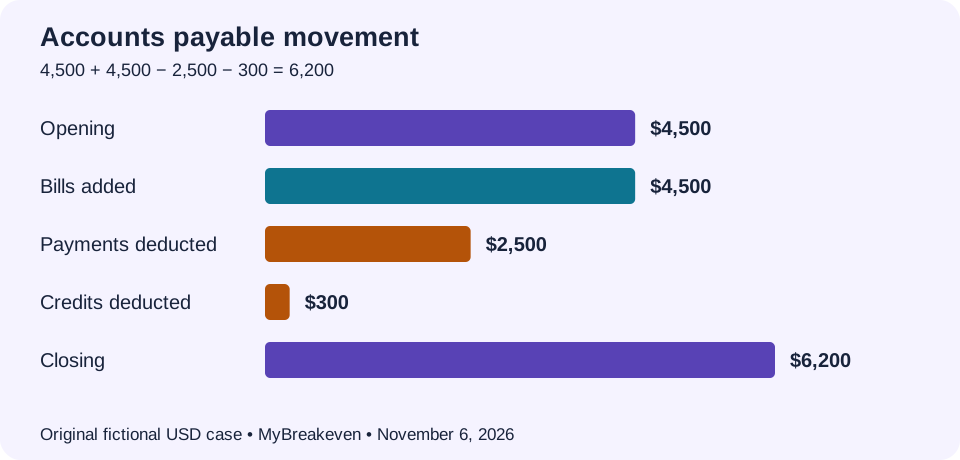
The separate month movement is $4,500 opening AP + $4,500 new bills − $2,500 payments − $300 credits = $6,200. Compare that result with the supplier-detail total and GL control balance. Do not add the opening balances to a closing ledger that already includes them.
Authorize the payment without duplicating the expense
Prepare a proposed payment run with invoice references, due dates, available cash and hold reasons. Review agreed discounts against actual terms; do not assume delaying every payment improves the business. A planned payment is not a completed bank transaction. Retain release approval and settlement evidence, then allocate the payment to the correct invoice.
If $1,500 of V-201 is paid after that invoice was already recorded, reduce cash and the payable. Posting another $1,500 expense at payment would duplicate the cost. A purchase can instead relate to inventory, equipment or a prepayment, so the AP workflow must not force every bill into operating expense.
Close with supplier, ledger and cutoff checks
Compare supplier statements with internal invoices, payments and credits. Investigate missing invoices, unallocated payments, duplicates and payments in transit. Reconcile supplier detail to the AP control account at the same cutoff. Review received goods and completed services not yet invoiced, keeping necessary accruals separate until matched so they are not counted twice.
Use liability classification for the reporting boundary and the customer collection workflow for incoming amounts. The AR-versus-AP comparison explains the distinction. Feed actual supplier due dates into the cash plan; a reconciled $6,200 balance does not itself say which payments are due tomorrow.
Download the editable worksheet
Download the printable HTML worksheet. It contains the completed case and a separate blank working record. It does not calculate automatically. Edit in your browser, then print or save a completed copy before closing; your edits are not sent to MyBreakeven.
Sources and scope
Primary references below support the stated definitions or framework. The worked case, numbers and decision records are original MyBreakeven material. Reviewed November 6, 2026; no external professional sign-off is claimed.
Frequently asked questions
Is a supplier statement another bill?
Not automatically. Match its lines to existing invoices, credits and payments before posting anything new.
Does invoice approval prove payment occurred?
No. Payment release and settlement require their own evidence.
Should paying a recorded bill create another expense?
No. Normally it settles the recorded payable; confirm the original posting and accounting policy.
Can a non-PO invoice skip controls?
It needs an appropriate documented authorization and evidence route for the purchase.
Browse the MyBreakeven blog hub for related planning guides.
Planning estimates only—not accounting, tax, legal or lending advice.