
Cash Flow Statement: Format, Example and Preparation
Published by MyBreakeven. Editorial standards and corrections. Report a calculation or content issue to support@mybreakeven.com.
Learn the cash flow statement format with a complete example, direct and indirect reconciliation, balance-sheet checks and an editable CSV close schedule.
A cash flow statement explains how cash changed during a completed reporting period. It groups movements into operating, investing and financing activities, then reconciles opening to closing cash. Unlike an income statement, it follows cash movements rather than simply recognizing sales and expenses. Unlike a forecast, it reports what happened.
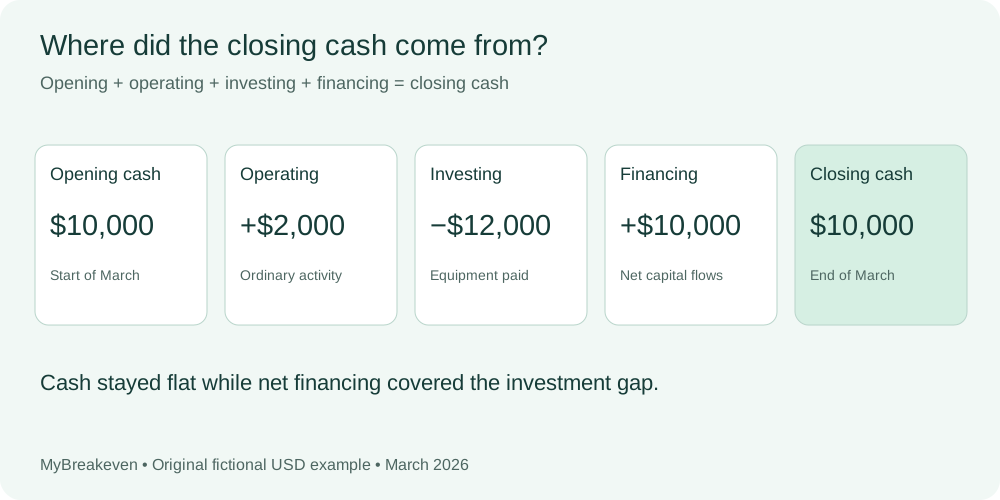
For the fictional Cedar Supply example, March 2026 profit is $9,000, operating cash flow is $2,000, equipment uses $12,000 and net financing provides $10,000. Total cash movement is zero, so opening and closing cash are both $10,000. The unchanged balance hides a reliance on new borrowing. All amounts are USD teaching assumptions, not customer results or industry benchmarks.
Cash flow statement format: the three sections
| Section | Question | Examples in a nonfinancial business |
|---|---|---|
| Operating | What did ordinary business activity collect and pay? | Customer receipts; supplier and employee payments |
| Investing | What cash went into or came from long-term assets? | Equipment bought for cash; cash proceeds from a sale |
| Financing | What cash came from or returned to capital providers? | Loan proceeds; debt principal repaid; owner capital or distributions |
Cash flow means money moving during an interval. Cash is a balance at a date. The statement links the two: closing cash = opening cash + operating cash flow + investing cash flow + financing cash flow, with foreign-exchange or other required reconciling effects separately identified when applicable. This example has none. Use one consistent cash and cash-equivalent perimeter at both dates. Transfers between included bank accounts are internal movements, not new receipts or expenses.
A complete cash flow statement example
Cedar Supply is an invented US-style nonfinancial reseller. The simplified example treats interest paid and income tax paid as operating cash flows, equipment purchases as investing, and debt principal and owner distributions as financing. It has no foreign exchange, restricted cash, cash-equivalent trades, business combinations, leases, asset sales or noncash acquisitions. Do not apply these simplified classifications to another reporting framework without checking its rules.
| Activity / line | Cash inflow / (outflow) |
|---|---|
| Cash received from customers | 88,000 |
| Cash paid to suppliers | (53,000) |
| Cash paid to employees | (19,000) |
| Other operating cash payments | (11,000) |
| Interest paid | (1,000) |
| Income taxes paid | (2,000) |
| Net cash from operating activities | 2,000 |
| Equipment bought for cash: investing | (12,000) |
| New loan proceeds: financing | 15,000 |
| Loan principal repaid: financing | (3,000) |
| Owner distributions: financing | (2,000) |
| Net cash from financing activities | 10,000 |
| Net change in cash | 0 |
| Opening cash, March 1 | 10,000 |
| Closing cash, March 31 | 10,000 |
Operating receipts of $88,000 less $86,000 operating payments give $2,000. Then $2,000 − $12,000 + $10,000 = $0 net change. Add this to the $10,000 opening balance. Neither the $15,000 loan nor the owner distribution belongs in revenue or operating profit.
Direct versus indirect method: the same operating total
The direct method groups actual operating receipts and payments. The indirect method reconciles accrual profit to operating cash by adjusting for noncash items, operating asset and liability changes, and other items requiring reclassification. These are alternative presentations of the operating section; they do not create different closing cash balances.
Here the income statement is $100,000 revenue − $55,000 COGS − $20,000 payroll − $10,000 other operating expense − $3,000 depreciation − $1,000 interest − $2,000 tax = $9,000 net income. The indirect bridge is $9,000 + $3,000 depreciation − $12,000 receivables increase − $5,000 inventory increase − $1,000 prepayment increase + $7,000 supplier-payables increase + $1,000 payroll-accrual increase = $2,000 OCF.
Depreciation is added back because it reduced profit without being a current cash payment. It is not a cash receipt. The equipment payment is reported separately in investing. The operating cash flow guide shows opening and closing balances and derives each cash payment, with an editable reconciliation checker.
How to prepare a cash flow statement from your records
- Set the dates and perimeter. List included bank accounts, cash and qualifying equivalents; reconcile both endpoints to their records.
- Collect supporting schedules. Use the income statement, comparative balance sheets, bank and cash ledgers, receivable/payable roll-forwards, fixed-asset register, borrowing records and equity movements.
- Identify actual cash events. Separate accrual entries, write-offs and other noncash movements from bank payments. Do not treat every balance-sheet difference as cash.
- Build the operating section. Choose the presentation, classify operating balances and cross-check unusual movements. Reconcile direct and indirect views when both are available.
- Build investing and financing. Use gross proceeds and cash payments where required. Check loan principal separately from interest and owner distributions separately from payroll.
- Reconcile closing cash. Investigate differences and document excluded noncash transactions and framework-required disclosures.
A simple bank export will not identify all accrual adjustments or tell you whether a payment buys an asset. For example, a $12,000 payable increase caused by equipment acquired on credit must not be added into operating cash as though it were an unpaid inventory bill. Use transaction detail, not a universal “current liabilities” shortcut.
Check the statement against the balance sheet
| Item | March 1 | March 31 |
|---|---|---|
| Cash | 10,000 | 10,000 |
| Trade receivables | 20,000 | 32,000 |
| Inventory | 15,000 | 20,000 |
| Prepaid operating costs | 2,000 | 3,000 |
| Net equipment | 30,000 | 39,000 |
| Total assets | 77,000 | 104,000 |
| Supplier payables | 12,000 | 19,000 |
| Payroll accruals | 3,000 | 4,000 |
| Income tax payable | 1,000 | 1,000 |
| Loan principal outstanding | 20,000 | 32,000 |
| Equity | 41,000 | 48,000 |
| Total liabilities and equity | 77,000 | 104,000 |
Net equipment rises by $9,000: $12,000 purchases less $3,000 depreciation. Debt rises by $12,000: $15,000 borrowed less $3,000 repaid. Equity rises by $7,000: $9,000 net income less $2,000 distributions. These supporting roll-forwards explain why total asset growth is much larger than the change in cash.
How to read the result without confusing cash and profit
Ask where the money came from before deciding whether a positive balance is healthy. Cedar Supply earned $9,000 but generated only $2,000 operating cash. It also spent $12,000 on equipment. New borrowing, net of repayments and distributions, kept the bank balance unchanged. Without that $10,000 net financing, modeled closing cash would be zero; the example does not establish that operations can fund the same investment repeatedly.
Negative investing cash may represent productive expansion, while positive investing cash may come from selling equipment. Positive operating cash may be temporary if overdue bills have increased. Review several comparable periods, customer collections, inventory and payment obligations. A statement alone cannot show whether a payroll payment earlier in the month was covered; it aggregates the completed period.
Statement, forecast and profit report answer different questions
| Record | Time basis | Use |
|---|---|---|
| Cash flow statement | Completed reporting period | Explain cash sources and uses and reconcile balances |
| Cash flow forecast | Expected future payment dates | Identify when receipts may fail to cover payments |
| Income statement | Recognized revenue and expenses for a period | Measure accounting performance |
| Break-even model | Assumed activity, price and included costs | Test the sales contribution required to cover a chosen cost scope |
Use the net cash flow calculator to total already-classified activity amounts and compare calculated cash with an observed closing balance. It does not classify the ledger or prepare every required statement disclosure. Then carry verified closing cash into the 13-week cash forecast. The profit-versus-cash guide covers the separate profitability question.
Common cash flow statement mistakes to catch
| Mistake | Why it fails | Correction |
|---|---|---|
| Treating sales as receipts | Unpaid invoices have not supplied cash | Reconcile trade receivables, credits and collections |
| Subtracting depreciation as a cash payment | It is already a noncash expense | Add back the included expense in the indirect bridge |
| Putting loan proceeds in operating income | Funding is not a sale | Classify the actual funding flow separately |
| Using all current assets in one adjustment | Cash and non-operating items may be included | Use operating balances with transaction support |
| Netting a bank transfer into revenue | Included-account transfers do not change total cash | Eliminate both sides within the perimeter |
| Forcing an unexplained balance to zero | A plug conceals missing or misclassified events | Resolve the source record or retain an explicit difference |
Download the statement example and close checklist
Download the cash flow statement CSV. It is an editable values schedule containing the fictional direct statement, indirect bridge, balance-sheet checks and source-record fields. It contains no spreadsheet formulas or automated classifications. Save an untouched example, copy it for your reporting dates and replace every amount. Recalculate subtotals and reconcile them to the source records before using the result.
Continue with the complete cash-flow statement, the operating cash flow calculation or cash-flow problems and management according to the question you need to answer.
Reporting basis and sources
The SEC financial statements introduction provides the reporting context; its cash flow statement building blocks describes the two operating presentations. The worked Cedar Supply records, calculations and commentary are original teaching material. They are a simplified US-style illustration, not a complete filing template.
For IFRS users, consult IAS 7 and the adopted reporting requirements. IFRS 18 applies for annual periods beginning on or after January 1, 2027, with earlier application permitted; related IAS 7 amendments change the indirect-method starting subtotal and interest/dividend classification requirements. A net-income bridge should not be copied unchanged into an IFRS 18 reporting package. Sources checked October 25, 2026.
Verify working-capital balances before the cash reconciliation
The working-capital calculation and balance-sheet example separates current balances, operating balances and bank cash. Match those account definitions before using changes in the operating section.
Keep earnings and cash subtotals distinct
The reconciled EBITDA, net-income and cash-flow comparison follows one original statement through its earnings and operating-cash bridges. An EBITDA result is not the statement’s closing bank balance.
Frequently asked questions
What are the three parts of a cash flow statement?
Operating activities describe ordinary business cash; investing covers items such as long-term asset purchases; financing covers capital raised or returned. Their totals reconcile opening and closing cash, with other required reconciling effects identified separately.
Is a cash flow statement the same as a cash flow forecast?
No. The statement explains a completed period. A forecast places expected future receipts and payments on dates. Use verified closing actual cash as the next forecast opening balance.
Can a profitable business have low operating cash flow?
Yes. In the fictional example, net income is $9,000 but OCF is $2,000 because operating assets absorb cash, partly offset by increased operating liabilities.
Does the CSV automatically prepare a compliant statement?
No. It is a values-only teaching schedule. You must classify and verify records, calculate results and meet the reporting framework and recipient requirements separately.
Are cash-equivalent and interest classifications universal?
No. Follow the applicable framework, transaction facts and reporting period. This example states its simplified US-style nonfinancial-business assumptions; IFRS presentation requirements can differ.
Browse the MyBreakeven blog hub for related planning guides.
Planning estimates only—not accounting, tax, legal or lending advice.