
Financial Contingency Plan: Cash Triggers, Actions and Funding
Published by MyBreakeven. Editorial standards and corrections. Report a calculation or content issue to support@mybreakeven.com.
Build a financial contingency plan with dated cash scenarios, triggers, owners and verified funding. Test an original cash-gap example and response worksheet.
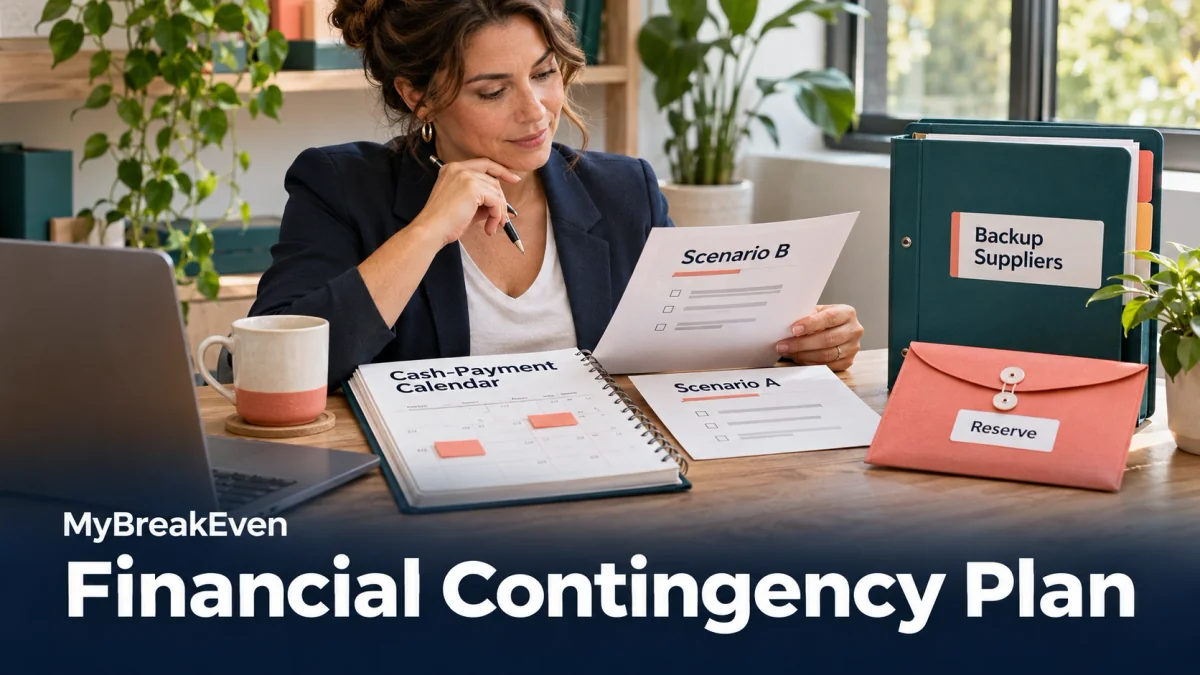
A financial contingency plan defines what the business will do when cash assumptions fail: the trigger, decision owner, dated response and funding actually available. It complements the cash forecast and operational continuity plan; it is not a promise that emergency finance will be approved.
Every amount in the worked case is an original fictional USD planning assumption. It is not an industry benchmark, a customer result or a prediction.
Connect a risk to a date and an accountable action
Choose a planning horizon that captures your payment commitments. List opening usable cash, expected receipts and committed payments by week or date. Separate restricted balances, unapproved borrowing and expected insurance recoveries from cash available to pay bills. Identify which receipts depend on customer acceptance, processing delays or unresolved disputes.
For each risk, record the event, a measurable trigger, the owner, the response deadline, the action’s cash effect and the dependency that could prevent it. A reserve target should follow the business’s downside timing and tolerance, not an unexplained percentage copied from another company.
Model the shortage before assuming a funding solution
| Case | Opening usable cash | Receipts | Payments | Closing cash |
|---|---|---|---|---|
| Base | $18,000 | $8,000 | $20,000 | $6,000 |
| Customer delay | $18,000 | $2,000 | $20,000 | $0 |
| Delay plus repair | $18,000 | $2,000 | $22,500 | −$2,500 |
Use a chosen $5,000 minimum cash floor for this case. The base case stays $1,000 above it. The customer-delay case needs $5,000 of timely improvement to restore the floor, and the combined downside needs $7,500. These are aggregate four-week checks; a payroll payment before the week-four receipt may create an earlier, larger need. The dated worksheet must test that ordering.
Build a response that can actually occur before the bill
| Action | Cash improvement | Evidence needed |
|---|---|---|
| Move discretionary equipment purchase | $2,000 | Purchase not committed; no penalty |
| Reschedule a supplier payment by agreement | $1,500 | Written acceptance and new due date |
| Available credit draw | $4,000 | Existing facility, conditions met, timely draw |
| Total improvement | $7,500 | Do not count unconfirmed actions |
| Revised closing cash | $5,000 | −$2,500 + $7,500 |
Deferring a payment shifts the obligation into a later period; it does not eliminate the cost. Add the new payment date and debt service to later weeks. Avoid showing credit as ordinary revenue. If the lender can suspend the line or the business fails its conditions, the draw must not appear as dependable cash.
Write an escalation ladder with a decision owner
An illustrative green level is forecast cash at or above the chosen floor, with a weekly review. Amber begins when a dated forecast falls below that floor or a material receipt slips: the finance owner confirms collection status and pauses uncommitted discretionary spending. Red is an inability to meet a critical due payment: the owner escalates immediately, verifies financing and contacts the affected counterparties before making unsupported promises.
The numbers and color levels belong to this fictional case. In a real plan, set them around payroll, critical suppliers, legal commitments, funding terms and operational resilience. Do not advise missing tax or wage obligations as a routine liquidity tactic.
Rehearse the plan and reconcile it after each review
Test a delayed receipt, a lost customer, an equipment failure and a funding source that is unavailable at the same time. Keep source evidence for cash, counterparties, approvals and facility conditions. Check after the event whether the action occurred on time and whether a temporary fix created another shortage.
Use the 13-week cash forecast for dated payments, the cash-flow recovery guide for causes and responses, and your business plan for the assumptions and owners. The broader business continuity task also covers staffing, systems, premises and recovery priorities; this article owns the financial response.
Use the worksheet with your own records
Download the printable, editable HTML worksheet. It contains the completed example and a blank table. Open it in a browser, edit the blank fields, calculate the outputs using the stated method and print to PDF or paper. It does not automatically calculate results or replace your accounting records.
Method references and source notes
The method references below support the definitions. The examples, assumptions and decision checks on this page are independently constructed.
Frequently asked questions
How large should the emergency reserve be?
Base it on dated downside cash needs, commitments, available financing and risk tolerance. The illustrative $5,000 floor is not a universal recommendation.
Can expected insurance or a new loan be counted as available cash?
Only with a supportable amount and timing, and after relevant conditions are met. Pending approval is not immediately available cash.
Does rescheduling a supplier bill remove the cost?
No. It moves the cash obligation to another date, subject to agreement. Include that later payment when checking the next forecast periods.
How often should the plan be reviewed?
Choose a cadence that matches the payment risk, and review immediately when a material assumption fails. The example uses more frequent escalation under stress.
Browse the MyBreakeven blog hub for related planning guides.
Planning estimates only—not accounting, tax, legal or lending advice.