
Cash Flow Problems: Causes, Solutions and a Recovery Plan
Published by MyBreakeven. Editorial standards and corrections. Report a calculation or content issue to support@mybreakeven.com.
Diagnose cash flow problems with a four-week example, tested timing fixes, a weekly review routine and an editable recovery action plan for your business.

A cash flow problem occurs when available cash on the required dates cannot cover payments you must make. A profitable month can still contain a payroll shortfall. Cash flow management means maintaining reliable records, forecasting collection and payment dates, assigning corrective actions and checking whether those actions actually worked.
Start with the next uncovered obligation, its date and the evidence behind expected receipts. Do not begin with “increase sales” or count an unapproved loan as available cash. This guide uses an original four-week USD example where a business ends the month with $7,000 yet falls to −$2,000 in week two. The remedy is tested against the timing gap and a chosen $3,000 operating floor, not a universal reserve rule.
Find the first shortfall before choosing a solution
- Reconcile usable opening cash. Check cleared balances, transfers, restricted funds and any amounts unavailable for operating payments. Keep an undrawn facility or loan application separate from cash already received.
- List the next dated obligations. Include payroll, supplier settlements, tax, debt service, owner withdrawals and committed purchases. Record the actual due date and whether a change is agreed.
- Review receipt evidence. An invoice issued, a sale booked, a payment promised and a cleared receipt are different stages. Separate confirmed, expected and uncertain collections.
- Calculate the lowest balance. Compare every dated step with zero and with your chosen cash floor. Check daily ordering when a weekly subtotal is close.
- Assign the response. Give each action an owner, deadline, evidence needed and fallback if it fails.
Warning signs include repeated unpaid invoices, a rising overdue supplier list, emergency borrowing for routine payments, inventory that cannot be sold promptly, and a forecast that changes without explanations. These are investigation triggers, not proof that the company has failed. Begin with source records so a missing bank entry is not mistaken for a commercial problem.
Seven cash flow problems: diagnose the cause and the trade-off
| Problem | What to check | Potential action and limitation |
|---|---|---|
| Customers pay later than planned | Invoice acceptance, aging, disputes and actual payment history | Resolve disputes and follow up; bring receipts forward only with credible customer confirmation |
| Sales do not contribute enough | Price less relevant delivery, product, fee and acquisition costs | Reprice or change scope; extra low-contribution sales may deepen the gap |
| Stock absorbs cash | Inventory age, sell-through, purchase commitments and returns | Reduce or reschedule purchases; do not assume all inventory sells at its recorded value |
| Growth runs ahead of funding | Deposit terms, staffing, lead times and settlement delays | Stage orders or expansion; new revenue can require cash before collection |
| Fixed commitments exceed affordable capacity | Leases, subscriptions, payroll and cancellation terms | Remove avoidable spending; cutting essential capacity can impair collections or delivery |
| Debt, tax or one-off payments bunch together | Actual repayment and due-date schedules | Discuss permitted changes early; borrowing adds costs and later obligations |
| Forecast and records are unreliable | Missing events, cutoff errors, duplicate receipts and undocumented assumptions | Reconcile actuals and revise dates; software cannot repair unsupported inputs |
A temporary timing gap has an identifiable receipt or event that could close it. A structural gap persists even after realistic collections and payment dates are used because prices, costs or fixed commitments do not support operations. Many businesses have both. Separate them before accepting a funding proposal as the whole solution.
Worked example: a positive month-end balance hides a week-two gap
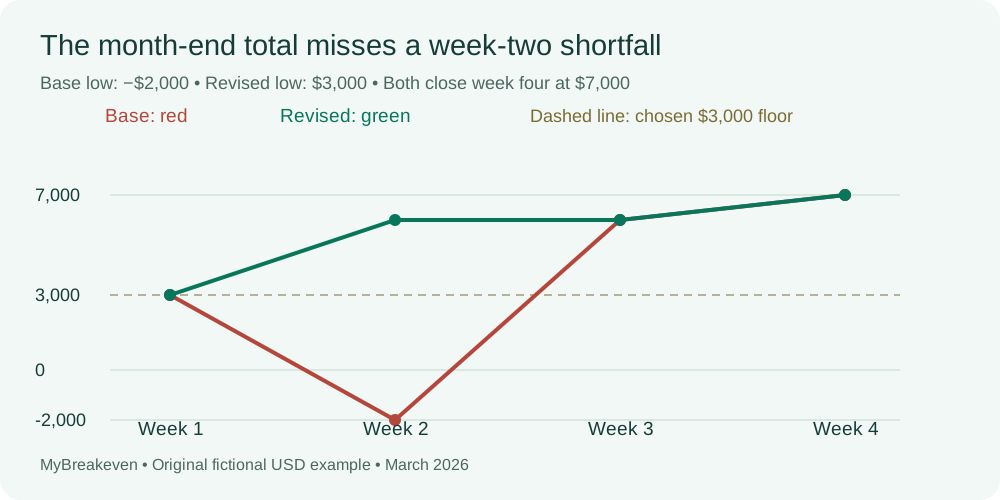
Assume $8,000 usable opening cash, a chosen $3,000 floor and the following four-week forecast. The $14,000 receipt in week three includes a collectible $4,000 invoice that may be accelerated. Week-two payments include a discretionary $4,000 equipment purchase that has not yet been irrevocably committed. This is an illustrative forecast, not an actual company ledger.
| Week | Opening | Receipts | Payments | Closing | Headroom above 3,000 |
|---|---|---|---|---|---|
| 1 | 8,000 | 4,000 | 9,000 | 3,000 | 0 |
| 2 | 3,000 | 6,000 | 11,000 | −2,000 | −5,000 |
| 3 | −2,000 | 14,000 | 6,000 | 6,000 | 3,000 |
| 4 | 6,000 | 8,000 | 7,000 | 7,000 | 4,000 |
The modeled negative balance is an unmet funding requirement, not evidence that a bank will permit an overdraft. Month totals are $32,000 receipts and $33,000 payments. Opening $8,000 plus the net −$1,000 gives $7,000 month-end cash, but that total conceals week two. The amount needed to avoid a negative weekly balance is $2,000; the amount needed to retain the chosen $3,000 floor is $5,000. Neither amount is a loan recommendation.
Test a recovery plan without double-counting money
Consider two explicit changes: collect $4,000 in week two instead of week three, after confirming the customer’s payment, and move the $4,000 discretionary equipment payment from week two to week three if operationally and contractually feasible. These are timing changes. Neither creates extra sales or permanently saves the purchase cost.
| Week | Opening | Receipts | Payments | Closing | Headroom above 3,000 |
|---|---|---|---|---|---|
| 1 | 8,000 | 4,000 | 9,000 | 3,000 | 0 |
| 2 | 3,000 | 10,000 | 7,000 | 6,000 | 3,000 |
| 3 | 6,000 | 10,000 | 10,000 | 6,000 | 3,000 |
| 4 | 6,000 | 8,000 | 7,000 | 7,000 | 4,000 |
Total receipts remain $32,000; payments remain $33,000; closing cash remains $7,000. The lowest weekly closing cash rises from −$2,000 to $3,000. Do not leave the accelerated $4,000 in week three or erase the deferred purchase entirely. That would invent money. Check actual within-week receipt and payment order before relying on the weekly totals.
| Scenario | Lowest weekly closing cash | Shortfall to chosen floor |
|---|---|---|
| Neither change succeeds | −2,000 | 5,000 |
| Only 4,000 receipt acceleration succeeds | 2,000 | 1,000 |
| Only 4,000 payment deferral succeeds | 2,000 | 1,000 |
| Both succeed | 3,000 | 0 |
| Both assumed, but accelerated receipt slips back to week 3 | 2,000 | 1,000 |
The last scenario shows why a promise is not a cleared receipt. If either action is unconfirmed, retain a fallback with its own timing and consequences. A price discount used to accelerate payment would change the receipt amount and possibly profit; it cannot be modeled as a date-only change.
Use an action register with evidence and a fallback
| Action | Owner / deadline | Evidence and fallback |
|---|---|---|
| Confirm accelerated 4,000 collection | Accounts lead before week-two payment cutoff | Written customer confirmation and later bank clearance; if late, re-test the 1,000 floor gap |
| Review equipment timing | Operations owner before placing the order | Confirm week-three delivery is workable and supplier terms permit it; otherwise retain original payment |
| Protect mandatory payments | Owner with accountant / payroll lead before due date | Verify actual obligations and permitted options; do not assume payroll, tax or debt can simply be skipped |
| Reconcile forecast to actual cash | Bookkeeper at each weekly close | Record cleared transactions once; explain date/amount variances and re-date only outstanding amounts |
The owner field creates responsibility; it does not prove an action was completed. Keep a status such as proposed, agreed, cleared or failed. If obligations cannot be met, obtain timely professional help on the actual business circumstances rather than silently treating overdue liabilities as free funding.
Build a weekly cash flow management routine
Close the completed week. Compare the forecast closing balance with reconciled actual cash on the same account basis. Separate timing, amount, missing-event and classification differences. Preserve the earlier forecast so changes remain explainable.
Roll the horizon forward. Update the remaining 13 weeks with outstanding receipts, actual supplier terms, payroll and tax dates, committed spending and documented funding conditions. Maintain a downside case for delayed collections. A facility limit is not the same as funds available at the needed time.
Review the drivers. Track overdue receivables, aged stock, near-term obligations, contribution by offer, lowest cash balance and forecast accuracy. Use comparisons consistent with seasonality and scope; avoid inventing a universal reserve, ratio or “safe” number of negative months.
Record a decision. Approve the action, owner, deadline and fallback. At the next review, compare the claimed saving or accelerated receipt with what cleared. Use the free 13-week forecast and Excel template for the dated schedule and the actual-to-forecast cutoff example to avoid duplicated events.
When growth or pricing is the real problem
Suppose a job sells for $500 but its relevant product, delivery, fees and acquisition costs total $520. The contribution is −$20 before monthly overhead. Ten extra jobs add $200 to that shortfall even if customers eventually pay in full. Faster collection changes timing; it does not make the job contribution positive. Recheck the cost scope, price and capacity before scaling the offer.
A positive-contribution offer can still require funding when inventory and labor are paid before customers settle. Test deposits, milestones and order staging against customer acceptance, refund obligations and delivery capacity. A deposit can improve near-term cash but creates work or refund obligations; it is not automatically earned revenue. The contribution-margin guide checks unit economics, while the startup cost calculator combines launch cash, early shortfalls and a separately chosen reserve.
Download the four-week scenario and action record
Download the cash-flow recovery CSV. It includes the base and revised weekly values, sensitivity results and an action register with evidence and owner fields. It is a values-only teaching record, not a formula workbook. Copy it, replace the dates and amounts, and recalculate each carry-forward. Use the 13-week tool for a longer dated forecast; the four-week example is not a replacement for that owner.
Continue with the complete cash-flow statement, the operating cash flow calculation or cash-flow problems and management according to the question you need to answer.
Use the completed cash flow statement to explain where actual cash came from. Use operating cash flow to distinguish underlying cash generation from borrowing or asset sales. Keep completed-period reporting separate from the proposed recovery forecast.
Evidence and source notes
The cause-and-action discussion was checked against the small-business guidance published by QuickBooks and Xero. Their recurring themes include collections, margins, inventory, growth and forecast discipline. The weekly scenario, floor choice, calculations, sensitivity tests and action register here are original fictional teaching material. No survey percentage or universal business-failure claim is used. Sources checked October 25, 2026.
Frequently asked questions
Can a business have cash flow problems while making a profit?
Yes. Profit recognition and cash collection occur at different times. Stock purchases, receivables, capital spending and debt payments can create cash shortfalls even when a period shows profit.
What should I do first if cash is short?
Reconcile available cash, list imminent obligations and verify expected receipt dates. Calculate the first uncovered payment and assign evidence-based actions with a fallback rather than relying on an unapproved loan or unconfirmed receipt.
Does more sales revenue always solve a cash shortage?
No. Negative-contribution sales worsen the economic gap, and growth can require inventory or payroll cash before collection. Check price, costs, timing and capacity separately.
How much cash reserve should every small business hold?
There is no single reserve suited to every business. Choose and document a floor based on actual obligations, volatility and access to funding, then stress-test payment dates. The example’s $3,000 is an assumption, not a benchmark.
Can I simply delay supplier, payroll or tax payments?
Do not assume a delay is permitted. Check obligations, terms and consequences, discuss feasible changes early and obtain appropriate professional advice when mandatory payments cannot be met. The worked deferral is a discretionary purchase under an explicit feasibility assumption.
Browse the MyBreakeven blog hub for related planning guides.
Planning estimates only—not accounting, tax, legal or lending advice.