
FREE EDITABLE BUSINESS PLANNING RESOURCE
Business Plan Template
Write a detailed business plan that connects the buyer, offer, operating capacity, funding and cash assumptions. Download a blank Word outline with a completed fictional example, then replace each claim with evidence.
Published · By MyBreakeven
Get the free Word templateDownload the editable business plan outline and example
The Word file contains a blank detailed outline, executive-summary prompts, a completed Harbor Desk Services narrative and a financial example. Keep the example as a reference, then replace every prompt and fictional assumption with your own evidence. Downloads are free and require no signup.
The blank outline comes before the completed example. Write the customer, offer, operating plan and financial assumptions first, then use those checked details in the executive summary. The example uses USD labels without currency conversion. Word and Excel formats are supplied as stated; Google application compatibility has not been tested.
Choose the plan that matches your decision
Use this detailed outline when the reader needs the evidence behind the business decision. For a short summary, use the one-page business plan template. For annual objectives and an editable longer-horizon worksheet, use the five-year business plan template.
A recipient may require a different order, more detail or particular financial statements. Match the format to that request. The downloadable examples do not imply funding approval or independent accounting certification.
Detailed business plan outline
1. Executive summary
Write this last. Identify the customer, offer, evidence, financial requirement and next approval. Label assumptions and describe the decision sought.
2. Company and ownership
State the purpose, stage, location or service area, ownership and responsibilities. List registrations or approvals to verify rather than assuming compliance.
3. Customer and market evidence
Define a specific buyer and problem. Record interviews, paid tests, competitor offers and dated sources. Separate addressable prospects from accepted work.
4. Offer and delivery scope
Describe the deliverable, price basis, quality standard, revision limit and exclusions. Explain variable costs and complete delivery hours.
5. Sales and customer retention
Name testable channels, spending boundaries, sales stages and retention measures. Reconcile accepted work, completed work and cash collected.
6. Operations and management
Assign delivery, review, supplier, backup and financial responsibilities. Compare the workload with available productive hours and document dependencies.
7. Financial plan and funding
Show volume, contribution, commitments, owner funding, opening cash, capital purchases and collection timing. Attach detailed statements when the reader requires them.
8. Risks milestones and review
Choose measurable approval conditions, a downside case, an owner and a review date. State the action taken when evidence contradicts the plan.
9. Appendix and evidence register
Attach only relevant dated records. Include references for each important assumption, approved decisions, historical statements if available and unresolved information.
Use dated source records beside important assumptions. Record what is known, what is still estimated and who must verify it. Do not fill a market-size or customer-contract field with an invented claim because a template has space for it.
How to write the executive summary
Write the summary after checking the rest of the plan. It should let the reader identify the buyer and offer, the evidence, the operating requirement, the source and use of funding, the major constraint and the decision requested. Keep the full assumptions and supporting schedules in the body and appendix.
Executive-summary example
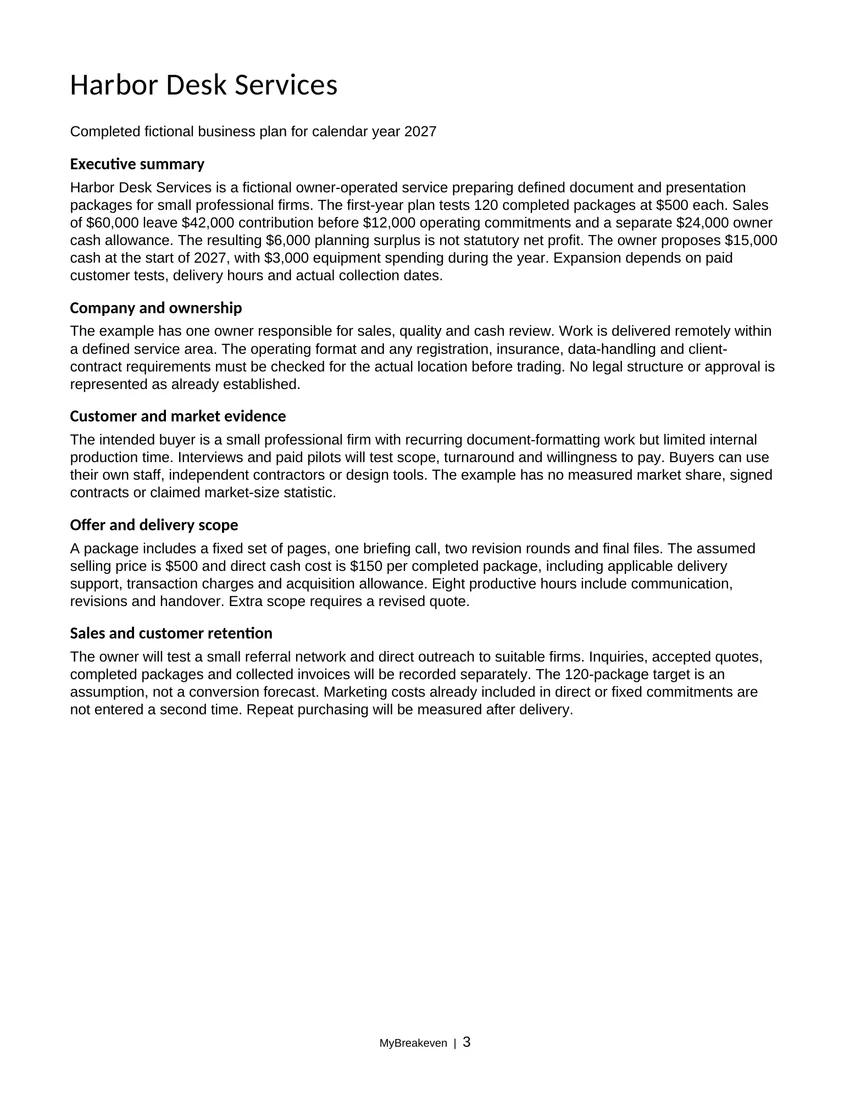
Harbor Desk Services is a fictional owner-operated service preparing defined document and presentation packages for small professional firms. The first-year plan tests 120 completed packages at $500 each. Sales of $60,000 leave $42,000 contribution before $12,000 operating commitments and a separate $24,000 owner cash allowance. The resulting $6,000 planning surplus is not statutory net profit. The owner proposes $15,000 cash at the start of 2027, with $3,000 equipment spending during the year. Expansion depends on paid customer tests, delivery hours and actual collection dates.
Before sharing your own version, replace the business name, customer claim, price, costs, hours and funding source together. A claim of strong demand needs evidence such as paid pilots or accepted work; it cannot be inferred from the revenue target.
Completed example: Harbor Desk Services
This original fictional case is a defined document-and-presentation service. All prices, customer volumes and costs are assumptions. It is not a customer success story, an industry benchmark or a quotation for your location.
Company and ownership
The example has one owner responsible for sales, quality and cash review. Work is delivered remotely within a defined service area. The operating format and any registration, insurance, data-handling and client-contract requirements must be checked for the actual location before trading. No legal structure or approval is represented as already established.
Customer and market evidence
The intended buyer is a small professional firm with recurring document-formatting work but limited internal production time. Interviews and paid pilots will test scope, turnaround and willingness to pay. Buyers can use their own staff, independent contractors or design tools. The example has no measured market share, signed contracts or claimed market-size statistic.
Offer and delivery scope
A package includes a fixed set of pages, one briefing call, two revision rounds and final files. The assumed selling price is $500 and direct cash cost is $150 per completed package, including applicable delivery support, transaction charges and acquisition allowance. Eight productive hours include communication, revisions and handover. Extra scope requires a revised quote.
Sales and customer retention
The owner will test a small referral network and direct outreach to suitable firms. Inquiries, accepted quotes, completed packages and collected invoices will be recorded separately. The 120-package target is an assumption, not a conversion forecast. Marketing costs already included in direct or fixed commitments are not entered a second time. Repeat purchasing will be measured after delivery.
Operations and management
The first year assumes 1,200 productive hours. At eight hours per package, the practical annual ceiling is 150 whole packages, compared with 120 planned. The owner must support these hours with a workable calendar that also allows selling, administration and leave. Supplier and contractor quotes, backup arrangements, review steps and permissions are evidence to obtain.
Financial plan and funding
At $350 contribution per package, $12,000 operating commitments plus a $24,000 owner cash allowance require 103 whole packages, rounded up. The 120-package case leaves $6,000 after those commitments. Opening cash is $15,000, supported by a proposed owner funding source rather than an approved loan. Ninety percent of annual sales is collected within the same year and the balance in the following year in this simplified example. Year-end cash is $12,000 after $3,000 equipment cash spending; $6,000 sales remains receivable. No new funding is assumed later.
Risks milestones and review
Before scaling, the owner will complete paid pilots, record full delivery time and validate the collection terms. At only 90 first-year packages, the same commitments produce a $4,500 shortfall after owner allowance and $3,000 year-end cash after equipment, below the illustrative $5,000 floor. The owner will postpone discretionary spending, revise scope or seek confirmed funding before making commitments. Monthly actuals and quarterly decisions replace unsupported annual growth assumptions.
Appendix and evidence register
The appendix will retain interview notes, paid-pilot records, accepted scopes, supplier quotes, delivery-hour logs, collection terms and a funding record. A decision log will name each assumption, source date, owner and next review. No attachment in this fictional example is represented as an actual customer contract, quote or audited financial statement.
Check the first-year financial example
| Measure | Calculation |
|---|---|
| Revenue | 120 × $500 = $60,000 |
| Contribution | $60,000 − $18,000 direct costs = $42,000 |
| After owner allowance | $42,000 − $12,000 fixed cash − $24,000 owner cash = $6,000 |
| Whole packages for commitments | Round up $36,000 ÷ $350 = 103 |
| Delivery ceiling | 1,200 productive hours ÷ 8 = 150 whole packages |
| Closing cash | $15,000 + $54,000 collected − $54,000 operating and owner cash − $3,000 equipment = $12,000 |
Contribution is revenue less the specified direct costs. Fixed operating cash commitments are separate from the owner cash allowance. The worksheet shows the result before that allowance and the planning result after it. Accounting and tax treatment depend on the actual business arrangement. Do not describe the post-allowance result as statutory net profit.
For the 2027 example, the same $350 contribution must cover $12,000 fixed commitments and $24,000 owner support. The 103-package rounded minimum is below the assumed 120 packages and 150-package capacity. Neither the target nor capacity proves demand. Include paid delivery support and owner work once within a consistent cost boundary.
Test a weaker first year
At 90 packages with unchanged price, costs, collection share and owner allowance, contribution falls to $31,500 and the result after commitments becomes −$4,500. Collections are $40,500. Opening $15,000 less $9,000 trading cash use and $3,000 equipment leaves $3,000 year-end cash, below the illustrative $5,000 floor. Name the spending, scope or funding response before committing.
Attach the financial schedules your reader needs
The Word example is a readable financial explanation. It does not replace the income statements, balance sheets, cash flow statements, capital schedules or historical records a lender, investor or owner may need. Build the first year with monthly or quarterly detail and keep later annual assumptions traceable.
The completed case collects $54,000 of its $60,000 first-year sales and leaves $6,000 receivable. Equipment uses $3,000 cash without automatically becoming a full current-year operating expense. Owner allowance is shown separately so the same work is not paid twice in the example.
Use the dated 13-week cash forecast for payroll, supplier and settlement dates. Annual positive cash can conceal a shortage before receipts arrive. For launch costs and the initial funding gap, use the business startup cost calculator. Opening either tool does not transfer these document or workbook inputs.
Review the plan before sharing or expanding
- Match the narrative and numbers. Update volume, scope, team hours, contribution, owner support, funding and collections together.
- Check evidence. Retain source dates, paid tests, accepted scopes, supplier records and delivery logs. Keep unresolved assumptions visible.
- Assign the next action. Give each milestone an owner, review date, measurable approval condition and response if the test fails.
- Compare actuals with the same plan. Review the first year monthly, record explanations and revisit the remaining years at quarterly decisions. Preserve the previous approved version.
- Fit the recipient’s request. Attach the statements and records they require. Remove examples from the submitted plan and identify projections as assumptions.
Use the budget-versus-actual worksheet for a recurring numerical review and the rolling forecast guide when extending the next twelve months. A five-year strategic plan and a rolling operational forecast serve different review horizons.
Frequently asked questions
What does the free business plan template include?
The editable Word file contains a blank detailed outline, executive-summary prompts, a completed fictional service-business narrative and a checked financial example. No email or account is required.
How is this different from the one-page business plan?
The one-page resource summarizes a decision. This detailed outline gives space for customer evidence, delivery scope, management, funding, financial assumptions, risks and an appendix. Use the shorter summary after checking the supporting plan.
What belongs in an executive summary?
State the customer and offer, the evidence supporting the plan, the operating and funding requirement, the main constraints and the next approval. Write it after the body and financial schedules agree.
Does the Word document include complete financial statements?
No. It includes a transparent annual example. Attach the income statements, balance sheets, cash flow forecasts and supporting schedules required by your reader, with monthly or quarterly first-year detail where needed.
Are the example customers and prices real?
No. Harbor Desk Services and all amounts are fictional planning assumptions. Replace them with your own customer evidence, accepted scopes, cost quotes, hours and collection terms.
Can this guarantee a business loan?
No. A recipient may require additional records, a particular format and an independent assessment. A written plan and an illustrative funding assumption are not loan approval.
References and specialist templates
The U.S. Small Business Administration business-planning guidance describes traditional and lean planning and the financial outlook a reader may need. This resource uses original prompts, examples and calculations; it is not an SBA-issued or approved plan.
Use the existing landscaping, marketing agency or ecommerce business plan when the specialist operating assumptions fit your task. Explore all business planning resources and read our editorial and correction standards.