
Operating Cash Flow: Formula, Calculation and Example
Published by MyBreakeven. Editorial standards and corrections. Report a calculation or content issue to support@mybreakeven.com.
Calculate operating cash flow with direct and indirect methods, a reconciled example, working-capital sign rules and a checker with current-values CSV.
TRY THE RECONCILIATION
Operating cash flow checker
Start with the fictional $2,000 example. Enter changes as closing minus opening: an increase is positive and a decrease negative. Use the same period and operating classifications in both views. Amounts are USD; no conversion is performed.
Noncash and other adjustments are signed totals already verified against your records. Include each adjustment once. The checker does not identify omitted accounts, classify tax or interest, or prepare a complete cash flow statement.
Other operating liabilities include only the relevant signed accrual/tax-payable changes under your chosen policy. Borrowing and cash balances are excluded. Enter zero explicitly when a relevant input is zero.
- Indirect operating cash flow
- $2,000.00
- Direct operating cash flow
- $2,000.00
- Difference: indirect − direct
- $0.00
Totals match. This checks the arithmetic, not source-record completeness or compliance.

Operating cash flow (OCF) is the cash generated or used by operating activities during a stated period. It is also called cash flow from operations or CFO. It separates day-to-day business cash generation from investing and financing movements. Revenue, net income and EBITDA each measure something different; none can simply be relabeled as OCF.
Cedar Supply, our fictional reseller, reports $100,000 March sales and $9,000 net income but only $2,000 operating cash flow. Below, actual receipts minus payments and a net-income reconciliation reach the same amount. All USD inputs are invented for instruction. The example uses a simplified US-style nonfinancial-business policy with interest and income tax paid in operations, no interest payable movement, and no foreign-exchange or noncash balance changes.
Operating cash flow formula: choose the presentation
Direct OCF = operating cash receipts − operating cash payments. Use actual collections rather than booked sales and actual payments rather than recognized expenses. Keep capital purchases and debt principal outside that operating subtotal under the example policy.
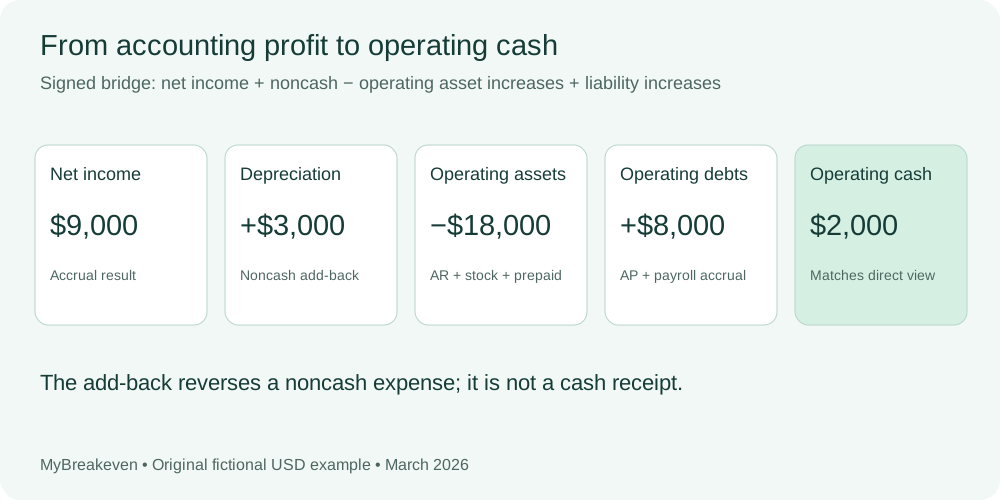
Indirect OCF = net income + included noncash adjustments − increases in operating assets + increases in operating liabilities + other signed reconciliation adjustments. Decreases reverse the signs. “Other adjustments” may remove investing or financing gains/expenses according to the reporting framework. The formula is a reconciliation structure, not permission to include cash, borrowings or every current account in working capital.
For the full operating/investing/financing layout, use the cash flow statement guide. This page focuses on calculating and diagnosing its operating section.
Worked example: start from opening and closing balances
| Operating account | Opening | Closing | Change: closing − opening |
|---|---|---|---|
| Trade receivables | 20,000 | 32,000 | +12,000 |
| Inventory | 15,000 | 20,000 | +5,000 |
| Prepaid operating costs | 2,000 | 3,000 | +1,000 |
| Supplier payables for inventory | 12,000 | 19,000 | +7,000 |
| Accrued payroll | 3,000 | 4,000 | +1,000 |
| Income tax payable | 1,000 | 1,000 | 0 |
Income is $100,000 sales − $55,000 COGS − $20,000 payroll − $10,000 other operating expense − $3,000 depreciation − $1,000 interest − $2,000 tax = $9,000. All sales are on credit before collection; there are no sales returns, VAT/sales tax flows, credit losses, acquisitions or other balance changes in this intentionally limited example. Inventory payables relate only to inventory, payroll accruals only to payroll, and the prepayment only to the other-expense line.
Indirect method: reconcile $9,000 profit to $2,000 cash
| Bridge line | Effect on OCF | Running total |
|---|---|---|
| Net income | 9,000 | 9,000 |
| Add back depreciation | +3,000 | 12,000 |
| Receivables increased | −12,000 | 0 |
| Inventory increased | −5,000 | −5,000 |
| Prepaid operating costs increased | −1,000 | −6,000 |
| Inventory supplier payables increased | +7,000 | 1,000 |
| Payroll accruals increased | +1,000 | 2,000 |
| Tax payable unchanged | 0 | 2,000 |
Receivables rising means some recognized sales remain uncollected. Inventory rising means more cost is held in stock rather than released into this period’s COGS. Higher prepaid costs mean cash paid exceeds the related current expense. Higher supplier payables and payroll accruals mean some recognized costs have not yet been paid. These explanations depend on the stated clean roll-forwards; real movements need reconciliation for write-offs, reclassifications, acquisitions and exchange differences.
Direct method: derive receipts and payments independently
| Cash line | Calculation | Amount |
|---|---|---|
| Customer collections | 100,000 sales + 20,000 opening AR − 32,000 closing AR | 88,000 |
| Inventory purchases | 55,000 COGS + 20,000 closing stock − 15,000 opening stock | 60,000 |
| Supplier cash payments | 60,000 purchases + 12,000 opening AP − 19,000 closing AP | 53,000 |
| Employee cash payments | 20,000 expense + 3,000 opening accrual − 4,000 closing accrual | 19,000 |
| Other operating payments | 10,000 expense + 3,000 closing prepayment − 2,000 opening prepayment | 11,000 |
| Interest cash payment | 1,000 expense; no payable change | 1,000 |
| Tax cash payment | 2,000 expense + 1,000 opening payable − 1,000 closing payable | 2,000 |
| Total operating cash payments | 53,000 + 19,000 + 11,000 + 1,000 + 2,000 | 86,000 |
| Operating cash flow | 88,000 receipts − 86,000 payments | 2,000 |
Purchases are $60,000 but supplier cash paid is $53,000; COGS is $55,000. Those three numbers are not interchangeable. There is no $3,000 depreciation payment in the direct view. If your indirect and direct totals differ, check the period, account scope, signs and missing adjustments before concluding that one method produces more cash.
Working-capital signs: use operating changes only
| Account movement | Indirect effect | Reason to investigate |
|---|---|---|
| Receivables or inventory increase | Subtract | Recognized sales remain uncollected, or cash is held in stock |
| Receivables or inventory decrease | Add | Collections or inventory release may exceed current sales/cost recognition |
| Operating payable or accrual increase | Add | Some recognized operating costs remain unpaid |
| Operating payable or accrual decrease | Subtract | Cash settles prior obligations as well as current costs |
| Borrowing increases | Not an operating adjustment here | Financing source; not unpaid operating expenditure |
| Cash increases | Do not subtract as working capital | It is the result being explained |
Do not use total net working capital from a balance sheet mechanically. It may include cash, debt, tax or non-operating items with different classification requirements. A supplier-finance arrangement also needs its actual terms and the applicable reporting rules reviewed. The working-capital calculation guide addresses the balance-sheet liquidity measure; the operating bridge is a narrower cash-reconciliation task.
Is positive or negative operating cash flow good?
Positive OCF means this period’s included operating receipts exceed its operating payments. It does not prove bills were paid on time or that the result will repeat. In Cedar Supply, the $8,000 combined increase in supplier and payroll obligations supports the cash result. A separate scenario with those increases removed and everything else unchanged would produce −$6,000 OCF. That scenario isolates payment timing; it does not claim the suppliers have agreed to any terms.
Negative OCF can accompany a planned inventory build or receivables growth, but also recurring losses or poor collections. Identify the cause, the dated funding need and the evidence of eventual recovery. Repeated borrowing to cover negative contribution does not repair the underlying economics. Use the cash-flow diagnosis and recovery example to separate a timing gap from a business-model problem. There is no universal healthy OCF threshold for every company or month.
OCF versus net income, EBITDA and net cash flow
| Measure | What it reflects | What Cedar Supply shows |
|---|---|---|
| Net income | Accrual revenue and expenses including depreciation, interest and tax in this example | 9,000 |
| EBITDA, simple example definition | Net income + interest + tax + depreciation; no amortization here | 15,000; not cash and not a universal adjusted-EBITDA definition |
| Operating cash flow | Included operating cash generation after the stated classifications | 2,000 |
| Net cash change | Operating + investing + financing in this no-FX example | 0 |
Subtracting equipment expenditure from OCF is a separate cash measure and does not change OCF itself. Cash-flow ratios, valuation and the full free-cash-flow task have their own scope. Before comparing companies, check period length, seasonality, policies, acquisitions and the denominator definitions rather than comparing an isolated number.
Download the operating reconciliation record
Download the OCF reconciliation CSV. It contains opening and closing operating balances, the signed indirect bridge, the direct reconstruction and evidence columns. It is a values-only record rather than a formula workbook. The checker above exports your currently valid inputs and computed totals separately; neither file automatically extracts accounts from your ledger.
Before closing the period, tie net income to the income statement; tie balance changes to supporting ledgers; remove noncash and non-operating changes; compare the two operating totals; and investigate every difference. Carry the verified operating subtotal into the net cash flow calculator alongside investing and financing. Then use a dated forecast to examine future payment coverage.
Method, reporting policy and sources
The SEC cash flow building blocks supports the direct/indirect distinction. All Cedar Supply calculations are original. The SEC financial statements introduction explains how the cash and accrual reports connect. This article uses the stated simplified US-style basis, not a universal compliance formula.
IAS 7 has related amendments under IFRS 18, effective for annual periods beginning January 1, 2027 or later, with early application permitted. Those amendments change the indirect-method starting subtotal and interest/dividend requirements. Check which version and adopted framework applies before using a net-income bridge for formal reporting. Sources checked October 25, 2026.
Check the account scope behind the working-capital adjustment
Use the net, trade and operating working capital comparison to verify the included accounts before adjusting cash flow. Its change-in-working-capital example explains why collecting an invoice and writing one off do not have the same cash effect.
Reconcile earnings before interpreting cash
The EBITDA calculator traces net income and included add-backs. Follow the EBITDA versus net income versus cash-flow example to see why the earnings subtotal and operating cash can differ.
Frequently asked questions
What is the operating cash flow formula?
The direct approach subtracts operating cash payments from operating receipts. A net-income indirect bridge adds included noncash adjustments, subtracts operating asset increases, adds operating liability increases and includes other required signed adjustments under the stated policy.
Why is an increase in receivables subtracted?
In the clean example, recognized sales exceed collections by the receivables increase. Subtracting that increase converts the accrual sales effect to cash. Noncash or acquisition changes need separate reconciliation.
Is depreciation a source of operating cash?
No. Adding back depreciation reverses an expense that reduced net income without a current cash payment. It does not create a new receipt.
Can operating cash flow be negative when net income is positive?
Yes. Inventory, receivables, prepayments and payments of older obligations can absorb more cash than current profits provide. Identify timing, balance movements and recurring operating economics.
Does the checker classify accounts or verify compliance?
No. It checks entered signed adjustments and compares them with a separately entered direct operating total. You must verify the dates, reporting policy and completeness of the source records.
Browse the MyBreakeven blog hub for related planning guides.
Planning estimates only—not accounting, tax, legal or lending advice.