
Straight-Line Depreciation: Formula, Partial Periods and Schedule
Published by MyBreakeven. Editorial standards and corrections. Report a calculation or content issue to support@mybreakeven.com.
Calculate straight-line depreciation with supported cost, residual value, useful life and partial periods. Reconcile a complete editable sixty-month schedule.

Straight-line depreciation allocates the depreciable amount evenly across the selected time-based useful life. Annual allocation equals cost minus residual value, divided by life in years; a partial-period schedule must use an explicit start date and time convention.
All amounts and operating results below are original fictional teaching examples in USD. They are not customer results, industry averages or forecasts. Use your own dated records and applicable accounting policies.
Define cost, life, residual and in-use date
For this independent service-asset case, capitalized cost is $14,000, residual value $2,000 and useful life five years. The asset is available for intended use on April 1, 2027. The example adopts a whole-month convention beginning that date and assumes no impairment, disposal, method switch or estimate change. These are teaching assumptions, not mandatory asset lives or a universal partial-month rule.
The purchase invoice can precede readiness for use. Keep evidence of the in-use date and explain any capitalization policy. Tax conventions can differ from this financial-reporting month count; do not automatically apply a tax half-year or mid-quarter convention to this schedule.
Compute the annual and monthly amounts once
Depreciable amount = $14,000 − $2,000 = $12,000. Annual straight-line depreciation = $12,000 / 5 = $2,400. Monthly amount = $2,400 / 12 = $200. Equivalently, $12,000 / 60 months = $200 per month. The full-year rate is 20% of the depreciable amount, not 20% of cost without considering residual value.
April through December includes nine months under the stated convention, so 2027 allocation is $200 × 9 = $1,800. Nine months is not a universal rule for every April purchase; it follows this exact in-use date and policy.
Reconcile the complete calendar-year schedule
| Calendar period | Months | Period allocation | Closing accumulated | Closing carrying amount |
|---|---|---|---|---|
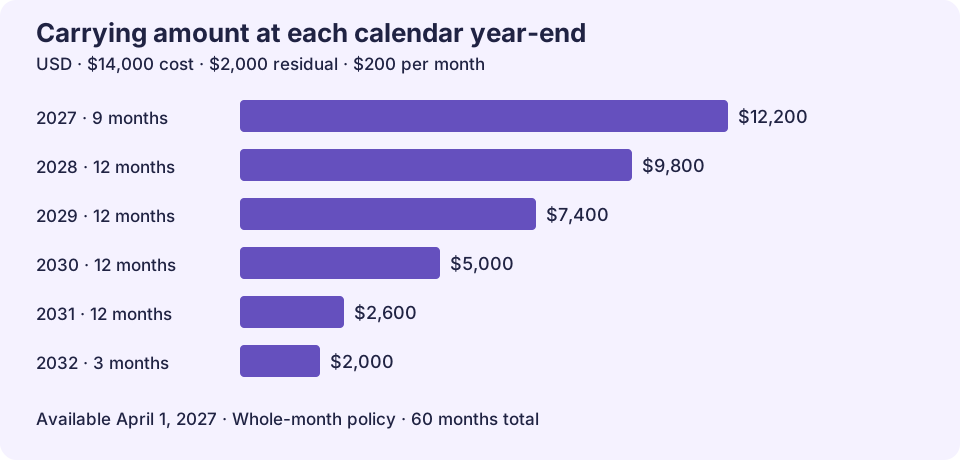
| 2027 Apr–Dec | 9 | 1,800 | 1,800 | 12,200 |
| 2028 | 12 | 2,400 | 4,200 | 9,800 |
| 2029 | 12 | 2,400 | 6,600 | 7,400 |
| 2030 | 12 | 2,400 | 9,000 | 5,000 |
| 2031 | 12 | 2,400 | 11,400 | 2,600 |
| 2032 Jan–Mar | 3 | 600 | 12,000 | 2,000 |
| Total | 60 | 12,000 | 12,000 closing | 2,000 residual |
The six calendar rows cover only five years of useful life: 9 + 12 + 12 + 12 + 12 + 3 = 60 months. Four full intervening calendar years allocate $9,600. The first $1,800 and final $600 complete the $12,000 depreciable amount. Closing carrying amount stops at the $2,000 residual; do not charge another full $2,400 in 2032.
Post the allocation without inventing another cash payment
If the first nine months are all period expense in this service example, debit Depreciation Expense and credit Accumulated Depreciation by $1,800 for 2027. The original asset cost remains $14,000, accumulated depreciation becomes $1,800 and carrying amount is $12,200. No cash leaves the bank merely because that entry is posted.
Production assets may contribute depreciation to inventory costs instead. The example does not prescribe that classification for every business. Keep acquisition cash, capitalization, current allocation and eventual expense recognition traceable rather than automatically treating them as one payment.
Handle changes and rounding with a documented policy
Reassess estimates when supported facts change. A change in remaining life or residual value may change future allocation; do not silently rewrite old months or automatically treat an estimate revision as an error. An actual disposal or impairment also requires its own analysis. Use the applicable framework and approval process.
For a monthly amount that is not exact to cents, retain calculation precision and reconcile the final allocation to the intended residual. Do not round every input repeatedly and then allow the schedule to drift below its floor. This worksheet is manual and does not enforce that check automatically.
Keep the method tutorial separate from the balance rollforward
The depreciation overview compares time, usage and declining patterns. The accumulated-depreciation guide reconciles additions, current allocations and removals. The bookkeeping close provides the recurring review routine.
Record your cost evidence, readiness date, life, residual, convention and reviewer in the downloadable schedule. If any is unknown, the result is provisional; a precise formula cannot supply missing business evidence.
Download the editable worksheet
Download the printable HTML worksheet. It contains the completed case and a separate blank working record. It does not calculate automatically. Edit in your browser, then print or save a completed copy before closing; your edits are not sent to MyBreakeven.
Sources and scope
Primary references below support the stated definitions or framework. The worked case, numbers and decision records are original MyBreakeven material. Reviewed November 7, 2026; no external professional sign-off is claimed.
Frequently asked questions
Why does a five-year asset appear in six calendar years?
The first and last calendar years are partial. The schedule still contains exactly sixty months.
Does straight line use cost without residual value?
The depreciable amount is cost less the supported residual estimate.
Is purchase date always the depreciation start date?
Not necessarily. Check readiness for intended use and the applicable reporting policy.
Does this calculate a tax deduction?
No. It is a financial-reporting illustration with a stated time convention.
Browse the MyBreakeven blog hub for related planning guides.
Planning estimates only—not accounting, tax, legal or lending advice.