
Bookkeeping for Small Business: A Monthly Record Workflow
Published by MyBreakeven. Editorial standards and corrections. Report a calculation or content issue to support@mybreakeven.com.
Organize transaction evidence, reconcile cash and customer balances, review adjustments and close the month with an original bank-reconciliation example.
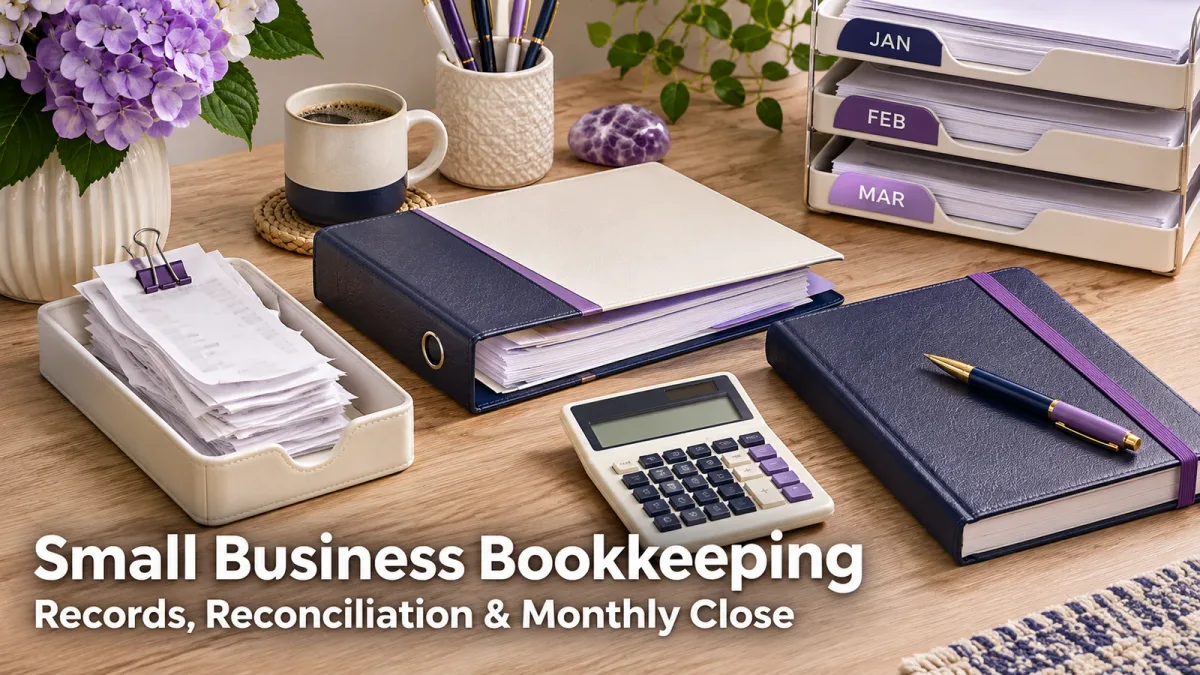
Small-business bookkeeping turns supported transactions into consistent records and reconciled balances. A useful monthly routine collects evidence, posts transactions once, resolves differences and preserves a reviewed closing package.
All amounts and operating results below are original fictional teaching examples in USD. They are not customer results, industry averages or forecasts. Use your own dated records and applicable accounting policies.
Build the record around evidence rather than the bank feed
Keep an identifiable link between each posting and the underlying sale, supplier bill, receipt, payroll record or agreement. The IRS describes supporting business documents as the evidence behind entries. Its tax-record guidance is not a substitute for your financial-reporting policy, but it reinforces why a bank description alone may not explain what a transaction represents.
Assign a unique reference, reporting date, amount, currency, counterparty and account. Separate business and personal activity appropriately. A bank feed entry can match an invoice payment already recorded; importing it as another sale would duplicate income. Keep unidentified items in a visible investigation list rather than assigning convenient categories.
Separate daily capture from the monthly close
| Frequency | Work | Evidence of completion |
|---|---|---|
| Daily / weekly | Collect and match documents; post invoices and payments | Unique references; no unexplained duplicates |
| Weekly | Review customer and supplier open items | Detail reconciles to control accounts |
| Month end | Reconcile cash, cards, loans and relevant stock | Dated schedules with differences explained |
| Month end | Review accruals, prepayments and asset schedules | Approved adjustments linked to evidence |
| Close | Review reports and preserve the version | Reviewer, unresolved issues and next actions |
Frequency depends on transaction volume and commitments, not a universal deadline invented by this guide. A business with payroll this week may need cash review before the formal month-end close. The formal close should use a consistent cutoff across reports.
Reconcile a bank difference without inventing a plug
| Record / adjustment | Amount | Reason |
|---|---|---|
| Cash book before omitted bank fee | $9,750 | 8,000 opening + 6,200 receipts − 4,450 payments |
| Unrecorded bank fee | −$50 | Post supported fee once |
| Adjusted cash book | $9,700 | Agrees to adjusted bank evidence |
| Statement balance | $9,850 | Statement at same month-end cutoff |
| Deposit in transit | +$250 | Already in books; absent from bank |
| Outstanding payment | −$400 | Already in books; absent from bank |
| Adjusted statement | $9,700 | 9,850 + 250 − 400 |
The $50 fee is missing from the books, so it needs a supported book entry. The $250 deposit and $400 outstanding payment are already recorded in the books; adding or subtracting them there again would duplicate their effects. Their role is to explain the statement timing. Both adjusted views reach $9,700.
An equal result does not validate every payment. Verify the recipient, amount and business purpose. Investigate old reconciling items and retain evidence of later clearing. Do not force unexplained differences into fees or owner equity.
Reconcile detail before accepting the report totals
In a separate customer subledger example, $3,000 opening receivables + $6,000 invoices − $5,200 allocated collections = $3,800 closing gross receivables. If the GL says $3,600, identify the $200 difference before treating the report as reconciled. Check credits, manual journals, duplicate invoices and unapplied receipts. This is independent of the bank example’s total receipts.
Use AR records and AP records for their respective workflows. Match asset cost and accumulated depreciation to an asset register. Check prepayment periods and accrued obligations. An account can reconcile mathematically while its valuation or classification still needs review.
Preserve the close and the unresolved-action list
Review unusual balances and changes against actual operations. Retain the trial balance, reconciliations, adjustment support and reports with their cutoff date. Assign an owner and deadline to each remaining issue. A lock date is useful only when corrections are still made through a controlled, documented process rather than silently changing prior reports.
The general ledger template supplies posting references and account-level balances; the accounting cycle explains adjustments and closing. The statement-analysis guide addresses interpretation after the records are prepared. Check the actual retention requirements for each document type; this article does not assert a single period for every business record.
Download the editable worksheet
Download the printable HTML worksheet. It contains the completed case and a separate blank working record. It does not calculate automatically. Edit in your browser, then print or save a completed copy before closing; your edits are not sent to MyBreakeven.
Sources and scope
Primary references below support the stated definitions or framework. The worked case, numbers and decision records are original MyBreakeven material. Reviewed November 7, 2026; no external professional sign-off is claimed.
Frequently asked questions
Is the bank feed the whole bookkeeping system?
No. It does not by itself explain unpaid invoices, noncash adjustments or the purpose and period of every transaction.
Should deposits in transit be entered again?
Not if already recorded correctly. Use them to explain timing between books and statement.
Can I close with an unexplained difference?
Record it as unresolved and investigate; do not conceal it with an unsupported balancing entry.
Does this guide recommend accounting software?
No. It defines the evidence and reconciliation workflow independently of a product.
Browse the MyBreakeven blog hub for related planning guides.
Planning estimates only—not accounting, tax, legal or lending advice.