
Assets, Liabilities and Equity: Accounting Equation Examples
Published by MyBreakeven. Editorial standards and corrections. Report a calculation or content issue to support@mybreakeven.com.
Follow eight reconciled transactions through assets, liabilities and equity. Separate profit, borrowing, customer collections and owner withdrawals.

The accounting equation is assets = liabilities + equity. Assets show recognized resources, liabilities show obligations, and equity is the residual interest. Every recorded transaction must preserve the equality even when cash, profit and debt move differently.
All amounts and operating results below are original fictional teaching examples in USD. They are not customer results, industry averages or forecasts. Use your own dated records and applicable accounting policies.
Read the equation as a relationship, not a valuation
The SEC financial-statement guide describes the balance sheet as a snapshot. Book equity is the accounting residual; it is not a promise of the price a business could sell for. A resource can be useful without all of its economic value appearing as a recognized asset. The equation alone does not tell you whether customer demand, liquidity or future profitability is strong.
Owner investment and earned income both can increase equity but represent different activity. Borrowing increases an obligation rather than creating revenue. An owner withdrawal reduces the owner’s interest; it is not automatically an operating expense. This simplified service example uses an accrual view with no tax, inventory, depreciation, interest or other omitted period adjustments.
Trace eight transactions without losing the balance
| Transaction | Total assets | Total liabilities | Equity |
|---|---|---|---|
| Owner invests $18,000 | $18,000 | $0 | $18,000 |
| Borrow $6,000 | $24,000 | $6,000 | $18,000 |
| Buy $5,000 equipment for cash | $24,000 | $6,000 | $18,000 |
| Earn and invoice $4,000 service | $28,000 | $6,000 | $22,000 |
| Collect $2,500 of that invoice | $28,000 | $6,000 | $22,000 |
| Incur $1,200 unpaid expense | $28,000 | $7,200 | $20,800 |
| Pay $700 of the expense | $27,300 | $6,500 | $20,800 |
| Owner withdraws $800 | $26,500 | $6,500 | $20,000 |
Buying the equipment exchanges $5,000 cash for $5,000 equipment: total assets do not change in this simplified initial-recognition example. Earning the service creates $4,000 receivable and increases equity through income. Collecting $2,500 exchanges receivable for cash without earning the revenue again. Incurring the unpaid $1,200 expense increases liabilities and reduces equity; paying $700 later reduces cash and the liability together.
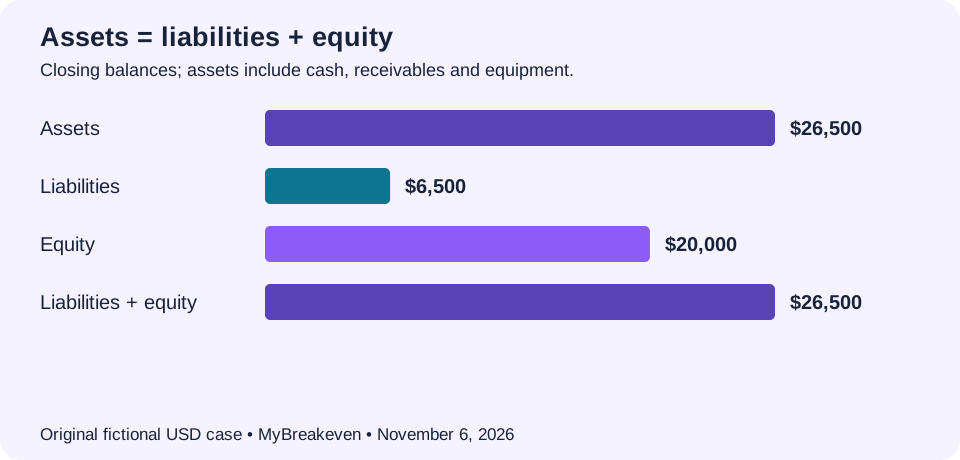
The last row balances: $26,500 = $6,500 + $20,000. An equal balance is necessary, but it does not prove that the correct accounts, period or amounts were used. Recording the same wrong amount on both sides still balances.
Reconcile the closing accounts and equity bridge
| Asset account | USD | Liability / equity account | USD |
|---|---|---|---|
| Cash | 20,000 | Loan | 6,000 |
| Accounts receivable | 1,500 | Unpaid expense | 500 |
| Equipment | 5,000 | Owner equity | 20,000 |
| Total | 26,500 | Total | 26,500 |
Cash is $18,000 + $6,000 − $5,000 + $2,500 − $700 − $800 = $20,000. Equity is $18,000 investment + $4,000 earned revenue − $1,200 expense − $800 withdrawal = $20,000. Included profit is $2,800, while cash increased $20,000 from zero because investment, borrowing and asset purchases also affect cash. Do not use the cash change as profit.
Find errors the equality will not reveal
Use source documents to confirm that a customer collection has not been recorded as new revenue. Check that a bank loan was not posted to sales and that an equipment payment was not automatically treated as an immediate period expense. Review whether an unpaid invoice belongs to the period. Each error can leave a superficially balanced ledger.
A negative equity balance is possible and needs analysis of accumulated losses, distributions and the relevant accounting basis. It is not a negative cash balance by definition. Likewise, an asset-heavy business can have little available cash. See current asset classification and current liability classification before interpreting short-term coverage.
Use the equation inside a complete close
Start from reconciled opening balances, post supported transactions, complete necessary period adjustments and compare detailed accounts with the statement totals. Retain the prior version and the reason for every correction. Do not force a difference into equity just to make the statement balance.
The AR workflow and AP workflow help support two common balances. Continue with financial statement analysis for the relationship among performance, balances and cash. This primer does not replace journal-entry policy, a full closing checklist or specialist review.
Download the editable worksheet
Download the printable HTML worksheet. It contains the completed case and a separate blank working record. It does not calculate automatically. Edit in your browser, then print or save a completed copy before closing; your edits are not sent to MyBreakeven.
Sources and scope
Primary references below support the stated definitions or framework. The worked case, numbers and decision records are original MyBreakeven material. Reviewed November 6, 2026; no external professional sign-off is claimed.
Frequently asked questions
Is equity the same as cash?
No. Equity is assets less liabilities under the accounting basis. Cash is one asset.
Does collecting an invoice create revenue again?
Not when the revenue was already recognized. It exchanges receivable for cash.
Does a loan increase profit?
Borrowed principal creates an obligation; it is not earned revenue.
Does a balanced equation prove the accounts are correct?
No. Wrong accounts, duplicated transactions or incorrect timing can still preserve equality.
Browse the MyBreakeven blog hub for related planning guides.
Planning estimates only—not accounting, tax, legal or lending advice.