
FREE BUSINESS PLANNING RESOURCE
Marketing Agency Business Plan Template
Build a marketing agency business plan around defined services, retained clients, delivery hours and payment dates. Get an editable Word plan with a completed fictional example and a 12-month Excel client, capacity and cash workbook.
Get the free templatesDownload the Word plan and Excel financial workbook
No account or email required. The Word document contains a blank outline, a completed narrative and the financial example. The separate Excel workbook starts with editable example inputs for January–December 2027.
In Excel, open Inputs and replace the blue values. Read the monthly calculations and annual totals in Plan. Enter explicit zeros for inapplicable costs; missing inputs make dependent results unavailable. The files use USD labels and do not convert currencies. They are Excel files; Google Sheets compatibility is not claimed.
How to write your marketing agency business plan
A revenue target needs a client roll-forward and a delivery schedule. A full pipeline alone does not establish signed revenue or enough productive hours. Start with evidence from customers and records, then write the executive summary after the operating and cash schedules agree.
Business and ownership
Record the agency niche, ownership, roles and operating model. Define whether delivery uses employees, contractors or the owner.
Customers and demand
Define the buyer, business problem, budget and qualification criteria. Record interview and proposal evidence.
Services and scope
Specify deliverables, revisions, reporting, exclusions, billing dates and change requests. Separate client ad spend from agency revenue.
Sales and retention
Record opening clients, losses and new wins by start date. Tie leads and win rates to a consistent funnel.
Delivery and staffing
Define productive hours by role, onboarding and recurring work. Reconcile contractor costs and payroll without duplication.
Revenue and operating costs
Build revenue from active billable clients and rates. Show direct cost, fixed costs, owner pay and profit separately.
Collections and funding
Record billing dates, current-month collection share, opening receivables and cash. Schedule purchases and principal payments separately.
Risks and response
Set triggers for concentration, churn, late payment, scope creep and excessive workload. Assign a response owner.
Milestones and evidence
Set dated validation, sales, onboarding and capacity milestones. Keep signed contracts separate from forecast wins.
Add an executive summary with the customer, offer, funding need and next milestone. If a bank or investor asks for a particular format, supporting statements or a longer projection, adapt the plan to that request. This download does not imply funding approval.
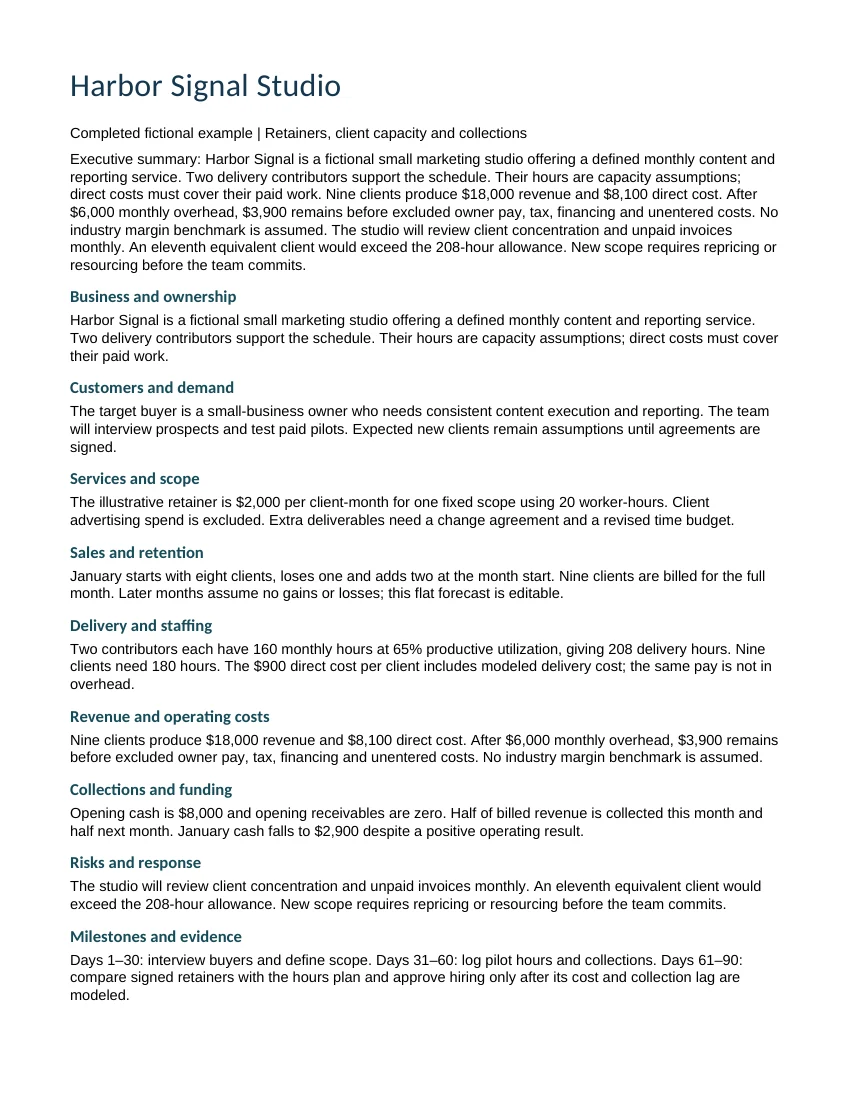
Completed example: Harbor Signal Studio
This is a fictional planning case for small businesses buying a defined monthly marketing service. Figures are assumptions, not industry averages, actual customer results or a forecast of demand.
Business and ownership
Harbor Signal is a fictional small marketing studio offering a defined monthly content and reporting service. Two delivery contributors support the schedule. Their hours are capacity assumptions; direct costs must cover their paid work.
Customers and demand
The target buyer is a small-business owner who needs consistent content execution and reporting. The team will interview prospects and test paid pilots. Expected new clients remain assumptions until agreements are signed.
Services and scope
The illustrative retainer is $2,000 per client-month for one fixed scope using 20 worker-hours. Client advertising spend is excluded. Extra deliverables need a change agreement and a revised time budget.
Sales and retention
January starts with eight clients, loses one and adds two at the month start. Nine clients are billed for the full month. Later months assume no gains or losses; this flat forecast is editable.
Delivery and staffing
Two contributors each have 160 monthly hours at 65% productive utilization, giving 208 delivery hours. Nine clients need 180 hours. The $900 direct cost per client includes modeled delivery cost; the same pay is not in overhead.
Revenue and operating costs
Nine clients produce $18,000 revenue and $8,100 direct cost. After $6,000 monthly overhead, $3,900 remains before excluded owner pay, tax, financing and unentered costs. No industry margin benchmark is assumed.
Collections and funding
Opening cash is $8,000 and opening receivables are zero. Half of billed revenue is collected this month and half next month. January cash falls to $2,900 despite a positive operating result.
Risks and response
The studio will review client concentration and unpaid invoices monthly. An eleventh equivalent client would exceed the 208-hour allowance. New scope requires repricing or resourcing before the team commits.
Milestones and evidence
Days 1–30: interview buyers and define scope. Days 31–60: log pilot hours and collections. Days 61–90: compare signed retainers with the hours plan and approve hiring only after its cost and collection lag are modeled.
Check that the financial plan reconciles
The example assumes gains and losses occur at the month start, so all nine active clients receive a full month of service. Mid-month starts require proration and a separate onboarding allowance. The workbook flags client losses above the opening cohort and insufficient delivery capacity instead of silently treating them as acceptable growth.
The result is sales less the specified direct costs, fixed commitments and entered additional owner pay. It excludes unentered tax, interest, depreciation and other costs. Include compensation for owner delivery work once in the chosen labor boundary. A separate owner draw can require cash without being an operating expense; the workbook's additional owner-pay row is an explicit funding allowance.
Connect the plan to customer receipts and cash payments
January collections of $9,000 are lower than $14,100 modeled cash costs. Opening cash of $8,000 falls to $2,900, while $9,000 remains receivable. February collects the other half plus half of February billings. This simplified model assumes the remaining share arrives the following month, without bad debts or longer delays.
The workbook rolls closing cash and uncollected sales into the next month. Opening cash and receivables apply only in January. The uncollected share is assumed received in the next month; there is no automatic bad-debt or longer-delay calculation. Enter equipment, principal, tax and other cash payments in their separate monthly rows. These cash amounts do not automatically become operating expenses.
Use the dated 13-week cash forecast for payroll dates, supplier deposits, staged funding and within-month cash gaps. A positive month-end balance cannot prove every payment date is covered.
Replace assumptions with evidence before committing money
- Signed scopes and client start/end dates
- Time records by client and delivery role
- Payroll, contractor and software records
- Invoice dates, receipts and outstanding balances
Cost and timing mistakes to avoid
- Do not call gross client advertising spend agency fee revenue.
- Do not charge employee or contractor pay in both direct costs and overhead.
- Separate owner compensation already in delivery cost from additional owner drawings.
- Reforecast client concentration, onboarding and scope changes alongside sales.
A practical 90-day review
In days 1–30, validate the customer problem and gather dated quotes. In days 31–60, run a small paid test and record delivery time, costs and collections. In days 61–90, compare actual results with the same plan and approve expansion only when the demand, hours and cash assumptions are supported. Give each milestone an owner, date and measurable pass condition in your plan.
Use the specialist guide for the next decision
This page owns the editable business plan and its supporting financial schedule. Pricing, job costing and specialist calculations remain on their existing pages. Opening another tool does not transfer the workbook's inputs.
- Agency break-even calculator
- Retainer pricing guide
- Billable utilization guide
- Client profitability guide
Explore all agency business planning guides. For a shorter narrative, use the one-page business plan template.
Frequently asked questions
Are these templates free and editable?
Yes. Download the Word narrative and Excel financial workbook directly without signing up. Replace the fictional example with your records.
Is a business plan the same as a break-even calculation?
No. The plan also describes the customer, offer, sales approach, operations, risks and milestones. Break-even is one check on its financial assumptions.
Can I use the completed example unchanged?
Use it to understand the structure and arithmetic. Its prices, demand, staffing and collection timing are fictional. Replace them before making a business commitment.
Does the workbook show net profit or guarantee enough cash?
No. The result covers only entered costs, and the cash schedule uses monthly timing assumptions. Add omitted costs and use dated cash planning for actual payment decisions.
Method and sources
Published and example arithmetic checked October 24, 2026. The financial schedules are original MyBreakeven examples. They have not received an independent accountant's review. The SBA business-planning guide provides general planning and market-research context; it does not supply the example numbers or endorse these templates. Read our editorial standards and calculation methodology.