
FREE BUSINESS PLANNING RESOURCE
Landscaping Business Plan Template
Write a landscaping business plan that connects repeat visits, route time, seasonal revenue and year-round bills. Download an editable Word plan with a completed fictional example and a separate 12-month Excel workbook.
Get the free templatesDownload the Word plan and Excel financial workbook
No account or email required. The Word document contains a blank outline, a completed narrative and the financial example. The separate Excel workbook starts with editable example inputs for January–December 2027.
In Excel, open Inputs and replace the blue values. Read the monthly calculations and annual totals in Plan. Enter explicit zeros for inapplicable costs; missing inputs make dependent results unavailable. The files use USD labels and do not convert currencies. They are Excel files; Google Sheets compatibility is not claimed.
How to write your landscaping business plan
The same plan must explain who buys, what one visit includes, how the crew delivers it and how the quiet months are funded. Start with evidence from customers and records, then write the executive summary after the operating and cash schedules agree.
Business and ownership
Name the owner, service area, business structure and responsibilities. Record local registration, insurance and service-specific requirements to verify.
Customers and demand
Define the customer, property scope and evidence from interviews, paid trials and comparable local quotes. Separate signed work from targets.
Services and pricing
Define a complete visit, exclusions, revisit policy and seasonal extras. Record time and materials before setting the price.
Acquisition and retention
List channels, spend, qualified enquiries, conversion evidence and renewal dates. Do not count each repeat visit as a new customer.
Operations and staffing
Record travel, setup, worker-hours, equipment availability and weather cancellations. Assign responsibility for route and quality checks.
Seasonal financial plan
List active months, costs that continue off-season, owner compensation and cash collection dates. Link figures to the workbook.
Funding and cash
List opening cash, equipment purchases, deposits, debt payments and a minimum reserve. Explain each source of funding.
Risks and response
Choose specific triggers and responses for weather, route delays, repairs, late invoices and insufficient capacity.
Milestones and evidence
Assign an owner, date, evidence and pass condition to each launch step. Review actual visits, hours, costs and collections monthly.
Add an executive summary with the customer, offer, funding need and next milestone. If a bank or investor asks for a particular format, supporting statements or a longer projection, adapt the plan to that request. This download does not imply funding approval.
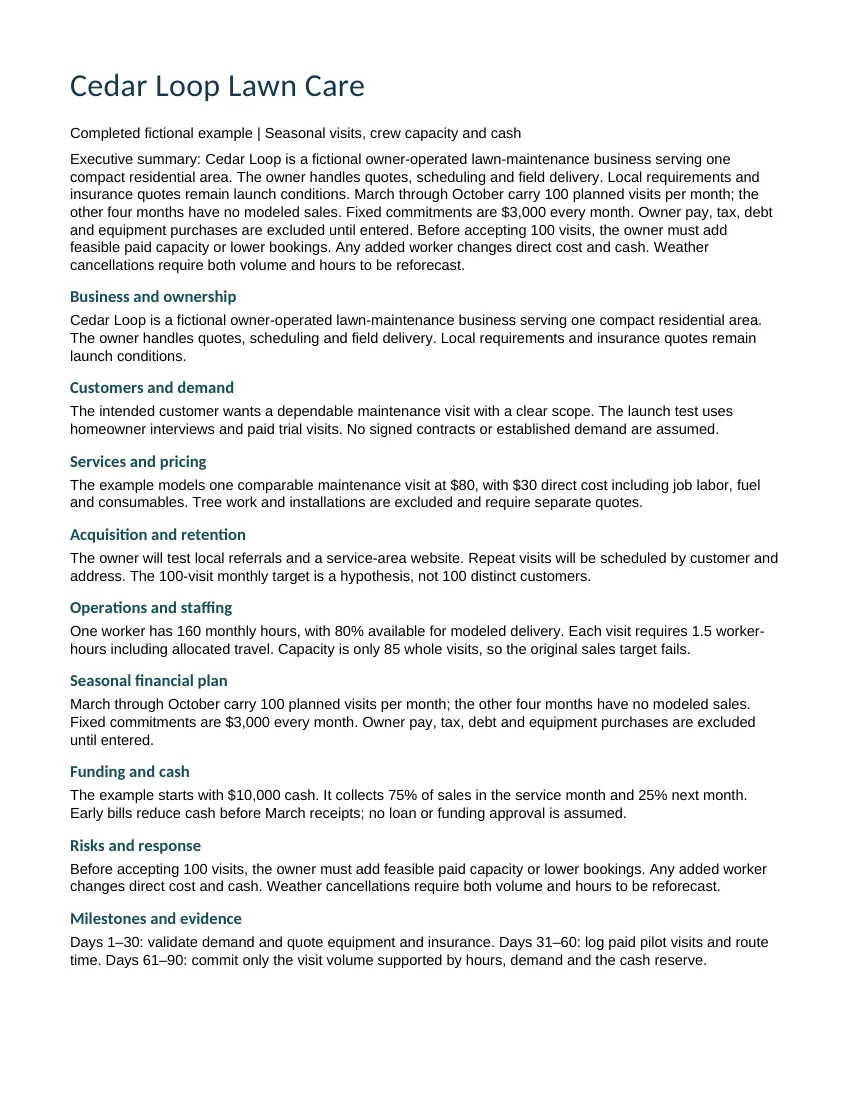
Completed example: Cedar Loop Lawn Care
This is a fictional planning case for residential lawn maintenance within a compact service area. Figures are assumptions, not industry averages, actual customer results or a forecast of demand.
Business and ownership
Cedar Loop is a fictional owner-operated lawn-maintenance business serving one compact residential area. The owner handles quotes, scheduling and field delivery. Local requirements and insurance quotes remain launch conditions.
Customers and demand
The intended customer wants a dependable maintenance visit with a clear scope. The launch test uses homeowner interviews and paid trial visits. No signed contracts or established demand are assumed.
Services and pricing
The example models one comparable maintenance visit at $80, with $30 direct cost including job labor, fuel and consumables. Tree work and installations are excluded and require separate quotes.
Acquisition and retention
The owner will test local referrals and a service-area website. Repeat visits will be scheduled by customer and address. The 100-visit monthly target is a hypothesis, not 100 distinct customers.
Operations and staffing
One worker has 160 monthly hours, with 80% available for modeled delivery. Each visit requires 1.5 worker-hours including allocated travel. Capacity is only 85 whole visits, so the original sales target fails.
Seasonal financial plan
March through October carry 100 planned visits per month; the other four months have no modeled sales. Fixed commitments are $3,000 every month. Owner pay, tax, debt and equipment purchases are excluded until entered.
Funding and cash
The example starts with $10,000 cash. It collects 75% of sales in the service month and 25% next month. Early bills reduce cash before March receipts; no loan or funding approval is assumed.
Risks and response
Before accepting 100 visits, the owner must add feasible paid capacity or lower bookings. Any added worker changes direct cost and cash. Weather cancellations require both volume and hours to be reforecast.
Milestones and evidence
Days 1–30: validate demand and quote equipment and insurance. Days 31–60: log paid pilot visits and route time. Days 61–90: commit only the visit volume supported by hours, demand and the cash reserve.
Check that the financial plan reconciles
A positive annual result does not make the delivery plan feasible. The workbook deliberately exposes the 15-visit capacity shortfall. Changing active-month visits to 85 reduces annual contribution to $34,000 and the result to a $2,000 loss before excluded items. Adding staff instead needs a new cost and hours assumption.
The result is sales less the specified direct costs, fixed commitments and entered additional owner pay. It excludes unentered tax, interest, depreciation and other costs. Include compensation for owner delivery work once in the chosen labor boundary. A separate owner draw can require cash without being an operating expense; the workbook's additional owner-pay row is an explicit funding allowance.
Connect the plan to customer receipts and cash payments
January and February each pay $3,000 commitments with no sales receipts, reducing opening cash from $10,000 to $4,000. March receipts are $6,000, direct payments $3,000 and fixed payments $3,000, leaving cash unchanged at $4,000. March ends with $2,000 uncollected sales. The workbook rolls that receipt into April. Monthly cash totals do not identify a shortfall inside a month.
The workbook rolls closing cash and uncollected sales into the next month. Opening cash and receivables apply only in January. The uncollected share is assumed received in the next month; there is no automatic bad-debt or longer-delay calculation. Enter equipment, principal, tax and other cash payments in their separate monthly rows. These cash amounts do not automatically become operating expenses.
Use the dated 13-week cash forecast for payroll dates, supplier deposits, staged funding and within-month cash gaps. A positive month-end balance cannot prove every payment date is covered.
Replace assumptions with evidence before committing money
- Completed visit and route-time logs
- Customer confirmations and renewal dates
- Equipment, insurance and supplier quotes
- Bank receipts and unpaid invoices
Cost and timing mistakes to avoid
- Treat eight active months and twelve months of bills separately.
- Keep crew elapsed time distinct from total worker-hours.
- Include travel once in the productivity and visit-time boundary.
- Price installation projects separately when their scope differs from routine maintenance.
A practical 90-day review
In days 1–30, validate the customer problem and gather dated quotes. In days 31–60, run a small paid test and record delivery time, costs and collections. In days 61–90, compare actual results with the same plan and approve expansion only when the demand, hours and cash assumptions are supported. Give each milestone an owner, date and measurable pass condition in your plan.
Use the specialist guide for the next decision
This page owns the editable business plan and its supporting financial schedule. Pricing, job costing and specialist calculations remain on their existing pages. Opening another tool does not transfer the workbook's inputs.
- Monthly landscaping break-even calculator
- Lawn route profit calculator
- Seasonal break-even guide
- Equipment cost per hour
Explore all landscaping business planning guides. For a shorter narrative, use the one-page business plan template.
Frequently asked questions
Are these templates free and editable?
Yes. Download the Word narrative and Excel financial workbook directly without signing up. Replace the fictional example with your records.
Is a business plan the same as a break-even calculation?
No. The plan also describes the customer, offer, sales approach, operations, risks and milestones. Break-even is one check on its financial assumptions.
Can I use the completed example unchanged?
Use it to understand the structure and arithmetic. Its prices, demand, staffing and collection timing are fictional. Replace them before making a business commitment.
Does the workbook show net profit or guarantee enough cash?
No. The result covers only entered costs, and the cash schedule uses monthly timing assumptions. Add omitted costs and use dated cash planning for actual payment decisions.
Method and sources
Published and example arithmetic checked October 24, 2026. The financial schedules are original MyBreakeven examples. They have not received an independent accountant's review. The SBA business-planning guide provides general planning and market-research context; it does not supply the example numbers or endorse these templates. Read our editorial standards and calculation methodology.