
Business Feasibility Study: Should This Venture Proceed?
Published by MyBreakeven. Editorial standards and corrections. Report a calculation or content issue to support@mybreakeven.com.
Assess demand, delivery capacity, economics and funding with a worked feasibility study. Use explicit proceed, revise or stop conditions and an editable record.

A business feasibility study investigates whether a defined venture can work under real market, operating, financial and funding constraints. Its output is an evidenced proceed, revise or stop decision with conditions, rather than a document written to justify a decision already made.
All business names, amounts and operating results in the worked examples are fictional teaching assumptions in USD. They are not industry averages, actual customer results or forecasts for your business.
Define the decision and the alternatives
Specify the offer, customer, delivery model, location where relevant, decision horizon and commitments under consideration. Include a smaller pilot or postponement as real alternatives. A study of “starting a business” is too broad to test supplier quotes, customer acceptance or the cash required before launch.
Decide in advance which evidence would change the answer. Separate confirmed facts from estimates and unknowns. Name the owner, date and source for important assumptions. Feasibility investigates whether the venture should proceed; the subsequent business plan develops how an accepted option will operate.
Test five connected forms of feasibility
| Area | Core question | Useful evidence |
|---|---|---|
| Market | Will the defined customer buy at this scope and price? | Paid pilot, buyer interviews and alternatives |
| Technical / operational | Can the team deliver the required quality and volume? | Timed process, supplier quotes and capacity |
| Organizational / requirements | Can the actual team operate within relevant obligations? | Competence, permissions and adviser checks |
| Economic | Does defined contribution cover the requirement? | Reconciled costs, price and scenarios |
| Funding / timing | Can commitments be paid when due? | Dated cash schedule and verified funding |
Passing one area does not pass the others. A popular product can fail a practical delivery test; a positive accounting result can still require more startup cash than is available. Obtain current specialist input for material location or activity requirements instead of copying a general statement that permits are “easy.”
Work through a constrained service venture
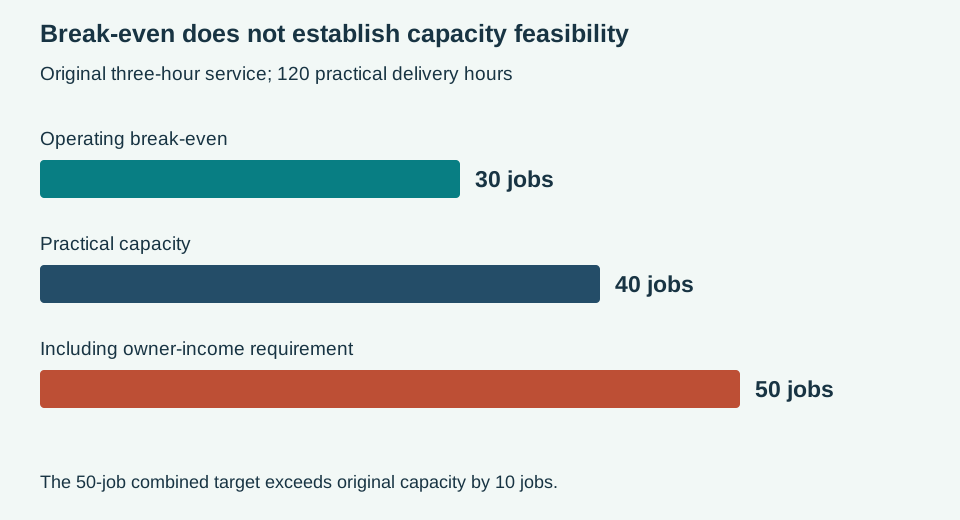
Consider a fictional monthly service priced at $300 with $120 relevant delivery cost per job. Contribution is $180. Period overhead is $5,400, so operating break-even is 30 whole jobs. A separately chosen $3,600 owner-income planning requirement raises the combined recovery target to 50 jobs: ($5,400 + $3,600) ÷ $180.
Each job takes three delivery hours. At 120 practical delivery hours a month, the business can complete only 40 jobs before other constraints. At 40 jobs, revenue is $12,000, delivery costs $4,800 and contribution $7,200. After $5,400 overhead, the result is $1,800, below the chosen owner-income requirement. Calling the idea feasible because it passes 30-job operating break-even would conceal that unmet requirement.
Compare explicit revisions instead of forcing a yes
One option is a $330 price with unchanged $120 job cost. Contribution becomes $210, and the combined $9,000 requirement needs 43 whole jobs after rounding up, still above 40-job capacity. Another option reduces the scoped delivery time to two hours, if quality and customer acceptance can be maintained. At the original $300 price, capacity becomes 60 jobs and the 50-job recovery target becomes operationally possible, but demand remains unproven.
Test revised scope rather than assuming the same job can be rushed without consequence. If the narrower offer loses customers or adds rework, update both the demand and cost cases. Funding remains a separate test: a $9,000 startup cash need against $7,000 confirmed funds leaves $2,000 unresolved even if the revised operating case works.
Write a conditional decision that can be checked
The original model should not receive unconditional approval: the owner-income requirement exceeds the capacity-supported result and a funding gap remains. A reasonable study output is “revise and test the narrower scope, obtain demand evidence at that scope, and resolve the dated $2,000 funding gap before launch commitments.” Record who must deliver each piece of evidence and by when.
Use the startup cost calculator for launch cash, CVP analysis for the cost range and business plan template after choosing a viable alternative. Archive rejected options as well as the approved one so later reviewers can see the trade-offs.
If a revised model passes the decision conditions, continue with the launch roadmap; use the seasonal funding case for an example of dated operating cash needs.
Download the editable decision record
Download the printable HTML worksheet. It includes the completed case and blank fields for your evidence, assumptions, dates and decision. It does not calculate automatically. Edits stay in the open browser until you print or save your completed copy; keep your original separately.
Sources and method
The linked sources support the general framework. The calculations, operating constraints and decision examples here are original MyBreakEven teaching material.
Frequently asked questions
How does a feasibility study differ from a business plan?
A study investigates whether and under which conditions to proceed. A business plan develops the chosen operating and funding approach.
Does break-even prove feasibility?
No. Capacity, demand, owner requirements, funding dates and other constraints can still fail.
Can the answer be revise rather than yes or no?
Yes. State the exact changes, evidence needed and commitments that must wait.
Are the cost figures industry averages?
No. All figures are fictional assumptions constructed to expose the capacity and funding decision.
Browse the MyBreakeven blog hub for related planning guides.
Planning estimates only—not accounting, tax, legal or lending advice.