
Landscaping Working Capital: Fund the Seasonal Cash Gap
Published by MyBreakeven. Editorial standards and corrections. Report a calculation or content issue to support@mybreakeven.com.
Build a dated landscaping cash schedule for materials, payroll and customer receipts. Test the funding gap, minimum cash floor and delayed-payment scenario.

Landscaping working-capital needs depend on when materials, crew payroll and overhead must be paid compared with when customer cash clears. Build a dated cash schedule, find its lowest balance and test a delayed-receipt case before choosing a funding amount.
All business names, amounts and operating results in the worked examples are fictional teaching assumptions in USD. They are not industry averages, actual customer results or forecasts for your business.
Separate the balance-sheet measure from the seasonal funding gap
Net working capital is current assets minus current liabilities. That balance-sheet measure is useful, but it does not say whether Friday’s payroll clears before Monday’s customer payment. A profitable landscaping job can require temporary funding if plants, soil, fuel and labor are paid first.
Start the cash schedule with reconciled, available business cash. List each receipt by its expected clearing date and each payment by its actual due date. Include equipment purchases, debt payments and owner withdrawals in separate lines when relevant. Those lines affect funding even though they do not all belong in operating profit. Do not count an unapproved credit limit or a customer promise as cleared cash.
A spring ramp-up with materials paid before collections
| Week ending | Opening cash | Receipts | Payments | Closing cash |
|---|---|---|---|---|
| April 2 | $12,000 | $2,000 | $10,000 | $4,000 |
| April 9 | $4,000 | $4,000 | $11,000 | −$3,000 |
| April 16 | −$3,000 | $12,000 | $8,000 | $1,000 |
| April 23 | $1,000 | $10,000 | $7,000 | $4,000 |
Week one includes $6,000 materials, $3,000 payroll and $1,000 other payments. Week two includes $4,000 materials, $5,000 payroll and $2,000 other payments. Total receipts are $28,000 and total payments $36,000, so $12,000 + $28,000 − $36,000 = $4,000 closing cash. The lowest weekly closing balance is −$3,000. A negative forecast is a funding warning, not an instruction to let a bank account overdraw.
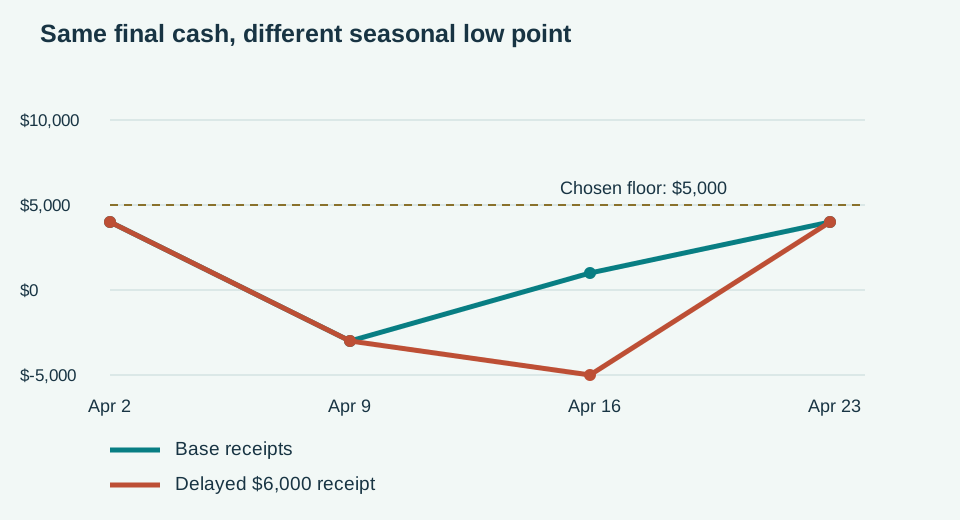
If management chooses a $5,000 minimum cash floor, the additional cash needed at the lowest weekly close is $5,000 − (−$3,000) = $8,000. The floor is a choice for this case, not a landscaping-industry standard. Check daily order within each week: a Monday payroll before a Friday receipt can create a deeper trough.
Delay one receipt without inventing a second payment
Move $6,000 of the April 16 receipts to April 23. Week-three receipts become $6,000 and week-four receipts $16,000. Closing balances become $4,000, −$3,000, −$5,000 and $4,000. The total month’s receipts and closing cash are unchanged, but the low point falls to −$5,000. Keeping the same floor now needs $10,000 additional cash at that weekly close.
Do not add the late receipt to the later week while leaving it in the original week. Reconcile every scheduled invoice to one open receipt record. Record evidence for customer approval, invoice disputes, deposits and clearing delays. A deposit may also carry delivery or refund obligations; it is not automatically earned profit.
Match the response to the timing and the underlying margin
Possible management responses include staging materials by job, agreeing milestone billing before work starts, aligning valid supplier terms with collections or evaluating a documented funding facility. Compare actual fees, repayment dates, availability conditions and the downside forecast. This schedule does not establish eligibility or recommend a lender.
Re-run the later weeks after any payment deferral or borrowing. Moving a supplier bill does not remove it, and a draw creates a repayment obligation. If each job loses money after its relevant costs, short-term funding only delays that problem. Check the seasonal landscaping break-even guide for operating recovery and the working-capital calculation guide for account definitions.
Keep a seasonal review tied to job and bank records
- Reconcile cash, open invoices, purchase commitments and payroll dates at the same cutoff.
- Update the next 13 weeks by clearing date, with daily detail near the tightest dates.
- Separate confirmed work from unaccepted quotes and isolate customer concentration.
- Assign an owner and deadline to each proposed funding or collection action.
- Archive the forecast, compare cleared results and investigate date or amount differences.
Use the 13-week cash-flow forecast for the dated model and the landscaping business plan for the wider operating assumptions. Extend the horizon through winter commitments instead of stopping the forecast at the first profitable month.
If the seasonal gap exposes a larger operating constraint, use the feasibility study to separate demand, capacity and funding conditions.
Download the editable decision record
Download the printable HTML worksheet. It includes the completed case and blank fields for your evidence, assumptions, dates and decision. It does not calculate automatically. Edits stay in the open browser until you print or save your completed copy; keep your original separately.
Sources and method
The linked sources support the general framework. The calculations, operating constraints and decision examples here are original MyBreakEven teaching material.
Frequently asked questions
Is working capital the same as a seasonal cash reserve?
No. Net working capital is a balance-sheet difference. The seasonal funding schedule tracks dated available cash and a separately chosen floor.
Does a profitable landscaping contract fund its own payroll?
Not necessarily. Payment timing can require cash before the customer settles. Test dates as well as margin.
Should the monthly closing balance determine the facility size?
Not by itself. Check the lowest daily balance, availability conditions, the downside case and the later repayment schedule.
Is $5,000 a recommended minimum cash reserve?
No. It is an explicit teaching assumption. Choose a floor using the actual business commitments and risk.
Browse the MyBreakeven blog hub for related planning guides.
Planning estimates only—not accounting, tax, legal or lending advice.