
Operating Expenses: Examples, Formula and COGS Comparison
Published by MyBreakeven. Editorial standards and corrections. Report a calculation or content issue to support@mybreakeven.com.
Classify operating expenses, separate COGS and equipment cash, and reconcile a checked expense report to operating income and margin.
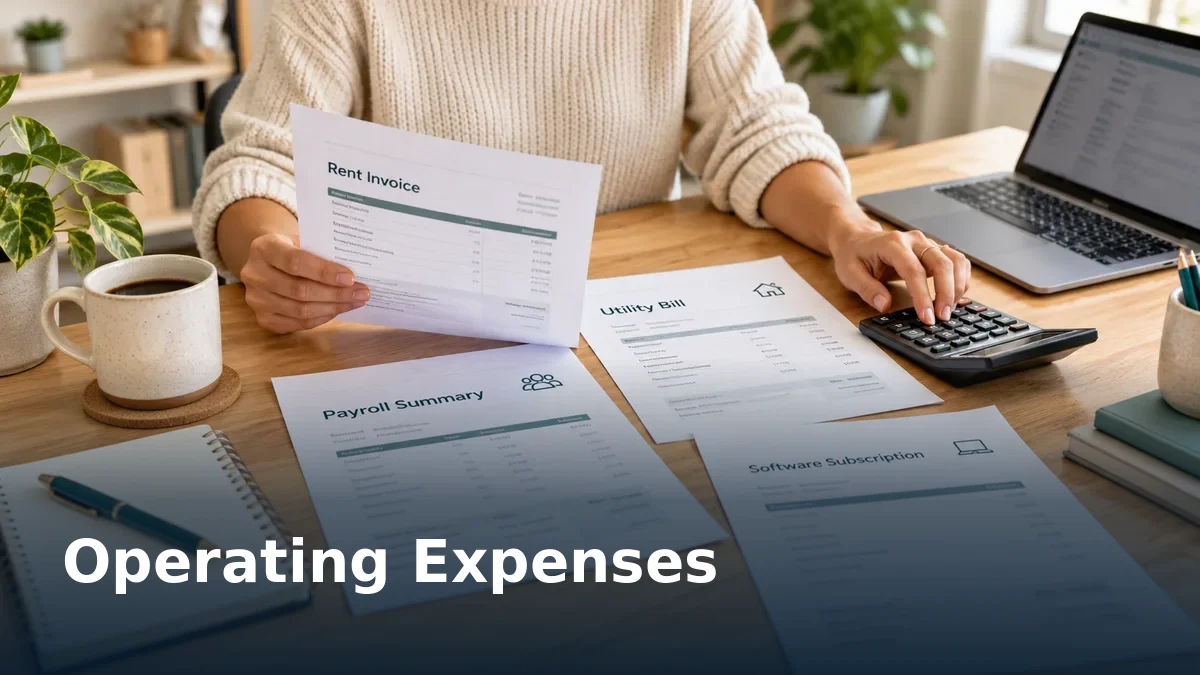
Operating expenses are the costs of supporting a business's operations under the reporting convention you use. This guide uses OPEX excluding cost of goods sold: selling and administrative expenses are deducted after gross profit. That boundary matters because some reports use “operating costs” more broadly to include both COGS and OPEX. Check the line definitions before comparing amounts.
For the original fictional monthly example below, net revenue is $50,000, COGS is $20,000 and OPEX is $18,000. Gross profit is $30,000; operating income is $12,000. The purpose is to classify each amount once and reconcile the result, rather than label every bank payment an expense. These USD figures are invented teaching inputs, not industry averages or tax guidance.
Operating expenses formula: define the subtotal first
OPEX = gross profit − operating income = net revenue − COGS − operating income. Use the formula only when the income statement has that same boundary. An independently reported operating charge outside your selected OPEX subtotal must be reconciled separately. Reversing a statement is not a substitute for checking its account classifications.
In the example, $50,000 − $20,000 − $12,000 = $18,000. Total included operating costs are $38,000: $20,000 COGS plus $18,000 OPEX. Calling the full $38,000 “OPEX” and then subtracting COGS again would reduce operating income to −$8,000 incorrectly. The operating profit margin calculator keeps COGS and OPEX separate in its statement-building mode.
Operating expenses list: classify the function and behavior separately
The same bill can have different classifications in different businesses. “Direct or indirect,” “COGS or period expense” and “fixed or variable” answer different questions. A factory's building depreciation may enter production cost, while head-office depreciation may be an administrative expense. Neither label proves that the amount is avoidable if one order is lost.
| Cost | Function in this guide | Behavior to verify |
|---|---|---|
| Office rent | Administrative OPEX for this example; production premises may have a different treatment | Fixed within the stated lease and capacity range |
| Advertising and marketing | Selling OPEX here | A committed campaign differs from a per-sale commission |
| Salaries and wages | Administrative salaries here; production or delivery labor may be in cost of sales | Guaranteed payroll, paid hours and piece rates behave differently |
| Depreciation and amortization | Operating allocation included once in the appropriate cost function | Method and usage affect behavior; the expense is distinct from asset cash payments |
| Software and communications | Administrative OPEX here | Base subscription plus per-seat or usage charges can be mixed or stepped |
| Bad-debt expense | Often operating in a trading business; follow the actual reporting policy | Do not subtract the same loss twice through revenue and expenses |
| Interest and income tax | Outside operating income in this nonfinancial business illustration | Reconcile separately; specialized businesses can use different presentations |
See fixed, variable and mixed costs for behavior and COGS calculation for the inventory boundary. This page owns the operating-expense classification task; it does not replace those guides.
A checked operating expense report
Assume a fictional business records the following six OPEX categories for one month. Administrative payroll is already loaded with the employer costs included in this example. The depreciation line is outside COGS. No category below is added again as another operating charge.
| Category | Amount |
|---|---|
| Administrative payroll | 8,000 |
| Office rent | 3,000 |
| Marketing | 2,500 |
| Software and communications | 1,000 |
| Insurance and professional services | 1,500 |
| Operating depreciation outside COGS | 2,000 |
| Total OPEX excluding COGS | 18,000 |
Reconcile $8,000 + $3,000 + $2,500 + $1,000 + $1,500 + $2,000 = $18,000. Then connect the schedule to the income statement: $50,000 net revenue − $20,000 COGS = $30,000 gross profit; $30,000 − $18,000 = $12,000 operating income. Operating margin is $12,000 ÷ $50,000 × 100 = 24%. A $1,000 non-operating gain is outside this operating subtotal and does not change its margin.
COGS, OPEX and capital expenditure: three different boundaries
For a reseller, purchasing inventory does not necessarily create COGS immediately: unsold items remain in inventory under the chosen accounting basis. COGS relates to the goods sold during the period. OPEX in this guide is the separate operating-period subtotal. A capitalized equipment purchase creates an asset, with subsequent depreciation recognized over its useful life according to the applicable policy.
Suppose the business pays $12,000 for office equipment and recognizes $2,000 depreciation this month under the explicitly assumed schedule. Do not add $12,000 equipment cash and $2,000 depreciation together into this month's OPEX merely because both relate to the same asset. The assumed $2,000 is part of the existing schedule, not an additional charge. Whether a purchase qualifies for capitalization and its actual depreciation schedule require the business's policy and supporting facts.
Likewise, a loan principal payment reduces debt; it is not OPEX. Loan interest is a separate non-operating expense in this example. The master budget connects operating results, asset purchases, debt and payment dates. A classification example does not establish a tax deduction or universal filing treatment.
Operating expense ratio: name what is in the numerator
OPEX ratio excluding COGS = $18,000 ÷ $50,000 = 36%. COGS is 40% of revenue, so the complete reconciliation is 40% COGS + 36% OPEX + 24% operating margin = 100%. A report using all operating costs in its numerator would instead show 76%. Both fractions can be calculated, but calling them the same metric would conceal a different cost scope.
The phrase “operating expense margin” is ambiguous. State the numerator instead of inventing a new profitability measure. Real-estate operating-expense ratios can use different income and expense conventions and are outside this trading-business example. At zero revenue the ratio is unavailable; zero revenue does not mean expenses are zero. Compare matching periods and consistent accounts before interpreting an increase.
Three scenarios: lower OPEX is not the only route to a better result
| Scenario | Revenue | COGS | OPEX | Operating income / margin |
|---|---|---|---|---|
| Baseline | 50,000 | 20,000 | 18,000 | 12,000 / 24% |
| More sales, same 40% COGS rate and same OPEX | 60,000 | 24,000 | 18,000 | 18,000 / 30% |
| Higher sales but weaker cost control | 60,000 | 27,000 | 22,000 | 11,000 / 18.33% |
| Documented $2,000 OPEX reduction, no other change | 50,000 | 20,000 | 16,000 | 14,000 / 28% |
The first growth case assumes existing capacity supports the sales. The second earns less operating income despite higher revenue. The cost-reduction case holds sales and quality unchanged solely to isolate the arithmetic. It is not proof that cutting support causes no lost customers or future repairs. Test the operational consequence before accepting the projected saving.
A reclassification can change gross margin without changing operating income
Move $2,000 of a correctly identified operating cost from OPEX to COGS in a comparison with otherwise identical totals. COGS becomes $22,000, OPEX $16,000 and gross profit $28,000. Operating income remains $12,000 and operating margin stays 24%. Gross margin changes from 60% to 56%; the OPEX ratio changes from 36% to 32%. The business has not saved $2,000. Document justified policy changes and restate comparisons where appropriate.
This is why a low OPEX ratio alone does not establish efficiency. Review the cost boundary, recognition period and actual work performed. Do not move expenses between accounts simply to display a preferred ratio.
Close the expense schedule before changing the budget
- Match accounts to a documented COGS/OPEX/non-operating/capital classification.
- Check unpaid accrued services, prepayments and credits against the reporting period.
- Reconcile each schedule category to its supporting ledger and total the selected accounts.
- Check depreciation appears once and inventory cash payments are not substituted for COGS.
- Compare the approved budget with actual expenses at a suitable activity level.
- Record explanations and an owner for justified corrective actions.
For an operating expense budget, forecast the actual drivers and commitments rather than applying the same sales growth rate to every category. The flexible-budget guide distinguishes activity effects from spending differences. Use the operating-margin calculator to test the reconciled statement and the contribution statement when the question is fixed versus variable recovery.
Use the editable expense-classification schedule
Download the expense-classification CSV. It contains the six fictional category amounts, reporting function, cost-behavior notes and evidence fields. It is an editable record schedule, not a formula workbook or automated accounting classifier. Replace the example amounts, document the period and classifications, then reconcile the total yourself or use the calculator. Preserve evidence of any split between production and administrative functions.
Method and sources
The SEC financial-statements introduction explains income-statement and cash-flow distinctions. The SEC income-statement building blocks explains depreciation. Cost-behavior definitions are supported by OpenStax. Figures, schedules and scenarios here are original illustrations; they are not copied company results.
Reconcile operating expenses to cash paid
Recognized expense is not automatically the cash paid in the same period. The direct operating cash example derives supplier, payroll and prepayment cash from supporting balances. Use the cash flow statement to keep equipment cash and loan principal in their stated separate activity categories.
Frequently asked questions
Is COGS an operating expense?
In a broad operating-cost total it can be included. This guide uses OPEX excluding COGS and subtracts those two subtotals once each. Follow the actual statement labels.
Is depreciation an operating expense?
Operating depreciation belongs in the appropriate operating cost function. It may already be included in COGS; do not add it again as administrative OPEX.
Are interest and income tax operating expenses?
They are outside operating income in this nonfinancial-business illustration. Specialized reporting can differ, so check the actual presentation.
Are restructuring costs always non-operating?
No. An unusual or infrequent cost is not automatically outside operations. Check its nature and the applicable presentation; this calculator does not create an adjusted earnings figure.
Is rent fixed or an operating expense?
Those labels describe different dimensions. Office rent is administrative OPEX in the example and fixed within its lease range; production rent may be in manufacturing cost.
What about bad debt and SG&A?
SG&A is generally an operating-period subtotal under this presentation. Bad-debt treatment depends on the business and reporting policy; avoid deducting the same effect in both net revenue and expenses.
Browse the MyBreakeven blog hub for related planning guides.
Planning estimates only—not accounting, tax, legal or lending advice.