
FREE EDITABLE BUSINESS PLANNING RESOURCE
Five-Year Business Plan Template
Translate a five-year direction into annual decisions, capacity and cash assumptions. Download a Word plan and Excel annual planning worksheet with one consistent fictional case from 2027 to 2031.
Published · By MyBreakeven
Get the free Word and Excel filesDownload the editable five-year plan and annual worksheet
The Word file contains a blank strategy outline, an annual objectives template and the completed Harbor Desk Services case. The separate Excel file reconciles annual operating assumptions and cash, and gives each milestone an owner and review field. Downloads are free and require no signup.
In Annual plan, replace the blue inputs while keeping the formulas. In Milestones, replace the example targets and add an owner and review date before approving a year. The cash and receivables roll forward between annual columns. The example uses USD labels without currency conversion. Word and Excel formats are supplied as stated; Google application compatibility has not been tested.
Choose the plan that matches your decision
Use this resource for annual priorities, resources, financial assumptions and approval conditions. For the complete business narrative, use the detailed business plan template. The one-page plan is the concise decision summary.
A recipient may require a different order, more detail or particular financial statements. Match the format to that request. The downloadable examples do not imply funding approval or independent accounting certification.
How to build a five-year business plan
- Establish the starting position. Record actual customers, products, team resources, cash and unresolved constraints before setting later targets.
- Choose an evidence-based direction. Define the offer and buyer you intend to serve. State what would cause you to change direction.
- Set a separate objective for each year. Name the measurable outcome, evidence, owner and next review. A percentage growth assumption alone does not describe the work.
- Reconcile resources and money. Link package volume to delivery hours, costed support, price and contribution. Review owner cash and collection timing separately.
- Gate expansion on results. Identify which purchase, hiring or capacity decision depends on each test. Record what you will postpone if the condition is not met.
- Review the first year in more detail. Keep monthly or quarterly financial schedules and actual payment dates alongside the annual view. Revisit the remaining years at each quarterly review.
Use dated source records beside important assumptions. Record what is known, what is still estimated and who must verify it. Do not fill a market-size or customer-contract field with an invented claim because a template has space for it.
Summarize the five-year decision
Summarize the starting position, intended direction, annual evidence gates, resources and cash conditions. Later annual targets are conditional plans rather than guaranteed outcomes. Make the first expansion decision clear before describing a year-five vision.
Executive-summary example
Harbor Desk Services is a fictional owner-operated service preparing defined document and presentation packages for small professional firms. The first-year plan tests 120 completed packages at $500 each. Sales of $60,000 leave $42,000 contribution before $12,000 operating commitments and a separate $24,000 owner cash allowance. The resulting $6,000 planning surplus is not statutory net profit. The owner proposes $15,000 cash at the start of 2027, with $3,000 equipment spending during the year. Expansion depends on paid customer tests, delivery hours and actual collection dates.
The later-year package targets are 144, 168, 192 and 216. Each requires its own supported price, cost and productive-hours plan. The worksheet does not create those resources or prove that the work will sell.
Completed example: Harbor Desk Services
This original fictional case is a defined document-and-presentation service. All prices, customer volumes and costs are assumptions. It is not a customer success story, an industry benchmark or a quotation for your location.
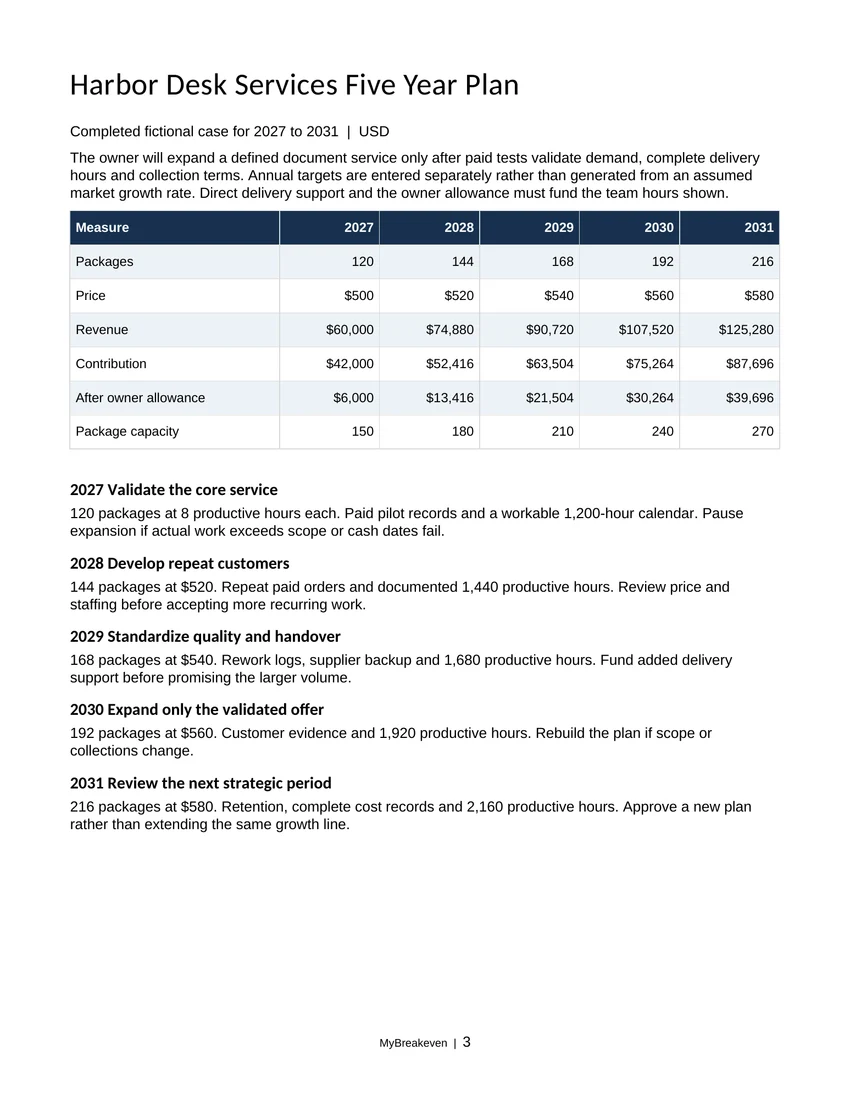
The plan expands only a validated offer. Productive team hours increase from 1,200 in 2027 to 2,160 in 2031. Those hours require an evidenced calendar and costed delivery support; increasing a spreadsheet input does not hire another worker.
2027: Validate the core service
Target: 120 packages at 8 productive hours each. Evidence: Paid pilot records and a workable 1,200-hour calendar. Response: Pause expansion if actual work exceeds scope or cash dates fail.
2028: Develop repeat customers
Target: 144 packages at $520. Evidence: Repeat paid orders and documented 1,440 productive hours. Response: Review price and staffing before accepting more recurring work.
2029: Standardize quality and handover
Target: 168 packages at $540. Evidence: Rework logs, supplier backup and 1,680 productive hours. Response: Fund added delivery support before promising the larger volume.
2030: Expand only the validated offer
Target: 192 packages at $560. Evidence: Customer evidence and 1,920 productive hours. Response: Rebuild the plan if scope or collections change.
2031: Review the next strategic period
Target: 216 packages at $580. Evidence: Retention, complete cost records and 2,160 productive hours. Response: Approve a new plan rather than extending the same growth line.
Check the five-year operating assumptions
| Measure | 2027 | 2028 | 2029 | 2030 | 2031 |
|---|---|---|---|---|---|
| Packages | 120 | 144 | 168 | 192 | 216 |
| Revenue | $60,000 | $74,880 | $90,720 | $107,520 | $125,280 |
| Contribution | $42,000 | $52,416 | $63,504 | $75,264 | $87,696 |
| Before owner allowance | $30,000 | $39,416 | $49,504 | $60,264 | $71,696 |
| After owner allowance | $6,000 | $13,416 | $21,504 | $30,264 | $39,696 |
| Whole packages for commitments | 103 | 108 | 112 | 115 | 119 |
| Package capacity | 150 | 180 | 210 | 240 | 270 |
Contribution is revenue less the specified direct costs. Fixed operating cash commitments are separate from the owner cash allowance. The worksheet shows the result before that allowance and the planning result after it. Accounting and tax treatment depend on the actual business arrangement. Do not describe the post-allowance result as statutory net profit.
For the 2027 example, the same $350 contribution must cover $12,000 fixed commitments and $24,000 owner support. The 103-package rounded minimum is below the assumed 120 packages and 150-package capacity. Neither the target nor capacity proves demand. Include paid delivery support and owner work once within a consistent cost boundary.
Test a weaker first year
At 90 packages with unchanged price, costs, collection share and owner allowance, contribution falls to $31,500 and the result after commitments becomes −$4,500. Collections are $40,500. Opening $15,000 less $9,000 trading cash use and $3,000 equipment leaves $3,000 year-end cash, below the illustrative $5,000 floor. Name the spending, scope or funding response before committing.
Reconcile annual cash and receivables
| Measure | 2027 | 2028 | 2029 | 2030 | 2031 |
|---|---|---|---|---|---|
| Opening cash | $15,000 | $12,000 | $22,928 | $40,848 | $68,432 |
| Cash collected | $54,000 | $73,392 | $89,136 | $105,840 | $123,504 |
| Operating and owner cash paid | $54,000 | $61,464 | $69,216 | $77,256 | $85,584 |
| Equipment cash | $3,000 | $1,000 | $2,000 | $1,000 | $2,000 |
| Closing cash | $12,000 | $22,928 | $40,848 | $68,432 | $104,352 |
| Uncollected sales | $6,000 | $7,488 | $9,072 | $10,752 | $12,528 |
The workbook starts with $15,000 cash and no opening receivables. Each year collects the entered share of current sales plus all prior-year receivables. The uncollected portion rolls into the next year. All stated direct and fixed costs and the owner allowance are paid in the year. Equipment, other payments and new funding have separate cash rows.
Ninety percent same-year collection and full collection of opening receivables are simplifying assumptions, not measured behavior. No bad debt, longer delay, tax, depreciation or debt schedule is supplied. Put applicable tax, principal, interest and other cash in the appropriate rows without double counting.
Use the dated 13-week cash forecast for payroll, supplier and settlement dates. Annual positive cash can conceal a shortage before receipts arrive. For launch costs and the initial funding gap, use the business startup cost calculator. Opening either tool does not transfer these document or workbook inputs.
Review the plan before sharing or expanding
- Match the narrative and numbers. Update volume, scope, team hours, contribution, owner support, funding and collections together.
- Check evidence. Retain source dates, paid tests, accepted scopes, supplier records and delivery logs. Keep unresolved assumptions visible.
- Assign the next action. Give each milestone an owner, review date, measurable approval condition and response if the test fails.
- Compare actuals with the same plan. Review the first year monthly, record explanations and revisit the remaining years at quarterly decisions. Preserve the previous approved version.
- Fit the recipient’s request. Attach the statements and records they require. Remove examples from the submitted plan and identify projections as assumptions.
Use the budget-versus-actual worksheet for a recurring numerical review and the rolling forecast guide when extending the next twelve months. A five-year strategic plan and a rolling operational forecast serve different review horizons.
Frequently asked questions
What comes with the five-year business plan template?
An editable Word outline and completed example, plus an Excel annual planning worksheet with Annual plan and Milestones tabs. The fictional case covers calendar years 2027–2031.
Does Excel automatically assume a growth rate?
No. Volume, price, costs, owner allowance, productive hours, collection share and cash payments are separate editable annual inputs. A larger target is not evidence of demand or available staffing.
Is this a full five-year financial model?
It is an annual planning worksheet for volume, contribution, capacity, owner funding and a simplified cash bridge. It does not supply an integrated balance sheet, depreciation, tax or debt schedule. Attach required financial statements separately.
Why show the owner cash allowance separately?
Owner cash support can be necessary without being an operating expense under the chosen business structure. The worksheet shows the operating result before that allowance, then the result and cash after it. Count the same owner work once.
How are receivables collected?
Each year collects the entered share of its sales plus all opening receivables. Uncollected current sales move to the next year. This simplified assumption does not model bad debt or delays longer than the following year.
Does positive annual cash mean every bill can be paid?
No. Annual netting can hide earlier shortages. Build a first-year monthly or quarterly plan and use the dated cash forecast for payroll, supplier payments and processor settlements.
How should I update the milestones?
Replace the example objectives with measurable outcomes. Assign an owner and a valid review date, retain evidence, and record the action taken when a condition fails. A populated field is not proof that a milestone was achieved.
Can I use the files in Google Sheets or Google Docs?
The files are supplied as Word and Excel downloads. Compatibility with Google applications has not been tested, so no native Google format or identical rendering is promised.
References and specialist templates
The U.S. Small Business Administration business-planning guidance describes traditional and lean planning and the financial outlook a reader may need. This resource uses original prompts, examples and calculations; it is not an SBA-issued or approved plan.
Use the existing landscaping, marketing agency or ecommerce business plan when the specialist operating assumptions fit your task. Explore all business planning resources and read our editorial and correction standards.